NAMES OF THE WEEK from: 2013 2014 2015 2016 2017 2018 2019 2020 2021 2022 2023 2024 2025
21 Oct.
Two death-themed fishes
Many fish names are inspired by Greek mythology. (See NOTW 8 Nov. 2023 for a sampling.) This week we feature two recently described fishes, both named for mythological figures associated with death.
Prognathodes thanatos Tea, Blum, Rocha, Parkinson & Stanley 2026 is a new species of deepwater butterflyfish (Chaetodontidae). The holotype was collected by a bottom trawl off the coast of Mozambique in 2007 and deposited at the South African Institute for Aquatic Biodiversity. There it was overlooked because it had been incorrectly allocated to the genus Roa. Based on the holotype and a few underwater photographs, this species appears to inhabit deep rocky reefs between 144–200 m.
Nineteen years after it was collected, the species gets its name. “The specific epithet,” the authors write, “is given after Thanatos, the personification of death in Greek mythology. Thanatos is known for his gentle guiding of souls into the afterlife. Like the new species, Thanatos was frequently referenced in literature and folklore but was rarely encountered.”
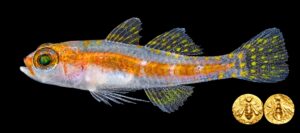
Trimma charon, paratype, 12.1 mm SL. Photo by Viktor N. Peinemann. From: Peinemann VN, Bogorodsky SV, Tietbohl Talas MD, Berumen ML (2026) Trimma charon, a new species of pygmygoby (Teleostei, Gobiidae) from the Red Sea with a key to the Red Sea species of the genus. ZooKeys 1293: 1-16. [Charon’s obuls not in source photo; added by us for illustrative purposes.]
The name refers to the golden spots on the goby’s caudal fin and peduncle. The authors say these spots are “reminiscent” of the coins. I added an example of Charon’s obols (5th-1st century BC) to the photo of the Trimma charon holotype, shown here.
13 Oct.
Tredecennial fishes
I am posting the Name of the Week one day early to commemorate two anniversaries.
It was on this date, October 13, 2013, 13 years ago, that the ETYFish Project went online. This was also the day I posted the first Name of the Week. [Oops. I goofed. Files for ETYFish Project and the first NOTW were uploaded on Oct. 13 but were not released until Oct. 16 and 17, respectively.]
Since the number 13 features so prominently in these anniversaries, here are the only fish species named for that number. (Only one of them is valid today.)
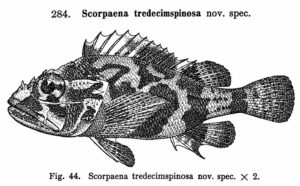
From: Metzelaar, J. 1919. Report on the fishes, collected by Dr. J. Boeke in the Dutch West Indies 1904-1905, with comparative notes on marine fishes of tropical West Africa. F. J. Belanfante, ’s-Gravenhage. 1-314.
In 1919, Jan Metzelaar described Scorpaena tredecimspinosa, a scorpionfish (Scorpaenidae) from Bonaire Island in the West Indies. “This species is at once characterized,” Metzelaar wrote, “by the 13 dorsal spines, constantly occurring in all of our specimens …”. Hence the specific name: tredecim = 13, spinosa = spiny. The species remains valid and is now known as Scorpaenodes tredecimspinosus.
In 1822, Francis Hamilton described Gobius tredecemradiatus, a mudskipper goby (Oxudercidae) from the Ganges River basin of India. He named it for the 13 rays in its first dorsal fin (radiatus = rayed). A few pages earlier, Hamilton described a similar species from the same location, Gobius septemradiatus, named for seven (septem) rays in its first dorsal fin. Since type specimens for both species do not exist, and since Hamilton’s descriptions were otherwise vague and unhelpful, goby taxonomist Edward O. Murdy synonymized the two species in 1989, selecting septemradiatus as the senior synonym. According to Murdy, the goby, now placed in the genus Periophthalmodon, has anywhere from 4 to 15 rays in its first dorsal fin.
In 1862, Albert Günther described Cossyphus tredecimspinosus, a hogfish (Labridae), from the eastern tropical Atlantic. He said it has 13/10 rays in its dorsal fin, 13 spiny and 10 soft. The species was deemed a junior synonym of Bodianus speciosus (Bowdich 1825) in 1962. This species has 12 dorsal-fin spines. In his 2006 review of Bodianus, Martin F. Gomon called the 13th spine in Günther’s specimen “aberrant.”
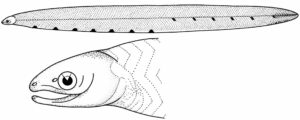
Leptocephalus tredecimpunctum. From: Fowler, H. W. 1938. The fishes of the George Vanderbilt South Pacific Expedition, 1937. Monographs of the Academy of Natural Sciences of Philadelphia No. 2: i-v + 1-349, Pls. 1-12.
In 1938, Henry Weed Fowler described a larval eel from Christmas Island in the North Pacific. He assigned it the provisional name Leptocephalus (=larval eel) tredecimpunctum, referring to 7 dark-brown blotches along the ventral edge of the abdomen and 6 dark-brown spots on the axial lateral line of the tail, for a total of 13 spots (punctatum = spotted). This larval eel has never been linked to an adult specimen so its identity remains unknown, although it appears to be a snake eel (Ophichthidae).
Whether you’ve been following the ETYFish Project for 13 years a, 13 days or even 13 hours, thank you for reading. Thank you for the likes on Facebook. Thank you for the comments and corrections.
Most of all, thank you for letting me know I am not alone in my fascination for the names of fishes and fish-like craniates.
7 Oct.
Xanthichthys Kaup 1856
Everything about this name is uncertain. We’re not sure who coined it. We’re not sure who wrote the description. And while we’re pretty sure what the name means, we’re not sure how it applies to the fish in question.
Xanthichthys is a genus of triggerfishes (Balistidae). The name was first published by Scottish surgeon-naturalist John Richardson in (1787–1865) in 1856. It appeared not in a journal, but in the “Ichthyology” entry in the Encyclopaedia Britannica. Richardson credited German naturalist Johann Jacob Kaup (1803–1873) with the name, presumably from an unpublished manuscript. Since Richardson translated Kaup’s German-language monograph on eels into English (published in 1857), we can assume that the Xanthichthys description was actually translated from Kaup’s German and therefore written by Richardson. But since Richardson credited Kaup as the author, “Kaup (in Richardson)” is the official authority, although one can make the case that “Richardson (ex Kaup)” is more accurate. Kaup, as far as we know, never mentioned Xanthichthys in any subsequent publication.
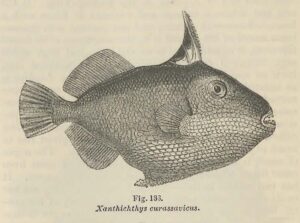
From: Richardson, J. 1856. Ichthyology. In: The Encyclopaedia Britannica, or Dictionary of Arts, Sciences, and General Literature. 8th Edition. Edinburgh: A. and C. Black. vol. 12: 204-331.
The description is extremely short: “Naked furrows on the face; two rays in the first dorsal. No shields before the gill-opening.” That’s it. One species is included in the genus, X. curassavicus. A black-and-white illustration is provided.
Kaup/Richardson did not mention the color of the fish, which would have been helpful since Xanthichthys translates as xanthus, yellow or golden, and ichthys, fish.
Contemporary photos of Xanthichthys curassavicus – now a junior synonym of X. ringens (Linnaeus 1758), Sargassum Triggerfish — show a blue-gray fish with elongate black spots on the scales and an orange-red edging around the caudal fin. No hint of gold or yellow. Juveniles, however, do exhibit a yellow coloration, which helps them blend into the floating beds of Sargassum weeds where they spend the first few months of their lives. I mentioned this in the ETYFish entry:
etymology not explained, perhaps xanthus, yellow, and ichthys, fish, but only juveniles of the type species, X. curassavicus (=ringens), which swim in floating Sargassum, could be considered yellow or yellowish in color
Last month, I received an email from ETYFish reader Joe Rowlett, who suggested another explanation for the name. Joe looked beyond Kaup/Richardson’s brief description of the genus to the original description of X. curassavicus.
Xanthichthys curassavicus was described as Balistes curassavicus by German naturalist Johann Friedrich Gmelin (1748–1804) in 1789. The specific epithet means “belonging to Curaçao,” referring to its type locality. Did Gmelin mention color? No, he did not. But Rowlett saw that Gmelin based his account on an earlier pre-Linnaean account published by the Dutch naturalist Laurens Theodoor Gronow (1730–1777, also known as Gronovius) in 1763. When Joe consulted Gronow’s account, he found an intriguing statement about the fish’s color:
“Cauda aurantio colore nitida.” The tail is a shining orange color.
Might this explain the Xanthichthys name? Maybe. As mentioned above, adult X. ringens have an orange-red edging around the caudal fin. “Shining orange” is not the same as orange-red, but close enough. We have no idea whether Gronow examined a living, freshly dead or preserved specimen, so its colors may have faded. What’s more, X. ringens undergoes dramatic color changes between its juvenile and adult stages. Did Gronow examine — assuming he had a fish before him, rather than referring to someone else’s field note or account — a young specimen or a mature adult? We do not know.
I continued searching the literature for additional clues. Gray (1854) contains what appears to be a redescription of Gronow’s original account of Balistes curassavicus, this time named Balistes nitidus (now a synonym of ringens). “Nitidus” means shiny. What’s shiny about it? The description does not tell us. But the description does tell us that the fish’s color is “lucide flavescens.” Bright yellow.
Might this explain the name? Once again, maybe. The clue is compelling but incomplete. What part of the fish is yellow? Its entire body? The fins around the tail? Something else? If yellow refers to the entire body, does that mean the description is based on a juvenile? These are all questions we cannot answer.
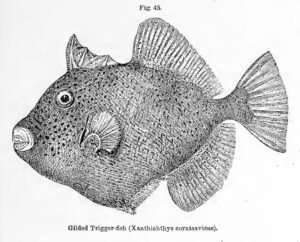
From: Richardson, J. ca. 1860. Class IV. Fishes. In: The Museum of Natural History. Being a Popular Account of the Structure, Habits, and Classification of the Various Departments of the Animal Kingdom. New York: James S. Virtue. vol. 2: 103-173.
I found a second clue in a subsequent account of X. curassavicus published by John Richardson sometime between 1859 and 1862 (a serialized publication, issued in parts). Richardson gave the fish a common name: “Gilded Trigger-fish” and provided a different black-and-white illustration than the one before. “Gilded” means plated or highlighted with gold or something with golden color. What was “gilded” on the fish? Richardson did not say. Based on the evidence we possess, there are three possibilities:
#1 “Gilded” refers to the overall body color of the fish (presumably a juvenile) – the “lucide flavescens” of Gray.
#2 “Gilded” refers to the tail – the “Cauda aurantio colore nitida” of Gronow, the earliest published description of the fish.
#3 “Gilded” refers to both.
I agree with Joe Rowlett and prefer #2. Gilded, in my mind, implies a highlight, like the gold edging on the pages of fancy special-edition books. If the entire fish is plated in gold or orange, then that implies that there’s a different color underneath. What’s more, if the entire fish was yellow or gold, then why didn’t Richardson call it “Yellow Trigger-fish” or “Golden Trigger-fish”?
To state it again, we’ll never know for sure what the name means. But it’s fun to speculate. The ETYFish entry has been emended to reflect all possibilities:
xanthus, yellow or golden; ichthys, fish, allusion not explained, perhaps referring to yellow coloration of the type species Balistes curassavicus (=X. ringens) based on three intertextual clues: tail a “shining orange color” (translation), per Gronow (1763), (2) “Bright yellow color” (translation) of Balistes nitidus (=X. ringens), per Gray (1854), and (3) “Gilded Trigger-fish,” common name given to X. curassavicus by Richardson (ca. 1860), all colorations not then known to occur only among juveniles, which swim in floating Sargassum (adults blue-gray with orange-red edging around caudal fin)
A final note: Jordan & Evermann (1898) suggested that Xanthium, the cocklebur, was Richardson’s intended allusion but did not provide an explanation. The cocklebur is generally green, brown or yellowish green rather than strictly yellow. Its name, derived from xanthos, refers to how the plant was historically used to produce a yellow dye. I see nothing cocklebur-ish about the fish.
30 Sept.
The Venus Flytrap goby
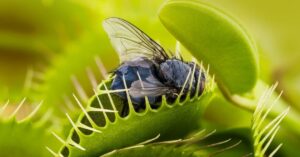 When I was in grade school, we studied in the Venus Flytrap plant in class and were given cultivated specimens to take home and care for. I named mine Cleopatra after the “pet” carnivorous African Strangler plant (a fictitious plant, of course) in the 1960s Addams Family TV show.
My Cleopatra did not survive my care.
Scientifically known as Dionaea muscipula, the Venus Flytrap is a carnivorous plant native to damp, acidic savannas and bogs of the coastal plains in North Carolina and South Carolina of the United States. Its leaves form snapping “jaws” to ensure living prey, primarily insects and arachnids. English botanist John Ellis formally described and named the plant in 1768. The genus name Dionaea comes from Dione, the Greek goddess of beauty (and mother of Aphrodite/Venus), chosen because of the plant’s delicate white flowers and leaves. The species epithet muscipula is Latin for mousetrap.
Unable to catch fresh insects for my plant, or too lazy to try, I tried feeding it tiny scraps of raw ground beef. After all, Morticia Addams fed her Cleopatra chunks of red, fleshy meat (zebra burgers and yak meatballs).
After a few weeks, the leaves turned black and the plant died.

Akko dionaea. From: Birdsong, R. S. and C. R. Robins. 1995. New genus and species of seven-spined goby (Gobiidae: Gobiosomini) from the offing of the Amazona River, Brazil. Copeia 1995 (3): 676-683.
I remembered all of this when I entered Akko dionaea into the ETYFish database. Described by Ray S. Birdsong and C. Richard Robins in 1996, it’s the only fish in the world named for the Venus Flytrap.
Akko dionaea occurs in muddy-bottomed coastal waters (15-20 m) from Colombia to the mouth of the Amazon River in Brazil. The authors named it Dionaea, after the Venus Flytrap genus, because the appearance of the goby’s open mouth, with its teeth exposed, reminded them of the plant’s stiff, spike-like projections along the outer edges of its “jaws.” These “teeth” interlock like prison bars when the trap closes to keep prey from escaping.
The goby’s generic name has nothing to do with the Venus Flytrap but is interesting in its own right. Akko is from the Greek akkṓ (ἀκκώ), meaning bugbear, bogeyman or specter. It refers to what the authors described as its “pallid and unusual” appearance.
The common name for Akko dionaea is Atlantic Specter Goby. I wish it were Venus Flytrap Goby instead.
23 Sept.
The etymological tangle of Sphyrna and Sphyraena
Look up the etymology of the hammerhead shark genus Sphyrna in just about any fish reference and it will tell you that the name is derived from the Greek sphȳ́ra (σφῦρα), meaning hammer. Look up the etymology of the barracuda genus Sphyraena and, depending on the reference, it will probably tell you one of two things: It’s an ancient Greek word recalling the idea of a javelin or a pointed stake, or prow of a ship, historically used for slender, sharp-headed fishes (which barracudas certainly are). Or it’s an ancient Greek word for “hammerfish,” also derived from sphȳ́ra (σφῦρα), meaning hammer.
You don’t have to be an expert in fish morphology to see that a barracuda looks nothing like a hammer. Yet etymologists and linguists, both past and present, have repeatedly associated the fish name Sphyraena with sphȳ́ra (hammer). Why?
Ichthyologist Eugene Willis Gudger (1866–1956) from the American Museum of Natural History in New York City unraveled this “etymological tangle” (his words) in his 1918 monograph on barracuda biology. Gudger devoted four pages to the topic. Basically, his analysis comes down to this:
There are different kinds of pounding tools variously called hammers, and that the words sphyrna and sphyraena have been used interchangeably for both.
At this point, it’s important to clear from your mind’s eye of the shape of the traditional carpenter’s hammer, the kind with the pounding surface on one side of the handle and the claw for removing nails on the other. Instead, imagine a mallet, with two equal faces for pounding. That’s the kind of hammering tool evoked by the hammerhead’s t-shaped head (technically termed the cephalofoil).
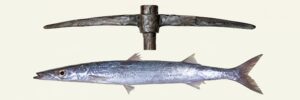 Now imagine a pick-axe – also historically known as a pick-hammer – which ancient Greek farmers would have used to break up clods of earth. The heads of the hammer are long and pointed, which ancient naturalists associated with the barracuda’s streamlined, silvery body and pointed head. In fact, according to etymologist and ethnobiologist Andrea Guasparri’s 2022 annotated checklist of Roman names for aquatic animals, the Greek sphȳ́ra refers to a pick-axe specifically.
Aristotle introduced “sphyraena” as an ichthyonym in his “Natural History” (book IX, chapter 3). He said it was a shoaling sea-fish but said nothing more about it. Subsequent scholars and naturalists associated Aristotle’s sphyraena with elongate fishes with long, beak-like jaws. Speusippus (about 407 B.C. to 339 B.C.) likened Aristotle’s sphyraena – which he called késtra (κέστρα), a Greek word variously defined as a weapon, a pick-axe or pole-axe with a broad head – to the Gar-pike (probably the European Garfish Belone belone), then known as acus in Latin. (Acus = needle, the root of several modern words related to sharpness, e.g., acute, acumen, acupuncture.)
Skip ahead four centuries to Pliny’s “Natural History” (book XXXIII, chapter 11, paragraph 54), wherein he speaks of a fish called “sudis” in Latin and “sphyraena” in Greek. One can presume that this is the same “sphyraena” mentioned by Aristotle. “Sudis” is the Latin word for javelin and a kind of pointed stake, both reminiscent of the streamlined, silvery body and pike-like pointed head of a barracuda.
As if three names — sphyraena, cestra, sudis — weren’t enough, another name was added to the mix. In the 1400s, Theodorus Gaza translated Aristotle’s “Natural History” from Greek into Latin. He translated sphyraena into the Latin word malleolus, meaning little hammer, further solidifying the association of sphyraena with a pounding tool.
As noted by Gudger, sphyraena, kestra and sudis “were all used synonymously for a certain slender sharp-headed fish recalling the idea of a javelin, a pointed stake, or the prow of a ship.” (I’m not sure where the ship allusion originated; apparently the barracuda’s long, sharp, wedge-shaped head looks like the cutting edge, or prow, of an ancient galley cutting through the water.)
Long story short: sphyraena, the “hammerfish,” is more accurately sphyraena, the “pick-hammer fish.”
In 1758, Linnaeus gave the European Barracuda its official scientific name: Esox sphyraena. In 1829, Cuvier adopted Sphyraena as the official scientific name of the barracuda genus. From this point forward, Sphyraena and barracuda (borrowed from a Spanish or Portuguese word, possibly of Caribbean origin) are inseparable.
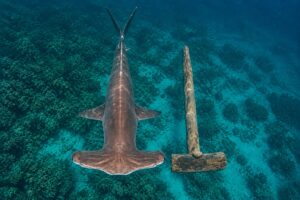 Fifty-two years later, Constantine Rafinesque proposed Sphyrna as the generic name for hammerhead sharks. Gudger did not address the etymology of Rafinesque’s Sphyrna. What follows is my own analysis.
I hypothesize that Rafinesque clearly had “hammer” in mind when he renamed Squalus zygaena as Sphyrna zygaena in his “Indice d’ittiologia siciliana” of 1810. Hammerhead sharks had been known as “le marteau” (the hammer) or “marteau marin” (marine hammer) since the Renaissance. The term “requin marteau” (hammer shark) appeared in a French encyclopedia in 1789. And Lacépède called the shark “Le squale Marteau” in the first volume of his Histoire Naturelle des Poissons in 1798, a foundational work in ichthyology.
Rafinesque includes both the hammerhead and the barracuda in this work, but in typical Rafinesqueian fashion, his spellings match his personality: eccentric and unconventional. For some reason, Rafinesque misspelled (or creatively re-spelled) Sphyraena as Sphyrena, reducing the “ae” ligature to a single letter. Desiring to evoke “hammer” in the scientific name of the hammerhead without using a name already taken by the barracuda, it appears that Rafinesque dropped the “e,” intentionally or carelessly, from the Sphyrena to create Sphyrna. This explains why the Greek sphȳ́ra now has the extra letter “n.”
A final note: In his analysis of Sphyraena, Gudger consulted with a professor of Greek, C. W. E. Miller of the Johns Hopkins University. Miller made an interesting suggestion for the name sphyraena. Since “sphyra conveys no suggestion of sharpness or pointedness, as does the word cestra, possibly the name may have been given in allusion to the hammer-like swiftness and force of the fish’s attack.”
Three THANK-YOUS to Holger Funk for (1) patiently fielding my many questions about the etymological histories of Sphyraena and Sphyrna, (2) for reviewing and correcting the text (any remaining errors are mine), and (3) for designing the “pick-hammer fish” image shown here.
16 Sept.
Brochis delphax (Nijssen & Isbrücker 1983)
Rule #1 of fish-name etymology research: Always go straight to the source, i.e., the original description or any other document where the name first appeared. Sometimes, when I need clarification or more information, I am able to go to the source of the source – the author or authors of the name itself. As happened here.
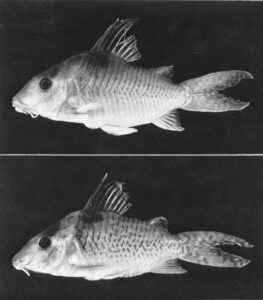
Brochis delphax, above: holotype, SL 49.7 mm; below: a paratype, 47.2 mm SL, showing variability of the color pattern. From: Nijssen, H. and I. J. H. Isbrücker. 1983. Review of the genus Corydoras from Colombia, with descriptions of two new species (Pisces, Siluriformes, Callichthyidae). Beaufortia 33 (5): 53-71.
Brochis delphax is an armored catfish (Callichthyidae) from the Inírida River and upper Orinoco River basin in Colombia. It was described as Corydoras delphax by the famous catfish duo of Han Nijssen (1935–2013) and Isaäc J. H. Isbrücker (b. 1944), both long-time researchers at the Institute for Taxonomic Zoology (Zoölogisch Museum) of the University of Amsterdam.
In the etymology section, the authors explain: “The specific name delphax is Greek, meaning young pig, an allusion to its feeding behaviour.”
Seeking more information, I emailed Dr. Isbrücker: “What about its feeding behavior inspired the name?” To which he replied:
“Corydoras delphax is just a common species compared to most other Corydoras spp., yet, watching a healthy group of C. delphax feeding in a tank one easily might think of the sight of sucking porkers.”
I liked the vivid image of the “sucking porkers” and included it in the ETYFish entry (citing a pers. comm., of course.)
Speaking of Dr. Isbrücker, I am delighted to report that a new species of his beloved Corydoras catfishes was named in his honor in July.
Corydoras isaacisbrueckeri Tencatt, Hercos, Carvalho, Santos & Britto 2026 occurs in the Tefé River drainage, Solimões River basin, of Amazonas, Brazil. The authors call Dr. Isbrücker a “beloved friend” who “devoted most of his life to the aquarium hobby and ichthyology, publishing dozens of scientific articles on Corydoradinae and Loricariidae along his career. This small homage intends to highlight how special Isaäc is as a human being, as well as a devoted scientist, inspiring [the first author] on personal and professional levels.”
I, too, am honored to call Dr. Isbrücker a friend. We’ve been email correspondents since at least December 2015. He has proofread much of the ETYFish Project and always lets me know when typos sneak into these Names of the Week.
I hope he doesn’t find one this time. 😊
9 Sept.
The Academy Eel, Apterichtus ansp (Böhlke 1968)
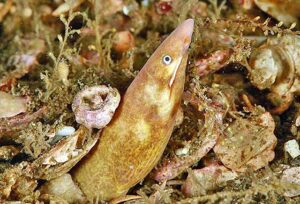
Apterichtus ansp. From: D. R. Robertson and J. Van Tassell. 2023. Shorefishes of the Greater Caribbean: online information system. Version 3.0 Smithsonian Tropical Research Institute, Balboa, Panamá.
Apterichtus ansp is a snake eel (Ophichthidae) from the Western Atlantic from Bermuda and Massachusetts south to Puerto Rico and the Gulf of Mexico. It was described as Verma ansp by James E. Böhlke (1930–1982), curator of the Department of Ichthyology at the Academy of Natural Sciences of Philadelphia (ANSP). He named the eel after the museum where the holotype is housed. The catalog number on the jar is ANSP 98366.
Last week came the sad and unexpected news that ANSP — now known as the Academy of Natural Sciences of Drexel University — would be closing the public portion of its museum on September 30, 2026.
Founded in 1812, the Academy is the oldest natural science institution in the Americas. It started publishing a journal in 1817, providing a forum for the leading ichthyologists, both American and European, of the 19th century. Lesueur. Bonaparte. Rafinesque. Holbrook. Gill. Cope. Today, ANSP hosts one of the most important collections of preserved fishes in the world, with an estimated 1.6 million specimens in 155,000 lots representing more than 15,000 species. ANSP also has one of the world’s largest collections of fish types, with 2,827 primary and 18,793 secondary type specimens representing 1,897 and 2,127 species/subspecies, respectively. In total, ANSP types represent ~3,182 species/subspecies and ~8.4% of all fish species ever named as such (as of January 2026).
ANSP first opened its collections to the public in 1828. In 1868, the museum displayed the world’s first mounted dinosaur skeleton. Attendance soared. Along with Independence Hall, the Liberty Bell, the Rocky statue at the Philadelphia Museum of Art, the U.S. Mint, and Philly cheesesteak sandwiches, the museum became an iconic landmark, a must-see attraction for residents and tourists alike.
ANSP affiliated with Drexel University in 2011 to, in part, gain financial and operational support from the university. Recent economic strains on both institutions necessitated the closure of the public museum. Critics and community members argue that the financial crisis was exacerbated by past leadership failures across both institutions.
Despite the September 30 closure, Drexel President Antonio Merlo promised that Drexel will continue stewardship of the Academy’s collections, which include ANSP 98366.
And 19 billion other biological specimens.
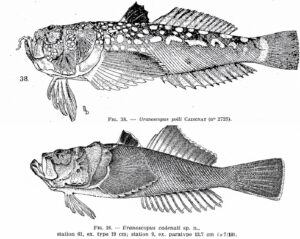
TOP: From: Cadenat, J. 1953. Notes d’ichtyologie ouest africaine. VI. Poissons des campagnes du “Gérard Tréca.” Bulletin de l’Institut Français d’Afrique Noire (Sér A) Sciences Naturelles 15 (3): 1051-1102. BOTTOM: From: Poll, M. 1959. Poissons V.-Téléostéens acanthoptérygiens (deuxième partie). Résultats Scientifiques. Expédition Océanographique Belge dans les Eaux Côtières Africaines de l’Atlantique Sud (1948-1949). Bruxelles. 4 (3B): 1-417, Pls. 1-7, 1 tab.
2 Sept.
Mutual Admiration Eponymy
Uranoscopus polli Cadenat 1951
Uranoscopus cadenati Poll 1959
Aphyosemion scheeli Radda 1970
Aphyosemion raddai Scheel 1975
Rasbora axelrodi Brittan 1976
Rasbora brittani Axelrod 1976
Stenogobius alleni Watson 1991
Stenogobius watsoni Allen 2004
Maylandia koningsi (Stauffer 2018)
Maylandia staufferi (Konings 2026)
Not an exhaustive list.
“A pox on both your fishes!”
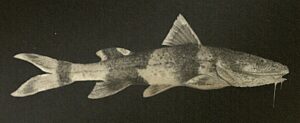
Rhyacoglanis variolosus. From: Miranda Ribeiro, A. de. 1914. Pimelodidae, Trachycorystidae, Cetopsidae, Bunocephalidae, Auchenipteridae, e Hypophthalmidae. In: Commissào de Linhas Telegraphicas Estrategicas de Matto-Grosso ao Amazonas. Annexo no. 5: 1-13, Pls. 1-2.
With apologies to Shakespeare’s “A pox o’ both your houses!” from Romeo and Juliet (see footnote), here are fishes names for pox, any contagious viral disease that causes skin bumps, blisters, or spots filled with fluid.
Variola Swainson 1839
Variola is a Latin word meaning pustule or pox. Swainson did not explain why he chose this name for a genus of groupers (Epinephelidae) from the Indo-West Pacific. But you don’t have to be an infectious disease expert to guess that the name refers to the numerous small and irregular spots and dashes on the head and body of the type species Variola longipinnis, a junior synonym of V. louti (Fabricius 1775).
Cirripectes variolosus (Valenciennes 1836)
This blenny (Blenniidae) from the Western and central Pacific is named for the whitish spots on its cheek and front of snout, “which look like pustules of smallpox” (translation).
Rhyacoglanis variolosus (Miranda Ribeiro 1914)
This skin of this bumblebee catfish (Pseudopimelodidae) from the Rio Taquary drainage of Mato Grosso, Brazil, has a granular texture. Miranda Ribeiro said the texture resembles smallpox pustules.
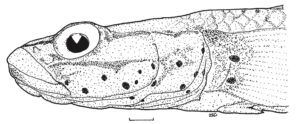
Rhinogobius variolatus, showing cephalic color pattern of male. Scale bar = 1 mm. From: Chen, I-S. and M. Kottelat. 2005. Four new freshwater gobies of the genus Rhinogobius (Teleostei: Gobiidae) from northern Vietnam. Journal of Natural History 39 (17): 1407-1429.
Rhinogobius variolatus Chen & Kottelat 2005
This goby (Oxudercidae) from Vietnam is named for variola, referring to the smallpox-like spots on its cheek and opercle.
Istiblennius pox Springer & Williams 1994
This blenny (Blenniidae) occurs in the northwestern Indian Ocean. The authors explained: “Pox is a varietal spelling of the English pocks, an eruptive disease such as chicken pox, referring also to spots resembling the disease eruptions, and, in the present case, to the spots on the occipital crest of males of the species…”.
* The traditional Shakespeare quote is “A plague o’ both your houses!” In the first printed edition of Romeo and Juliet (1597), “pox” was used instead of “plague.” In Shakespeare’s time, pox may have referred to syphilis. I dare anyone to name a fish after syphilis.
19 August
Cybium: The fish and the journal
 Why does a major ichthyology journal bear the name of a genus that is to longer considered valid?
That’s the question ichthyologist John P. Sullivan shared with The ETYFish Project while preparing a manuscript for Cybium, published by the Société Française d’Ichtyologie.
Cybium is a genus-level name for Spanish mackerels proposed by Georges Cuvier in 1829. Cuvier borrowed the name from the Ancient Greek word kýbion (κύβιον), a certain portion or a certain preparation of tunny, which became the Latin cybium, a dish made of pieces of the tunny-fish salted and chopped. Species historically placed in the genus were absorbed into Scomberomorus Lacepède 1801 and other genera over the course of 19th- and 20th-centuries.
Cybium, the journal, was founded in 1947 by the French naturalist and explorer Théodore Monod (1902–2000). Monod named it Cybium, Bulletin de l’Association des Amis du Laboratoire Colonial des Pêches, honoring Cybium commersoni (now known as Scomberomorus commerson). At that time, Cybium was primarily a fisheries bulletin, so naming it after a commercially important species seemed appropriate. The bulletin ceased publication from 1955 to 1967 and came back as an annual publication in 1968. In 1977, the recently formed Société Française d’Ichtyologie (SFI) retained the historic title for its journal and it’s been published as an international ichthyology journal ever since. SFI also retained the original 1947 logo depicting a fish larva sitting on top of the Earth.
While Cybium (the genus) is relegated to synonymy, it lives on as the root in the names of two related genera proposed by Theodore Gill in 1862: Acanthocybium (Scombridae) and Lepidocybium (the newly proposed Lepidocybiidae).
When Dr. Sullivan posed his question about the Cybium–Cybium connection to ChatGPT, the chatbot replied with a mostly accurate answer. It also added a surprisingly thoughtful observation (edited slightly for clarity):
“I find it amusing that a journal devoted to modern ichthyology has preserved a bit of taxonomic history in its very title—a quiet reminder that nomenclature evolves, but some names become institutions in their own right.”
Dang, I couldn’t have said it any better myself.
Maybe ChatGPT should be writing the NOTW from now on?
12 August
Pseudolaguvia khairii Vijayakrishnan, Shinde & Gogineni 2026
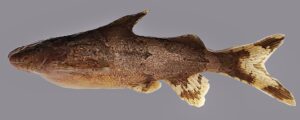
Pseudolaguvia khairii, paratype, 24.9 mm SL, showing live coloration. From: Vijayakrishnan, B., G. Shinde & P. C. Gogineni. 2026 Pseudolaguvia khairii, a new diminutive catfish from Odisha, India (Teleostei: Sisoridae). Zootaxa 5853 (4): 584-592.
In the 5 July 2023 NOTW, I playfully coined the term “petonym” for zoological nomina that honor pets. In that case, a killifish was named after a pet cat. This recently described catfish is also named for a pet cat but a different kind of cat. A tiger.
Pseudolaguvia khairii is a sisorid catfish from the Budhabalanga River in Odisha, India. It is distinguished from all its congeners in possessing a prominent and fleshy protuberance along the dorsal-fin base. The Budhabalanga River is adjacent to Similipal National Park, home of Similipal Tiger Reserve.

Khairi, at home with Saroj Raj Choudhury and his wife Nihar Nalini Swain.
In October 1974, forest dwellers living near the reserve found a seven-week-old tiger cub near the river Khairi. The mother was nowhere to be found. They knew that the frail and weak cub would not survive on its own. So they carried the cub to the house of Saroj Raj Choudhury, the field director of the Similipal forest. Choudhury and his family were no strangers to raising orphaned wild animals. They already had a bear, a hyena, deer and even crocodiles.
The cub — which they named Khairi, after the river where it was found — roamed freely in their bungalow, jumping on to beds and chairs exactly as a puppy or a kitten would do. Visitors were encouraged to cuddle and play with her. She matured into a full-grown tigress (200 kg) but remained an affectionate household pet. She snuggled with family members and guests in bed at night. Now too big to care for, Choudhury released her into the forest but Khairi came back later that night. The bungalow and surrounding compound, not the forest, was her home.
In their description of the catfish, the authors note that Khairi became one of the most extensively studied tigers in history, playing a pivotal role in our understanding of tiger behavior. Daily up-close observations of Khairi allowed Choudhury to document how Khairi used scent markings to signal territory and identity. Specific behavioral traits (e.g., vocalizations) revealed natural territorial boundaries and behavioral triggers. And insights into her reactions during reproductive cycles offered rare baseline data on tiger mating patterns.
The story has a doubly tragic ending. In 1981, a stray dog with rabies entered the compound and bit Khairi. Suffering from the fatal virus, she was euthanized to end her agony. Choudhury died a year, in his office, after a massive heart attack. Some say he never quite recovered from Khairi’s loss.
5 August
Batman River Loach, Schistura chrysicristinae
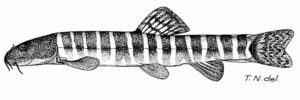
Schistura chrysicristinae, paratype, adult female, 33 mm SL. From: Nalbant, T. T. 1998. The presence of the genus Schistura (Pisces: Ostariophysi: Nemacheilidae) in Tigris drainage, western Asia. The description of a new species. Travaux du Muséum d’Histoire Naturelle “Grigore Antipa.” 40: 371-375.
The Batman River Loach was one of the 10 “most wanted” and presumably “lost” fish species in the world. It was described by Romanian ichthyologist Theodor Nalbant (1933–2011) in 1998, based on four specimens (now lost) collected in 1974 by in the upper Tigris drainage of Türkiye. Despite extensive surveys in the streams where it was collected and nearby sites, the species was not seen again for 48 years. It was rediscovered in 2021 at two sites upstream of its type locality. With fresh specimens, the species was redescribed and had its taxonomic status clarified earlier this year.

Cristina Ana Hoinic. From: Nalbant, T. 1997. In memoriam: Cristina Ana Hoinic (8 September 1967-7 September 1997). Travaux du Muséum d’Histoire Naturelle “Grigore Antipa.” 39: 427-429.
The common name Batman River Loach has nothing to do with the DC Comics superhero. Instead, the loach takes its name from Batman River, a major tributary of the Tigris in southeast Türkiye, where it was rediscovered. According to Wikipedia, the origin of the name “Batman,” dating from the 19th century, is unclear. It might be a shortening of the name of the 1,228m tall Bati Raman mountain located nearby or refer to the unit of weight used in the Ottoman Empire.
The story of the fish’s specific epithet chrysicristinae is a sad one.
Nalbant named the loach in memory of Romanian entomologist Cristina Ana “Chrysi” or “Crina” Hoinic (1967–1997). He described her as a “wonderful friend and colleague” and that his “debts to her are beyond the words.” He said nothing about her passing at such a young age, perhaps because he published a memorial tribute to her a few months earlier in the same journal. In that article Nalbant explained the tragic circumstances of her death.
She died the day before her 30th birthday after a 12-day coma caused by a medical procedure to see if she was a suitable kidney donor for her twin sister.
Nalbant said she died with a smile on her face.
29 July
Demogorgonichthys arcanus Hart, Niemiller, Sandel & Armbruster 2026
This is the 666th consecutive weekly NOTW posting since the series began in October 2013. The number “666” is famously known as the number of the beast in the Christian Bible, and has become a widely recognized symbol for the Antichrist and Satan in modern popular culture. The number seems appropriate for the demonic name of this week’s fish.
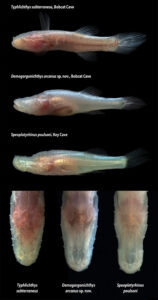
Comparative images of amblyopsid cavefishes in northern Alabama. Profile views of the full body and dorsal views of the head of Typhlichthys subterraneus and Demogorgonichthys arcanus from Bobcat Cave, Madison County, Alabama, and Speoplatyrhinus poulsoni from Key Cave, Lauderdale County, Alabama. Photos by Matthew L. Niemiller. From: Niemiller, M. L., J. W. Armbruster, M. W. Sandel, E. C. Maxwell, O. M. Bierstein, C. L. Anderson, J. Schaefer, C. I. Quering, A. Hinkle, M. Candeias, K. D. K. Niemiller, and P. B. Hart. 2026. Surprising cryptic cavefish diversity in a long-studied karst cave ecosystem of northern Alabama. Scientific Reports 16: 20765.
Demogorgonichthys arcanus is a newly described genus and species of blind cavefish (Amblyopsidae) from Bobcat Cave on Redstone Arsenal (a federal installation) in Huntsville, Alabama, USA.
The name came from a conversation between co-authors Jonathan Armbruster and Pamela Hart at the University of Alabama. Hart had been keeping a list of underground figures and mythological beings in case she ever named a cave species. Armbruster suggested the Demogorgon, an underworld phantom demon in Greek mythology, the name of the Demon Prince in the role-playing game Dungeons and Dragons, and a monster in the television series Stranger Things, where the creature can be found in the Upside-Down, a cave-like version of the real world. Ichthýs (ἰχθύς), of course, is Greek for a fish.
The specific name “arcanus” is Latin for Latin for hidden, secret or mysterious. It refers to the “long-undetected existence of this cavefish despite decades of intensive biological study at the type locality, as well as its occurrence within a subterranean environment largely concealed from human observation. The name further alludes to the species’ probable primary occupancy of the underlying karst aquifer rather than the accessible cave passages themselves, emphasizing its cryptic nature.”
Remarkably, D. arcanus occurs in the same cave as the Southern Cavefish Typhlichthys subterraneus, yet phylogenetic analyses demonstrate that the two taxa are not sister lineages. According to the authors, “This co-occurrence represents an independent evolutionary origin of cave adaptation within the same subterranean system, underscoring the complexity of colonization history and lineage persistence in karst aquifers.”
Only 20 or so of the new cavefish have been seen at one time. It may spend much of its life deeper in the aquifer, beyond human reach. “It may have been living down in the aquifer and only recently made its way up,” Armbruster said. “Or it may have been there before, and we just never saw it.”
Its common name is Demon Cavefish.
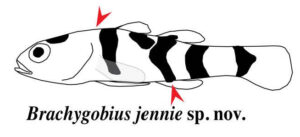
Brachygobius jennie, showing its diagnostic marking pattern. From: Tian, J.-Y., J.-Y. Wu, C.-L. Lan, S. Lavoué and J.-R. Huang. 2026. Brachygobius jennie, a new bumblebee goby (Teleostei, Oxudercidae) from Hengqin Island, Guangdong Province, China. Zoosystematics and Evolution 102 (3): 853–863.
22 July
Brachygobius jennie Tian, Wu, Lan, Lavoué & Huang 2026
Bach. Vivaldi. John Lennon. Pink Floyd. Led Zeppelin. Earl Scruggs. Fishes named for musical luminaries span the genres. Classical. Rock. Bluegrass.
Now we can add K-pop.
Brachygobius jennie is a new species of bumblebee goby from Hengqin Island in Guangdong Province, China. It’s distinguished from other species in the genus by its unique marking pattern comprising four narrow body bars behind the head, two of which are located past the anal fin base, including a chevron-shaped second bar that extends fully to the midventral line. Species in the genus occurs in fresh and brackish waters throughout Southern and Southeast Asia. This is the first recorded species from China. It may also be the smallest fish in China, reaching up to 9 mm SL.
 The goby is named for Jennie Ruby Jane, the stage name of Jennie Kim (b. 1996), a South Korean singer, rapper, songwriter, and actress. The original description credits her “exceptional character and achievements, which proved [a] source of inspiration for the first author who discovered the new species.” In a press release from the journal publisher Pensoft, Jiangyan Tian, the first author, added: “Listening to the songs of Jennie Ruby Jane during my studies was a constant source of inspiration. Naming this species after her is my way of acknowledging the positive influence she had on my work.”
Some names tell us more about the describer than the fish being described.
15 July
Kent E. Carpenter (1953–2026)
 This one’s hard to write about and even harder to fathom.
On 12 July, 2026, American ichthyologist Kent E. Carpenter was shot and killed when three masked assailants forcefully entered his residence in the Philippines. According to news reports, Dr. Carpenter was watching television with a 34-year-old Filipina companion when the crime occurred just after 11:30 p.m. The men took a laptop, an unspecified amount of cash and a backpack before fleeing. The companion sustained unspecified injuries and was being treated.
Dr. Carpenter was an Emeritus Professor of Biological Sciences at Old Dominion University, Virginia, USA. He earned his B.S. in marine biology in 1975 and his Ph.D. from the University of Hawaii. He specialized in the systematics and evolution of marine fishes. He was also a long-term collaborator with the Food and Agriculture Organization of the United Nations Species Identification and Data Programme for Fisheries, producing identification guides for regions such as the western Pacific and the western and eastern Atlantic Oceans. He did fieldwork in the Caribbean, West Africa, and the Philippines. In addition to research and teaching responsibilities, he is also the coordinator for the IUCN Global Marine Species Assessment, completing the first global review of every marine vertebrate species, and of selected marine invertebrates and marine plants, to determine conservation status and possible extinction risk for about 20,000 marine species. At the time of his passing, Dr. Carpenter was a research associate at Silliman University in the Philippines, which posted the memorial graphic shown here. He was due to leave the Philippines at the end of the month and set to retire in September.
Dr. Carpenter described or co-described 16 species of marine fishes (in chronological order):
Cirrhilabrus flavidorsalis Randall & Carpenter 1980
Cirrhilabrus lubbocki Randall & Carpenter 1980
Cirrhilabrus rubripinnis Randall & Carpenter 1980
Caesio varilineata Carpenter 1987
Pterocaesio lativittata Carpenter 1987
Pterocaesio randalli Carpenter 1987
Pterocaesio tessellata Carpenter 1987
Pterocaesio trilineata Carpenter 1987
Lethrinus ravus Carpenter & Randall 2003
Acanthopagrus taiwanensis Iwatsuki & Carpenter 2006
Caranx fischeri Smith-Vaniz & Carpenter 2007
Acanthopagrus randalli Iwatsuki & Carpenter 2009
Caesio xanthalytos Holleman, Connell & Carpenter 2013
Chelidoperca santosi Williams & Carpenter 2015
Acanthurus albimento Carpenter, Williams & Santos 2017
Acropoma arafurense Okamoto, Williams, Carpenter, Santos & Kimura 2019
Three species have been named in Dr. Carpenter’s honor:
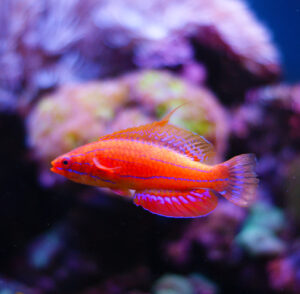
Paracheilinus carpenteri. Courtesy: Wikipedia.
Paracheilinus carpenteri Randall & Lubbock 1981 – a flasher wrasse (Labridae) from the Western Pacific Ocean, for being the principal collector of the type specimens and assisting the authors “in many other ways”
Dentex carpenteri Iwatsuki, Newman & Russell 2015 – a sea bream (Sparidae) from the Eastern Indian Ocean of Western Australia, for his many contributions to ichthyology and activities pertaining to ichthyology at the Food and Agriculture Organization of the United Nations (FAO) and the International Union for Conservation of Nature (IUCN)
Meganthias carpenteri Anderson 2006 – a jewelfish (Anthiadidae) from the Eastern Atlantic Ocean off Nigeria; Carpenter invited Anderson to participate in the FAO-COC (Food and Agriculture Organization of the United Nations and Centro Oceanográfico de Canarias) workshop held at Tenerife in July 2004, and did a “superb job” editing and organizing the production of FAO Species Identification Guides
Kent E. Carpenter was 73 years old.
8 July
Honoring a Dying Wish
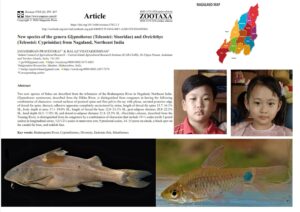 Jamir Limaakum (1979-2024) was an Assistant Professor at Fazl Ali College in Mokokchung, Nagaland, India. He specialized in Northeast Indian ichthyology, documenting and protecting the aquatic biodiversity of the region’s rivers. In January 2022, Limaakum collected a new species of sisorid catfish in Nagaland. In April 2024, he collected a new species of smiliogastrine minnow, also in Nagaland. He was planning to study and describe the new species but passed away later in 2024.
Before he died, Limaakum asked his colleagues Jayasimhan Praveenraj and Balaji Vijayakrishnan to name the two new species after his children. Praveenraj and Vijayakrishnan honored Limaakum’s dying wish.
Oreichthys elianae — in honor of Limaakum’s daughter Eliana
Glyptothorax sentimereni — in honor of Limaakum’s son Sentimeren
On a 3 March 2026 post to Facebook (detail shown here), the first author Jayasimhan Praveenraj wrote:
“Fulfilling that wish was more than taxonomy — it was a tribute to friendship, dedication, and the passion he had for science and his family.
“This work stands as a scientific contribution to biodiversity, but also as a lasting remembrance of a colleague who deeply loved both research and his children.
“Science preserves life in many ways — sometimes, it also preserves memories.
“Grateful to have fulfilled a promise.”
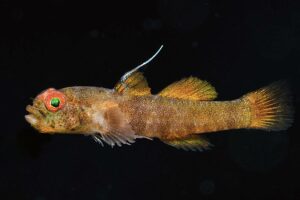
Eviota bikiniensis, holotype, 12.7 mm SL male. Photo by Mark V. Erdmann. From: Erdmann, M. V., D. W. Greenfield and N. K. Ichida. 2025. Eviota bikiniensis, a new dwarfgoby from Bikini Atoll, Marshall Islands (Teleostei: Gobiidae). Journal of the Ocean Science Foundation 45: 1-5.
1 July
Eviota bikiniensis Erdmann, Greenfield & Ichida 2025
Today, July 1st, marks the 80th anniversary of the 1946 Operation Crossroads “Able” test at Bikini Atoll, an isolated coral reef in the Marshall Islands of the Western Pacific. “Able” was the first of two nuclear weapon tests conducted by the United States at Bikini Atoll in 1946. They were the first detonations of nuclear devices since the atomic bombing of Nagasaki on August 9, 1945. The purpose of the tests was to investigate the effect of nuclear weapons on warships. Another component of the tests was to study the relative abundance of flora and fauna before and after the explosions. They were also the first nuclear tests publicly observed by the international media.
The residents of Bikini Atoll, 167 in number, were forcibly relocated before the tests to a nearby atoll. Unable to catch enough fish or gather sufficient food, and largely forgotten by the U.S. government, they suffered from malnutrition and nearly starved to death as nuclear tests continued at Bikini in 1954, 1956 and 1958. In 1970, about 200 residents returned to their home island but were evacuated 10 years later due to health problems from radioactivity in the well water and food supply. Except for divers, a few scientists and a handful of caretakers, Bikini Atoll remains unoccupied today.
Two fishes collected as part of Operation Crossroads are named for Bikini Atoll:
Enchelycore bikiniensis (Schultz 1953) – a moray eel
Ichthyocampus bikiniensis Herald 1953 – a pipefish
In 2025, a third species, Eviota bikiniensis, a dwarfgoby, known only from one specimen collected there, was named for the atoll. But unlike the previous two fishes, the name not only honors the place, but also the people who once lived there. The authors say:
“It is an honor to name this unique species in recognition of Bikini and the People of Bikini, who have suffered tremendously as a result of the nuclear testing that required their displacement from their ancestral home – which nonetheless remains to this day a stunningly beautiful part of the planet and a testament to the resilience of nature.”
24 June
Volcanic fishes
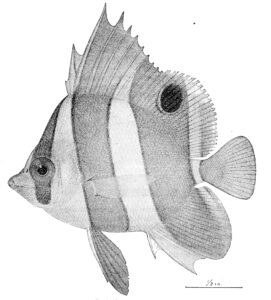
Fishes don’t live in volcanos, of course (see footnote). But those that live near volcanos are sometimes discovered because of them. The following fishes were all boiled alive and floated to the surface when a volcano erupted and lava flowed into the water.
Roa excelsa (Jordan 1921) – This deepwater butterflyfish (Chaetodontidae) was killed and brought to the surface by a lava stream from the eruption of Hawaii’s Mauna Loa volcano in November 1919. “Mauna Loa” means “Long Mountain” in Hawaiian. The specific epithet “excelsa” is the feminine form of “excelsus,” meaning lofty or high, the Latin equivalent of the Hawaiian “loa.” In fact, Jordan proposed “Loa” as a new genus for this species but later learned that the name is preoccupied by Loa Stiles 1905 in nematodes. In 1923, Jordan replaced Loa with Roa, a Polynesian word meaning the same thing.
Jordan described a second species from the Mauna Loa eruption in 1919:
Lampanyctus reinhardti (Jordan 1921) – a lanternfish (Myctophidae), named in honor of Hawaiian boatman Tom Reinhardt, who collected a number of “boiled” fishes floating in the water, including the holotype of this one.
Mauna Loa erupted again in 1950. The carcasses of six new species were scooped up by ichthyologists:
Cataetyx hawaiiensis Gosline 1954 – a viviparous brotula (Bythitidae), named for Hawaii.
Pycnocraspedum armatum Gosline 1954 – a cusk-eel (Ophidiidae). Its name is the neuter form of armatus, Latin for “armed with a weapon,” referring to spines on the preopercular border.
Luciobrotula lineata (Gosline 1954) – another cusk-eel (Neobythitinae), named for the linear fleshy ridges on the front of its snout and lower jaw. Gosline proposed a new genus for this species, the aptly named Volcanus, but it was sunk into the synonymy of Luciobrotula in 1974.
Araiophos gracilis Grey 1961 – a marine hatchetfish (Sternoptychidae). Its name is Latin for thin or slender and refers to what Grey described as its “elongate, slender” body.
Hollardia goslinei Tyler 1968 – A spikefish (Triacanthodidae), named in honor of ichthyologist William A. Gosline (1915-2002), University of Michigan, who was instrumental, along with other colleagues, in collecting fishes killed by Mauna Loa.
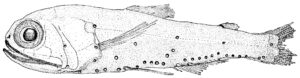
Bolinichthys distofax, holotype, 84.1 mm SL. From: Johnson, R. K. 1975. A new myctophid fish, Bolinichthys distofax, from the western and central North Pacific Ocean, with notes on other species of Bolinichthys. Copeia 1975 (1): 53–60.
Bolinichthys distofax Johnson 1975 – a lanternfish (Myctophidae). Its name is a combination of the Latin “disto,” to stand apart (i.e., be different), and “fax,” torch or firebrand, referring to rearward displacement of the Vn photophore (in front of eye below olfactory capsule), unique among congeners.
Two fishes were discovered after the 2007 eruption of Piton de la Fournaise, a volcano on Réunion Island, western Mascarenes, in the southwestern Indian Ocean.
Symphysanodon pitondelafournaisei Quéro, Spitz & Vayne 2009 – a slopefish (Symphysanodontidae) named for Piton de la Fournaise.
Chromis durvillei Quéro, Spitz & Vayne 2010 – a damselfish (Pomacentridae) named in honor of ichthyologist Patrick Durville, Saint-Gilles Aquarium, Reunion Island, co-author of a 2004 checklist of Reunion Island fishes, and who helped collect this species floating at the surface after the eruption.
Footnote: Alexander von Humboldt actually believed that the climbing catfish Astroblepus cyclopus was regularly expelled by volcanoes in the Andes. See the 2 Sept. 2015 Name of the Week for the full story.
17 June
The Useless Goby
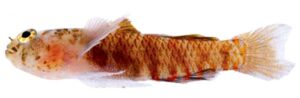
Eviota inutilis, courtesy of the Western Australian Museum. From: Greenfield, D. W. and R. Winterbottom. 2016. A key to the dwarfgoby species (Teleostei: Gobiidae: Eviota) described between 1871 and 2016. Journal of the Ocean Science Foundation 24: 35-90.
In 1943, Australian ichthyologist Gilbert Percy Whitley described a new subspecies of pygmy goby, Eviota viridis inutilis. (It was later elevated to full species). As per his custom, Whitley did not explain the meaning of the goby’s specific epithet, but it wasn’t hard to figure it out. “Inutilis” is Latin for “useless.” While the goby’s diminutive size means it’s useless in terms of human consumption, that’s not why Whitley chose the pejorative adjective. The name is, in fact, a toponym, a proper noun used to identify a specific geographic location. As explained by Whitley, he discovered the goby amongst material brought up by a pearl oyster dredge on 2 July 1939. The location: the head of Useless Inlet, Shark Bay, Western Australia.
Always curious about the meanings of names, I needed to know why Useless Inlet is called Useless Inlet. The name dates to 1801. That’s when French explorer Henri-Louis de Saulces de Freycinet dubbed it Havre Inutile (Useless Harbour) out of frustration because a shallow sandbar, with only a few feet of water, blocked the entrance and prevented his ship from safely anchoring or passing through. Because it couldn’t admit vessels of any size, Freycinet deemed the inlet useless to sailors.
Useless Inlet isn’t the only “useless” body of water in the world. In Washington (the state), USA, there is Useless Bay, so named by early navigators because it was too shallow for safe ship anchorage. And the name of Paraíba do Sul, the southern Paraíba River of Brazil, is from the Tupi words para (river) and aíba (bad, difficult or useless), because the shallowness of the river makes it difficult to navigate.
Whoever was responsible for coining the common names for Australian fishes opted not to call Eviota inutilis the “Useless Goby.” Instead, it has a more attractive common name, the Chestspot Dwarfgoby, referring to the distinctive dark spot located above its pectoral and pelvic fins.
10 June
Characidium x 2
These two recently described South American darters (Crenuchidae) have vastly different but equally interesting names. One is named for a plant, the other for a slain biologist.
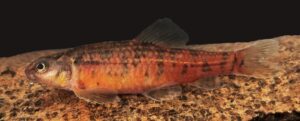
Live coloration of Characidium urucum, 44.5 mm SL, paratype, female. From: Uzeda, P. L. C., B. H. M. Stabile, R. B. dos Reis, L. J. Sartori, C. S. Pavanelli, V. P. Margarido and W. J. da Graça. 2026. Integrative taxonomy reveals a remarkably colored species of Characidium (Characiformes: Crenuchidae) from the upper Paraná river basin, Brazil. Neotropical Ichthyology 24 (1): e250174: 1-28.
Characidium urucum Uzeda, Stabile, Reis, Sartori, Pavanelli, Margarido & da Graça 2026 – This species is distinguished from its congeners by the intense red hue on the body and head of living adults. This coloration, unique in the genus, is reflected in its name, a delightful combination of botany and cultural anthropology. “Urucum” is the South American Tupi word for Bixa orellana, a plant native to tropical America known for the intense red hue of its seeds. These seeds have traditionally been used by South American indigenous peoples as condiments, pigments and body paint.
Characidium noelkempffi Oliveira-Silva, Or, Zanata & Schaefer 2026 – This crenuchid occurs in a small, isolated river in the highland areas of Noel Kempff Mercado National Park, Bolivia. Both the park and the species are named in honor of Bolivian biologist and environmentalist Noel Kempff Mercado (1924–1986), for his lifelong dedication to the exploration and preservation of Bolivia’s natural heritage.
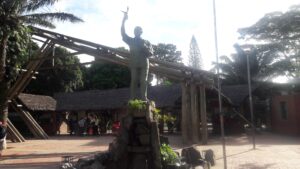
Noel Kempff Mercado Monument, Santa Cruz, Bolivia.
In 1986, Kempff Mercado was part of a four-man team studying rare plants in the Huanchaca National Park of Bolivia. Their plane landed on a runway that, unknown to them, was part of a clandestine cocaine processing laboratory. Kempff Mercado, along with pilot Juan Cochamanidis and guide Franklin Parada Auclos, were shot and killed by cartel guards. Vicente Castello, a Spanish scientist, escaped the bullets and hid in the jungle for 24 hours until he was able to signal a rescue plane.
The crime set off a public uproar at the time, in part because Kempff Mercado was a beloved conservationist, but also because American D.E.A. agents had photographed the suspected laboratory a month earlier and deemed it vacant and not in use.
After a long investigation, 10 Brazilians and one Colombian were convicted for their direct involvement in the drug operation and the murders. At the same time, charges against 16 Bolivians—including several well-known figures in the drug trade—were dismissed, which sparked significant public outrage and doubts regarding corruption in the Bolivian justice system.
Two years later, the Huanchaca National Park was renamed Noel Kempff Mercado National Park in honor of the slain biologist.
3 June
Arhinolemur: The mammal that’s really a fish
It’s one of the strangest fish names ever. Why? Because it was originally proposed for a mammal, not a fish.
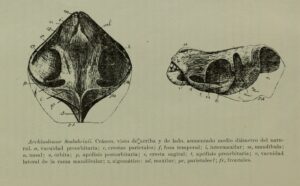
Holotype of Arhinolemur scalabrinii (spelled as Arrhinolemur). From: Ameghino, F. 1899. Los Arrhinolemuroidea, un nuevo orden de mamíferos extinguidos. Comunicaciones del Museo Nacional de Buenos Aires 1 (5): 146-151.
Arhinolemur was described by Argentine paleontologist Florentino Ameghino (1853-1911) in 1898. He based the description on a single small, incomplete skull discovered in the cliffs Paraná, Argentina, by Pedro Scalabrini (1848-1916), an Italian-born history teacher and fossil hunter. Ameghino assigned the fossil to an extinct order of lemur-like mammals and named it accordingly: á– (ἄ), a Greek privative, i.e., without; rhinós (ῥινός), genitive of rhís (ῥίς), snout; lemur, small, tree-dwelling primate of Madagascar, referring to its “obliterated anterior nasal aperture” (translation).
In 1945, American paleontologist George Gaylord Simpson (1902-1984) reexamined the fossil and determined it to be the “crushed skull of fish.” In 1986, Uruguayan paleontologist Álvaro Mones (b. 1942) suggested that the fossil belonged to the fish order Characiformes. In 2012, a team of paleontologists and ichthyologists confirmed Mones’ suspicion, identifying the fossil as a species of Leporinus within the South American characiform family Anostomidae. In March of this year, a team of nine paleontologists and ichthyologists reassigned Arhinolemur — and its one species, A. scalabrinii, named for its discoverer — to the anostomid genus Megaleporinus based on its 3/3 dental formula and the incisiform shape of the upper and lower teeth.
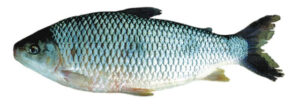
An extant Arhinolemur from Argentina, A. obtusidens. Courtesy: Sara Beatriz Sverlij, Professional advisor of the Directorate of Ichthyologic and Aquatic Resources, Secretariat of Environment and Sustainable Development of Argentina.
Since Arhinolemur (proposed in 1898) predates Megaleporinus (proposed in 2017), the name of the fossil genus clearly has nomenclatural priority. Faced with the oddity of rechristening a genus of large extant species (some of them commercially important) with an obscure name originally conceived for a skull fragment of a non-existent extinct genus of lemur-like mammals, the authors considered several approaches to resolve this “taxonomic dilemma” (their words). They opted for the simplest: treat Megaleporinus as a junior synonym of Arhinolemur, necessitating new combinations for 11 species (listed below).
The ETYFish Project played a minor behind-the-scenes role in the nomenclatural “rebirth” of Arhinolemur. Early last year, one of the current study’s authors asked me to comment on the correct spelling of the fossil genus, which Ameghino spelled as “Arhinolemur” in 1898 and as “Arrhinolemur” in a follow-up publication a year later. I said that Arrhinolemur (1899) is an unjustified emendation of Arhinolemur (1898) and that the original spelling should prevail.
In addition, my bibliographic digging unearthed something new about this fossil name. Although everyone studying Arhinolemur dated the name to a short note published by Ameghino in 1898, Ameghino had actually proposed the genus in a monograph published earlier that same year. This is the publication that made the name available. Unfortunately, my finding did not find its way into the current paper. Oh, well.
Anostomid species reassigned by Panzeri et al. (2026) from Megaleporinus to Arhinolemur
Arhinolemur brinco (Birindelli, Britski & Garavello 2013)
Arhinolemur conirostris (Steindachner 1875)
Arhinolemur elongatus (Valenciennes 1850)
Arhinolemur gaiero (Birindelli, Britski & Ramirez 2020)
Arhinolemur garmani (Borodin 1929)
Arhinolemur macrocephalus (Garavello & Britski 1988)
Arhinolemur muyscorum (Steindachner 1900)
Arhinolemur obtusidens (Valenciennes 1837)
Arhinolemur piavussu (Britski, Birindelli & Garavello 2012)
Arhinolemur reinhardti (Lütken 1875)
Arhinolemur trifasciatus (Steindachner 1876)
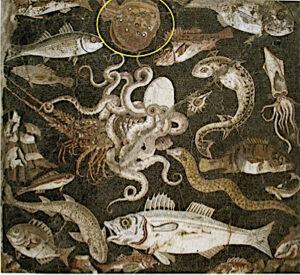
The Torpedo was well known among the Greeks and Romans. For example, a Torpedo can be seen in the fish mosaic in the House of the Faun in Pompeii (c. 50 BC).
27 May
Torpedo: the fish and the weapon
(written with Holger Funk)
Today, when most people hear the word “torpedo” they think of the self-propelled underwater missile that disables or sinks ships. In ancient Rome, when people heard the word “torpedo” they thought of electric rays. In fact, the Common Torpedo of the Mediterranean goes by the tautonymous name Torpedo torpedo (Linnaeus 1758).
Why do a flattened cartilaginous fish and a cigar-shaped military weapon share the same name? Both are designed to “shock” or paralyze, that’s why.
The Common Torpedo can deliver a strong electric shock of 70 to 200 volts, which it uses for both offensive (stunning prey) and defensive (repelling predators) purposes. Touching one is quite unpleasant, though rarely life-threatening, for humans. The Greek and Romans were well aware of its electric properties (but did not understand the underlying physics of electricity). The Greeks called it nárkē (νάρκη), meaning numbness (hence the English word narcosis). The Romans literally translated νάρκη as torpedo, also meaning numbness (hence the English word torpor). Both words live on in the scientific names of the electric ray genera Narke Kaup 1826, Narcine Henle 1834, Tetronarce Gill 1862, and Torpedo Duméril 1805.
Plutarch (before AD 50 – after 120) wrote this account:
You know, of course, the property of the Torpedo: not only does it paralyse all those who touch it, but even through the net creates a heavy numbness in the hands of the trawlers. And some who have experimented further with it report that if it is washed ashore alive and you pour water on it from above, you may perceive the numbness mounting to the hand and dulling your sense of touch by way of the water which, so it seems, suffers a change and is first infected. Having, therefore, an innate sense of this power, it never makes a frontal attack or endangers itself; rather, it swims in a circle around its prey and discharges its shocks as if they were darts, thus poisoning first the water, then through the water the creature which can neither defend itself nor escape, being held fast as if by chains and frozen stiff.
In antiquity, the Torpedo’s electricity was used for medicinal purposes, especially as a remedy for headache, gout, prolapsed anus and other ailments. Scribonius Largus (1st century AD, court physician to the Roman emperor Claudius) recorded remarkable observations such as the following:
A headache, no matter how old and unbearable, is immediately lifted and permanently cured by a living black Torpedo placed on that place, which is in pain, until the pain ceases and that part becomes senseless. When this is first felt, the remedy should be taken away so that sensation in this part is not lost. But rather a lot of Torpedos of this type should be kept ready, because sometimes healing – that is numbness, which is a sign of the curing process – scarcely follows from two or three Torpedos.
Is it too far-fetched to see this as the beginning or precursor of modern electrotherapy?
The Latin “torpedo” became the English word for electric rays circa 1527:
Torpido is a fisshe, but who so handeleth hym shalbe lame & defe of lymmes, that he shall fele no thyng.
— The noble lyfe & natures of man of bestes, serpentys, fowles & fisshes (translated by Laurence Andrewe)
Two centuries later, “Torpedo” was being used figuratively to describe any benumbing influence:
He used to call a pen his torpedo, whenever he grasped it, it numbed all his faculties.
— Oliver Goldsmith, Life of Richard Nash (1762)
English scientist William Gilbert coined the Neo-Latin word electricus in 1660, from ἤλεκτρον (ḗlektron), the Greek word for amber. “Electricus” referred to the static electricity produced by rubbing amber. The term was later applied to objects capable of attracting “light bodies” (e.g., bits of paper) when excited by friction, and then applied even later to the cause (electricity) rather than the property of the attraction. By 1774, scientists had started to call the torpedo fish the “electric ray.”
At around the same time, the word “torpedo” began to shift away from the fish to devices intended to shock or “stun” enemy ships, effectively making them sluggish. In 1775, American inventor David Busnell (1740–1824) created The Turtle, the first submarine ever used in combat. This one-man oak vessel carried a timed, explosive mine to attack British ships from beneath during the American Revolutionary War. Busnell called the explosive mine a “torpedo.”
Eventually, Busnell’s floating torpedoes became the self-propelled high-speed underwater projectiles used in naval battles ever since.
20 May
Solenostomus snuffleupagus Short & Harasti 2026
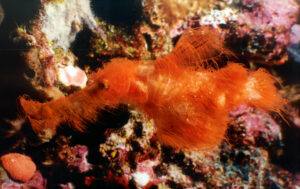
Solenostomus snuffleupagus, Papua New Guinea, 2003. Photo by David Harasti. From: Short, G. & D. Harasti. 2026. Solenostomus snuffleupagus sp. nov., a hairy ghost pipefish (Teleostei: Solenostomidae) from the Southwest Pacific, with an integrative comparison to S. paegnius. Journal of Fish Biology, 1–16. https://doi.org/10.1111/jfb.70497
How can this one NOT be a Name of the Week?
Solenostomus snuffleupagus is a new species of ghost pipefish (Solenostomidae) from the southwest Pacific, including northeastern Australia (Coral Sea), Papua New Guinea, New Caledonia, Fiji and Tonga. With its conspicuously shaggy appearance, formed by abundant elongate integumentary filaments, and its long, drooping snout, the fish is nearly a dead ringer for Mr. Snuffleupagus, a character on the long-running American educational television series for children, Sesame Street.
There’s another reason, not mentioned in the original description, for naming this fish after Mr. Snuffleupagus.
 “Mr. Snuffleupagus was famously the friend that nobody else could see. For years on Sesame Street, only Big Bird knew he existed, and the adults simply did not believe he was real,” lead author Graham Short told Discover. “This fish had exactly that quality. Divers kept reporting it [since the early 2000s], photographs kept surfacing from across the southwest Pacific, but it remained outside the formal scientific record. It was real, it was out there, but science had not yet caught up with it.”
In recent years, ichthyologists have gained publicity for new species by naming them after characters from comic books, Star Wars, The Lord of the Rings, and other pop-culture phenomena. In most of these cases, the resemblance between the character and the fish is superficial at best.
But this one?
How can it NOT be named snuffleupagus?
Footnote: The generic name Solenostomus, proposed by Lacepède in 1803, is a combination of sōlḗn (σωλήν), pipe or tube, and stóma (στόμα), mouth, referring to a small mouth at end of long, tube-like snout.
13 May
Strait of Hormuz
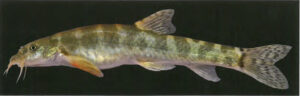
Paraschistura hormuzensis. From: Freyhof, J., G. Sayyadzadeh, H. R. Esmaeili and M. F. Geiger. 2015. Review of the genus Paraschistura from Iran with description of six new species (Teleostei: Nemacheilidae). Ichthyological Exploration of Freshwaters 26 (1): 1-48.
It’s the most famous body of water in the world today. Two Iranian fishes have been named after it (although neither specifically occurs in it):
Paraschistura hormuzensis Freyhof, Sayyadzadeh, Esmaeili & Geiger 2015 — Paraschistura is a genus of stone loaches (Nemacheilidae) with 24 species in Afghanistan, Iran, Pakistan, India, Nepal, and Turkmenistan. This species occurs in the shallow areas of streams in the Minab River of Iran, which flows into the Strait of Hormuz.
Garra hormuzensis Zamani-Faradonbe, Zhang & Keivany 2021 — Garra is one the most speciose genus of cyprinids, with over 160 species in Africa, Asia and the Middle East, including 15 species from the Persian Gulf basin. This species was described from the Shur River, a tributary in the upper Kol River drainage, which flows into the Strait of Hormuz.
Two other fishes with the same specific epithet are named not for the Strait per se.
The cichlid Iranocichla hormuzensis Coad 1982 is named for Hormuz, “once a famous emporium at the mouth of the Persian Gulf,” from which is derived the Harmozdgan province of Iran, where it is endemic.
The killifish (Aphaniidae) Aphaniops hormuzensis (Teimori, Esmaeili, Hamidan & Reichenbacher 2018) is named for the Hormuzgan basin of southern Iran, where it is endemic.
The etymology of “Hormuz” is uncertain. Four explanations have been proposed by scholars:
- Middle Persian pronunciation of the name of the Zoroastrian god Hormoz
- derived from the local Persian word Hur-Mogh, meaning “Place of Dates”
- named after Ifra Hormizd, the mother of King Shapur II of Persia, who ruled between 309 and 379 AD
- from ὅρμος (hormos), the Greek word for cove or bay
Here’s hoping that the Strait of Hormuz stops being so famous soon.
 6 May
6 May
Germán Galvis (1942–2026)
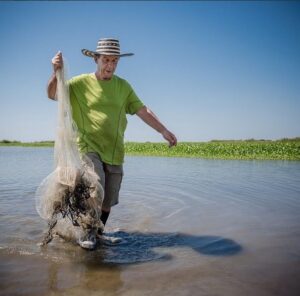
Beloved Colombian ichthyologist Germán Galvis passed away on April 29. He was Emeritus Professor and Curator of the Fish Collection at the Instituto de Ciencias Naturales, Universidad Nacional de Colombia (Bogotá). Two Colombian freshwater fishes have been named in his honor:
Hemibrycon galvisi (Román-Valencia 2000) This tetra (Stevardiidae: Hemibryconinae) occurs in the upper Putumayo River of Colombia. Prof. Galvis was honored for provided funding and comparative material for Román-Valencia’s study.
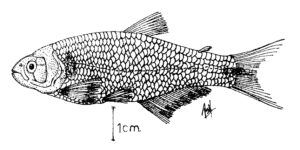
Hemibrycon galvisi, paratype. From: Román-Valencia, C. 2000. Tres nuevas especies de Bryconamericus (Ostariophysi: Characidae) de Colombia y diagnóstico del género. Revista de Biología Tropical 48 (no. 2/3): 449-464.
Apteronotus galvisi de Santana, Maldonado-Ocampo & Crampton 2007 This ghost knifefish (Apteronotidae) occurs in Colombia’s Meta River basin. The authors praised Prof. Galvis for his “vast” contributions to our knowledge of the freshwater fishes of Colombia.
In addition to his work as an ichthyologist, Prof. Galvis taught and mentored many students over the years. One such student is ichthyologist Adela Roa-Varon, now a Research Associate at the National Museum of Natural History, Smithsonian Institution, and the California Academy of Sciences. Dr. Roa-Varon posted this lovely tribute to Facebook last week:
“Germán was my first mentor in ichthyology. I still remember sitting in the front row of his biogeography class, completely fascinated. Then came the fish collection, Fishes of the World, Joseph Nelson, and months of moving jars as a first-semester undergraduate volunteer. One day, he told me, ‘You have trained your arm muscles; now I will train your brain.’
“And he did.
“Germán taught me ichthyology in the most complete way: not only through books and lectures, but through the daily practice of the discipline. He taught me how to collect, fix, and preserve specimens, and to understand why every specimen deposited in a collection matters. He even taught me how to throw a cast net, and eating fish with him was never about the flavor; it was always a ‘name-the-bone’ challenge.
“I will always be grateful for his guidance and for seeing something in me before I fully knew where this path would lead. His legacy lives on in the collections he built and cared for, the students he trained, and the many lives he changed.
“Rest in peace, querido profe.”
29 April
The trouble with Trimma
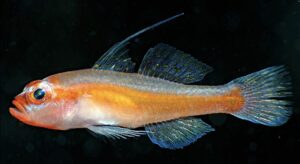
Trimma tufiense, male, paratype, 19.9 mm SL. Photo by Mark V. Erdmann. From: Allen, G. R., M. V. Erdmann, W. M. Brooks and C. Dudgeon. 2025. Two new species of Trimma pygmy gobies (Teleostei: Gobiidae) from Papua New Guinea. Journal of the Ocean Science Foundation 45: 48-65.
Ichthyologists often have trouble spelling names in the goby genus Trimma. There are currently 118 named species in the genus. Of these 118 names, 53 are adjectives. Of these 53, six (11%) were initially misspelled. In Latin, adjectives must adopt the gender of the noun they are modifying. This is a basic rule in zoological nomenclature:
ICZN 3.2. Agreement in gender A species-group name, if it is or ends in a Latin or latinized adjective or participle in the nominative singular, must agree in gender with the generic name with which it is at any time combined.
ICZN 34.2. Species-group names The ending of a Latin or latinized adjectival or participial species-group name must agree in gender with the generic name with which it is at any time combined [Art. 31.2]; if the gender ending is incorrect it must be changed accordingly (the author and date of the name remain unchanged
Trimma, proposed by Jordan & Seale in 1906, is based on the Ancient Greek noun trimma (τρίμμα), meaning “that which is rubbed.” We do not know why Jordan & Seale chose that name, but we know, according to Greek dictionaries, that its gender is neuter.
In 1975, Yoshino & Araga described Trimma caudomaculata from Okinawa Island, Japan. The specific epithet is a combination of caudo– (L.), tail, and maculatus/a/um (L.), spotted, referring to the darkish red blotch at caudal base. But the authors used the feminine spelling of the Latin adjective. The correct spelling for the neuter Trimma is caudomaculatum.
Also in 1975, Allen & Munday made a similar mistake in their description of Trimma rubromaculatus, described from Kimbe Bay, New Britain Island, Papua New Guinea. The correct spelling is rubromaculatum. (A second misspelling, rubromaculata, appears in some publications.)
In 2000, Richard Winterbottom, perhaps the world’s leading expert on Trimma gobies, described Trimma omanensis from the Gulf of Oman. The mistake here involves the Latin adjectival suffix “-ensis,” which means “of or from” and is commonly used in toponymic names, i.e., names that refer to a place where the animal occurs. This Latin suffix is declined differently than Latin adjectives. The masculine and feminine spellings are the same: “-ensis.” The neuter spelling, however, is “-ense.” The correct spelling for the neuter Trimma is omanense.
Winterbottom’s mistake has been repeated by himself and others:
Trimma hotsarihiensis Winterbottom 2009 — described from Hotsarihie, local Tobian name for Helen Reef, Hatohobei State, Palau, type locality (correct spelling is hotsarihiense)
Trimma taipinensis Chang, Shen & Chen 2025 — described from Taiping Island, South China Sea (correct spelling is taipinense)
Trimma tufiensis Allen, Erdmann, Brooks & Dudgeon 2025 — described Tufi area, Oro Province, eastern Papua New Guinea (correct spelling is tufiense)
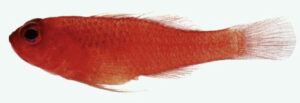
Trimma sanguinellus, 16.7 mm SL, female, paratype. Photo by Richard Winterbottom. From: Winterbottom, R. and L. Southcott. 2007. Two new species of the genus Trimma (Percomorpha: Gobiidae) from western Thailand. aqua, International Journal of Ichthyology (2): 69–76.
Even Eschmeyer’s Catalog of Fishes (ECoF) has trouble with Trimma. The editors overlooked the misspellings of the two Trimma species described last year. (These entries will be corrected in the May edition.) In addition, ECoF unnecessarily “corrected” the spelling of Trimma sanguinellus, described in 2007 by Winterbottom & Southcott from the Andaman Sea off the western coast of Thailand. The authors clearly indicated that the name is a noun derived from the Latin sanguinellus, literally meaning “little blood,” referring to the goby’s red-suffused flesh. ECoF, believing the name to be an adjective, changed the spelling to “sanguinellum.” The spelling will be changed back in the May edition.
I’ve made my share of similar and other errors over the years. I don’t mind being corrected. That means people are paying attention.
Careproctus argosgeorgiae. Composite drawing from fresh and fixed specimen. Drawing by Daniela Álvarez Bravo. From: Villarroel-Perez, M. L., N. V. Chernova, J. J. N. Weston, V. Vukasin and Z. Shcherbich. 2026. A new species of Careproctus (Cottoidei: Liparidae) from the Falkland Plateau, southwestern Atlantic, with COI-based phylogenetic analysis. Zootaxa 5777 (3): 453-470.
22 April
Careproctus argosgeorgiae Villarroel-Perez & Chernova 2026
Careproctus argosgeorgiae is a new species of snailfish (Liparidae) collected at 1680 m from the northeastern Falkland Islands in the southwestern Atlantic Ocean. It is named in honor the F/V Argos Georgia, a longline fishing vessel that sank in the South Atlantic near the Falkland Islands on 22 July 2024, resulting in the loss of 13 lives.
While on route from Stanley in the Falkland Islands to the Patagonian Toothfish fishing grounds near South Georgia, the Argos Georgia encountered severe weather conditions, including waves up to 10 meters and winds exceeding 50 knots (93 km/h). During this time, a starboard side shell door — a hydraulically operated door built into a ship’s hull used for cargo loading and other needs — malfunctioned, descending slowly into the fully open position. The crew was unable to close it. Open doors inside the vessel facilitated the spread of seawater to adjacent compartments. The vessel listed, lost propulsion and drifted in heavy seas. Some crew members were lost during the abandonment and others perished in life rafts during the ongoing search-and-rescue mission. Fourteen crew members survived. The bodies of four crew members remain missing.
 In naming the fish after the vessel, its crew, and all those connected to it, the authors wrote:
“The response to the tragedy reflects the resilience and compassion of the South Atlantic islands community and underscores the human risks of deep-sea fishing in subantarctic and Antarctic waters.”
An interim report on the loss of F/V Argos Georgia, from the Marine Accident Investigation Branch — the UK government organization that investigates all maritime accidents in UK waters and accidents involving UK registered ships worldwide — is available here.
15 April
Fishes and yellow fever
Last week’s entry on fishes named for measles made me curious about fishes named for other diseases. Yellow fever came up several times in my search.
Yellow fever is an infectious viral disease spread by the bite of an infected mosquito. It only affects humans, non-human primates, and, of course, mosquitoes. Yellow fever originated in Africa, where local populations had developed some immunity to it. European explorers, colonists and slave traders who caught the disease usually died. The mosquitoes, and hence the disease, spread to North and South America aboard slave ships (although some evidence exists that yellow fever existed in pre-Columbian America). Scientists hypothesized that yellow fever spread by insect bites in 1848, and confirmed mosquitoes as the vector in the 1890s. Soon after that, scientists and physicians began isolating and locally eradicating the virus through mosquito control. Vaccines were developed in the 1930s.
The following five fishes are not named for yellow fever. Instead, they are named for victims of yellow fever, all of them European mariners or explorers. In fact, all of them were French.
Jean René Constant Quoy (1790-1869) and Joseph Paul Gaimard (1793-1858) were French naval surgeons who served together on several voyages. Like many naval surgeons of the time, they were also naturalists. They scientifically described many of the fishes they caught during their voyages. They apparently dodged the yellow fever virus. Four of their colleagues did not.
Cyphocharax gilbert (Quoy & Gaimard 1824) – a toothless characin (Curimatidae) from coastal drainages of eastern Brazil. Named in memory of M. (Monsieur?) Gilbert, a French naval surgeon who died of yellow fever in the Antilles. (I have not been able to find his first name.)
Cymolutes lecluse (Quoy & Gaimard 1824) – the Sharp-headed Wrasse (Labridae) from the Hawaiian Islands. Named in memory of naval surgeon M. (Monsieur) de Lécluse, who died of yellow fever, presumably aboard the ship from which the holotype was collected. (I have not been able to find his first name.)
Nelusetta ayraud (Quoy & Gaimard 1824) – the Ocean Jacket, a filefish (Monocanthidae) from off the coast of Australia, named in memory of Jean Jacques Victor Ayraud (1789-1821). Quoy & Gaimard said: “The name given to this fish recalls one of the many victims of yellow fever among naval medics. It was in the last epidemic that M. Ayraud died in Martinique, after seeing one of his comrades, an ensign, succumb to the same disease” (translation).
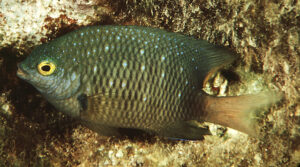
Stegastes lacrymatus. Photo by John E. Randall. Courtesy: FishBase.
Stegastes lacrymatus (Quoy & Gaimard 1825) – the Whitespotted Devil or Jeweled Damselfish (Pomacanthidae), described from the Mariana Islands of Guam. The name is Latin for “having shed tears.” One could surmise that the name refers to the tear-shaped markings on the fish’s side (see photo). But Quoy & Gaimard explicitly said they dedicated this species to the “memory of Monsieur Vidal, a young naval surgeon, who died of yellow fever” (translation).
One more “yellow fever” fish:
Brycon devillei (Castelnau 1855) – This poorly known dorado or jaw characin (Bryconidae), known only from one specimen collected in Bahia, Brazil, is named in memory of French physician, naturalist and taxidermist Emile Deville (1824-1853). He was Castelnau’s “unfortunate travel companion who, having escaped the horrors [e.g., mosquitoes and other insect or spider bites] of Ucayali [River in Peru], died of yellow fever in Rio de Janeiro” (translation).
According to the World Health Organization, an estimated 67,000-173,000 severe yellow-fever infections and 31,000-82,000 deaths occur each year in Africa and the Americas, with most of the burden being in Africa. The potential for international spread to unaffected regions remains a global health security concern.
8 April
Two measly fishes
Now that measles is making a comeback in the USA, here are two fishes named for this highly contagious disease.
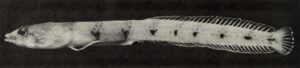
Chaenopsis roseola, holotype, anterior dorsal fin is depressed. From: Hastings, P. A. and R. L. Shipp. 1981. A new species of pikeblenny (Pisces: Chaenopsidae: Chaenopsis) from the western Atlantic. Proceedings of the Biological Society of Washington 93 (4): 875-886.
Chaenopsis roseola Hastings & Shipp 1981 The Flecked Pikeblenny (Chaenopsidae) occurs in the Western Atlantic Ocean from North Carolina (USA) to the Gulf of Mexico and the northwestern Caribbean Sea. Its specific epithet, roseola, is a Neo-Latin word meaning rose-colored or reddish. The name refers to the fish’s rust- or pink-colored flecks (in living adults), which the authors described as reminiscent of roseola (a childhood illness caused by two strains of the herpes virus) or measles.
Rhinogobius boa Chen & Kottelat 2005 This freshwater goby (Oxudercidae) inhabits small boulder-strewn and leaf-littered forest streams in the foothills of northern Vietnam, close to the border of China. The specific epithet boa does not refer to the snake, but to a Latin word for a disease producing red postules, including measles and small pox. The name refers to the red spots on the goby’s cheeks and branchiostegal membrane.
According to Chen & Kottelat, who described Rhinogobius boa, the Latin word boa is derived from boarius or bovarius (bovines), “because Romans used cow-dung to cure measles.” Our resident Greek and Latin scholar, Holger Funk, says this is not quite accurate. He says that bovarius (bovine) is the adjective to bos (cattle). Likewise, the disease boa (measles or smallpox) is derived from bos.
Did the Romans really use cow-dung to cure measles? I don’t know. Chen & Kottelat did not provide a source for this claim. Prominent Roman physicians like Galen and Pliny the Elder prescribed animal dung — including from cows, goats, and dogs — for a wide range of infections and inflammatory conditions. So, it’s possible that cow dung was also prescribed for measles, although that disease (in the modern medical sense of the term) was not a distinct clinical diagnosis in Roman times. It’s possible that the Romans applied stercoraceous (fecal) salves for any kind of febrile rash, measles included.
I hope U.S. Health Secretary Robert F. Kennedy, Jr., doesn’t see this post. Given his predilection for alternative therapies, drinking raw milk, collecting roadkill, and swimming in sewage-contaminated creeks, he may recommend cow dung as a pharmacological option in controlling America’s measles outbreak.
1 April
Speoplatyrhinus poulsoni Cooper & Kuehne 1974
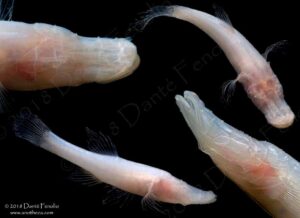 The Alabama Cavefish Speoplatyrhinus poulsoni (Amblyopsidae) is one of the rarest fishes in North America. It is found only in underground pools in Key Cave, in northwestern Alabama. No more than 10 individuals have been observed at any one time. Biologists estimate that fewer than 100 are left. It was discovered underneath a colony of gray bats in 1967 by Robert A. Kuehne and John E. Cooper. The nutrient-rich guano of the bats is essential to its survival.
Kuehne and Cooper scientifically described the fish in 1974, representing both a new genus and species. Speoplatyrhinus is from the Greek spéos, meaning cave, and platýs (flat), and rhinós, genitive of rhís (nose), referring to its greatly flattened snout. For the specific epithet they named the fish in honor of biologist and speleologist Thomas L. Poulson, then with the University of Illinois Chicago, for his “outstanding work with the amblyopsid fishes and for his continuing interest in these animals, their ecology and their evolution.” His 1963 dissertation “Cave Adaptation in Amblyopsid Fishes” is a seminal work in the field. He authored or co-authored several major papers on cavefishes over a 45-year career before his retirement.
Dr. Poulson passed away on March 16, 2026, at the age of 91.
“You can’t study cavefishes and not know who he was,” said Danté Fenolio, Tom’s friend and fellow speleologist.
Danté tells a wonderful story about Dr. Poulson and the fish named in his honor:
“One of my favorite memories of Tom was a visit out to see the fish that is named in his honor, the Alabama Cavefish (Speoplatyrhinus poulsoni). Tom had never seen a live specimen prior to that day. I got to witness his excitement and emotional reaction when a colleague emerged from the cave with a fish to show Tom (by permit and very briefly), before returning it to the cave waterway. His reaction was priceless and his excitement went through the ceiling. Many expletives were had. I loved it. That moment was special.”
Read more about Dr. Poulson’s life and career here.
25 March
Glaridoglanis verruciloba Gong 2025
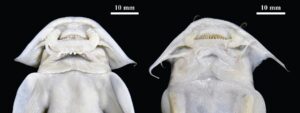
Ventral view of mouth structures of Glaridoglanis verruciloba (left, holotype, 147.8 mm SL) and the closely related G. andersonii (right, 146.5 mm SL). Note presence of wart-like lobes on lower lip of Glaridoglanis verruciloba. From: Gong, Z., H.-S. Wang, Y.-C. Liu and J.-C. Li. 2025. Glaridoglanis verruciloba sp. nov., a new glyptosternine catfish (Siluriformes, Sisoridae) from the Zayul River in southeastern Tibet, China. ZooKeys No. 1262: 289-301.
One quirk of the International Code of Zoological Nomenclature (ICZN) is that it can be unflinchingly strict in the latinized spellings of animal names. But it can also be accommodatingly tolerant. A case in point:
Glaridoglanis verruciloba Gong 2025 is a recently described glyptosternine catfish (Sisoridae) from the Zayul River in southeastern Tibet, China. The specific epithet is derived from the Latin nouns verruca (wart) and lobus (lobe), referring to the verruciform (wart-like) lobes on the central-posterior margin of its lower lip. The compound noun “verrucilobus” (wart lobe) would have been a perfectly acceptable treatment of the name. But the author treats the name as an adjective, wart-lobed, and, per ICZN 31.2 …
A species-group name, if it is or ends in a Latin or latinized adjective or participle in the nominative singular, must agree in gender with the generic name with which it is at any time combined.
… accordingly spells “lobus” as “loba” to agree with the feminine gender of the genus.
Trouble is, “loba” is not the correct adjectival form of the noun “lobus.” The Latin words for “lobed” are lobatus (masculine), lobata (feminine) and lobatum (neuter). From the perspective of a Latin purist, the preferred (correct) spelling of the catfish’s name is “Glaridoglanis verrucilobata.”
The ICZN Code accommodates the fact that not all zoologists are Latin purists. ICZN 32.5.1 stipulates:
If there is in the original publication itself, without recourse to any external source of information, clear evidence of an inadvertent error, such as a lapsus calami or a copyist’s or printer’s error, it must be corrected. Incorrect transliteration or latinization, or use of an inappropriate connecting vowel, are not to be considered inadvertent errors.
The key phrase here is “incorrect latinization.” The author of Glaridoglanis verruciloba incorrectly latinized “lobus” as “loba” in an attempt to turn the noun into an adjective. But that’s okay. In the eyes of the ICZN, an incorrect latinization is considered its “correct original spelling” and “is to be preserved unaltered” …
Except for when ICZN 31.2 comes into play.
Since the author of Glaridoglanis verruciloba identified the specific epithet as an adjective, its spelling is forever contingent upon its generic placement. Should G. verruciloba be reassigned to a masculine or neuter genus, its spelling would need to be changed to verrucilobus or verrucilobum, respectively.
The takeaway is this: You can mangle the Latin language when forming a new animal name. But you better follow the rules of Latin grammar when you do!
18 March
Myxine floyd Mincarone, Kurtz, Di Dario & Gonçalves 2026
Biologists who want to eliminate eponyms because naming species after humans “was and is never right — regardless of good intentions” are probably clenching their jaws with this one. Which is amusing considering that the fish (or fish-like craniate) is jawless.
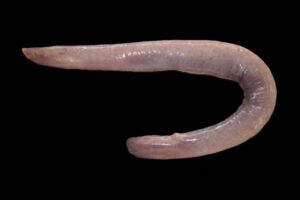
Myxine floyd, holotype, 293 mm TL. From: Mincarone, M. M., Y. R. Kurtz, F. Di Dario and P. R. Gonçalves. 2026. A new five-gilled species of Myxine (Myxinidae) from the western South Atlantic sheds light on the phylogenetic relationships and biogeography of the genus. Zoological Journal of the Linnean Society 206 (3): zlag019: 1-10.
Myxine floyd is a new species of five-gilled hagfish (Myxinidae) from the South Atlantic Ocean, on the continental slope of southern Brazil, off the states of Paraná and Santa Catarina, at depths ranging from 460 to 750 m. It differs from its congeners in several traits, including the total number of teeth cusps, number of anterior and posterior unicusps, number of caudal pores, and color pattern.
The authors named it for the “iconic rock band Pink Floyd, whose groundbreaking musical experimentation, conceptual depth, and artistic innovation have influenced generations of musicians and listeners, including the authors of this paper. The name acknowledges the enduring legacy of the band in pushing creative boundaries into the unfathomable depths of the human mind, an inspiration reflected in the discovery of this distinctive pinkish deep-sea species.”
A species of snapping shrimp, Synalpheus pinkfloydi Anker, Hultgren, De Grave 2017, was named after the band because of its vibrant pink claw and the fact that the sound from its claw can stun or kill a small fish. I asked Michael Mincarone, the lead author of the hagfish paper, if the fish’s pinkish color was a factor in the selection of its name as well. The answer is no. “The pinkish color is a happy coincidence,” he told me. “A good one.”
A spider and a catfish also have Pink Floydian names.
Pinkfloydia Hormiga & Dimitrov 2011 is a genus of tetragnathid spiders from Western Australia. It’s “named after the British psychedelic and progressive rock band Pink Floyd. In its heyday Pink Floyd was an innovative group that created music, which was an eclectic mixture of styles. The band also pioneered the use of very sophisticated lights and lasers in their live shows and often had highly innovative album covers. Pinkfloydia has very unusual morphological features and its name aims to reflect its uniqueness.”
Neoplecostomus watersi Silva, Reia, Zawadzki & Roxo 2019 is a catfish from Goiás, Brazil. It’s named for George Roger Waters (b. 1943), composer, singer and guitar player from Pink Floyd, “for his talent as [a] musician and social awareness around [the] world, [e]specially his brave concerns to Brazilian economic, social and politic[al] issues.”
11 March
Cyttus Günther 1860
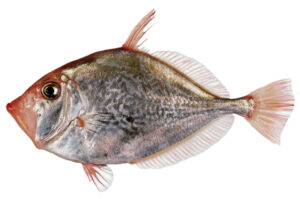
Silver Dory, Cyttus australis. Source: Australian National Fish Collection, CSIRO.
It’s a name that has long puzzled scholars. A typo may be to blame.
Cyttus is the sole genus in the family Cyttidae, large, deep-bodied marine fishes known as Lookdown Dories. There are three species in the family, from the southeast Atlantic to the Indo-West Pacific (e.g., from South Africa to off Australia and New Zealand). Albert Günther of the British Museum said he borrowed the name Cyttus from κυττός, an “unknown fish” mentioned by the Greek author Athenaeus (circa 200 AD).
Here’s what’s puzzling about the name. Not only is the fish κυττός unknown, the very word itself is unknown as well. Κυττός is not attested in any Greek dictionary. Nor does its Latin equivalent Cittulus exist in classical Latin. Our resident Greek and Latin scholar Holger Funk recently researched the history of κυττός. Here is what we know, and don’t know, about this enigmatic name.
Κυττός appeared in Deipnosophistai (Δειπνοσοφισταί, often titled “The Learned Banqueters” or something similar in English) by Athenaeus of Naucratis, an ancient Greek rhetorician and grammarian. The work, set in Rome, recounts a series of banquets in which various literary, historical and antiquarian matters are discussed. In one such discussion, fishes are linked with corresponding Greek deities. Κυττός is said to be sacred to Dionysus, the Greek god of wine-making (equivalent to the Roman god Bacchus).
As stated above, the word κυττός is not recorded from antiquity. Moreover, while various animals associated with Dionysus/Bacchus are known, none of them were fish. “Something doesn’t add up,” Dr. Funk said. The answer might be that κυττός is a misspelling, perhaps by scribe or a typesetter (or a combination of both) for an entirely different kind of organism.
In 1881, classical philologist Georg Kaibel opined that κυττός is a lapsus for κιττός, the Greek word for ivy, especially since vine and ivy are representative attributes of a wine god. There the matter stood for over 125 years, until classics professor S. Douglas Olson (University of Minnesota) published a new translation of Athenaeus’ work in 2008. Olson reopened the discussion on the κυττός–κιττός issue by replacing the reading κιττός with κίττα, Greek for the bird jay. Olson’s underlying assumption was that Athenaeus was primarily concerned with listing deities associated with other animals, and while ivy would not be incorrect in connection with Dionysus/Bacchus, it was not the central theme of the fictional banquet depicted in the work.
Per Dr. Funk: “Olson thus emphasized the general context of the passage (animals associated with deities, not with plants or other things), while Kaibel highlighted the specific point (the pictorial attributes of the wine god Dionysus). Both perspectives are valid. However, it remains difficult to understand to what extent the bird jay can be associated with the wine god.”
“While Dionysius was very peripherally associated with certain birds,” Dr. Funk continues, “it was never with a jay. According to the extensive research literature on Dionysus, he was often associated with a number of quadrupeds, but only very peripherally with birds, and certainly not with the jay.”
I leave the ivy vs. jay debate to the philologists. Instead, I prefer how Günther, either consciously or accidentally, provided a satisfyingly ichthyological solution to the mystery. While Günther credited Athenaeus as the source of Cyttus, he did not explain why he selected that name for the type species, Capros australis Richardson 1843. Initially, I thought that Günther’s selection was arbitrary, that he was simply repurposing a name from Ancient Greek. (Cuvier often did the same.) But then I noticed that Günther included Cyttus and the John Dory genus Zeus in a clade he called “Cyttina.” (Both genera, in different families, are today classified in the order Zeiformes.) I also noticed that in his account of the John Dory, Günther mentioned that it was known by two other common names: Sancti Petri piscis (St. Peter’s fish), and a name that is orthographically similar to κυττός, κιττός, κίττα and Cittulus …
Citula.
A clue or just a coincidence? No one can really know for sure. I’m not suggesting Athenaeus was linking the John Dory, or any dory-like fish, to the Greek god of wine. But the notion does intrigue me.
4 March
Garra widdowsoni (Trewavas 1955)
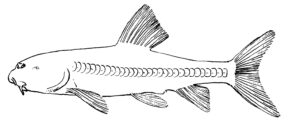
Holotype of Garra widdowsoni. From: Trewavas, E. 1955. A blind fish from Iraq, related to Garra. Annals and Magazine of Natural History (Series 12) 8 (91): 551-555.
This story involves corn flakes and an eyeless, colorless fish from Haditha, Iraq.
A. G. Widdowson was a refrigeration engineer for the Iraq Petroleum Company Ltd. In 1953, he wrote a letter to British writer and explorer Anthony Smith (1926–2014), who had just published a travelogue, Blind White Fish in Persia, recounting his unsuccessful efforts to find blind, white fishes that lived in the qanats of Iran. (Qanats are underground tunnel systems that transport groundwater from mountain aquifers to arid plains in Iran and Iraq.)
Widdowson explained that “he happened down a pot-hole 300 feet deep” in Haditha, where he found a some “blind white fish.” He had read Smith’s book and thought they might be of interest to him. Widdowson said he kept the fish alive “on one corn flake each every other day, but they are now dead.”
Smith sent Widdowson’s note to the Natural History Museum in London. The Museum’s Fish Department contacted Widdowson, suggesting that if he happened to be down the same pot-hole again, he should (in Smith’s words) “refrain from pisciculture in general and corn flakes in particular.” Instead, the Fish Department instructed, Widdowson should “place his catch forthwith inside the tubes of alcohol enclosed for that purpose.”
Widdowson apparently put those tubes to good use. He procured two more specimens and sent them to the Natural History Museum, where they were described by Ethelwynn Trewavas in 1955. She named the species in honor of Widdowson. She also proposed a new genus for the fish, Typhlogarra (typhlós = blind), but recent DNA studies indicate that the species’ closest relative is Garra rufa, so Typhlogarra is now a junior synonym of Garra.
Today, G. widdowsoni is known from three wells near Haditha, connected to underground rivers in the Euphrates River drainage. Once abundant, the species is now on the verge of extinction because of water extraction. It feeds on layers of bacteria and ciliates from rock surfaces and also grazes upside-down from the water’s surface.
Corn flakes do not appear to be part of its natural diet.
As for Anthony Smith, he finally discovered a “blind white fish from Persia” in 1976. See the 4 January 2023 NOTW for the full story (including a link to a fascinating video).
25 Feb.
Lepusigobius pallida or Lepusigobius pallidus?
I’ve made my fair share of spelling and grammatical mistakes over the years, in these posts and in the peer-reviewed papers I’ve written. It’s reassuring to know that I am not alone. Consider this unfortunate mistake in a recently described genus.
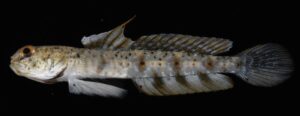
Lepusigobius pallidus. From: Suzuki, T., H.-E. Li and I-S. Chen. 2025. Lepusigobius, a new generic name proposed for Gobiosoma pallida Herre, 1934 (Gobiiformes: Gobiidae) from west Pacific with re-description of the species. Zootaxa 5738 (1): 13-26.
Lepusigobius Suzuki, Li & Chen 2025 is a new genus proposed for Gobiosoma pallida Herre 1934, a goby from the Philippines and Okinawa, Japan. The name is a combination of Lepus, the genus for hares and jackrabbits, referring to the goby’s distinct clefted upper lip, and gobius, goby. The specific name pallida is an adjective meaning pale or colorless, referring, based on Herre’s original description, to the goby’s “old ivory” color in alcohol and/or its “colourless” fins.
In biological nomenclature, Latin or Latinized adjectives must agree with the gender of the genus. In this case: pallidus (masculine), pallida (feminine), and pallidum (neuter). The authors of Lepusigobius correctly state the genus is masculine and correctly spell it pallidus 12 times throughout the paper. Yet the name is also spelled pallida twice, including in the main subject header introducing the new combination: “Lepusigobius pallida comb. nov.” This is where the fish is officially (o-fishily?) renamed. It’s clear the authors know that pallidus is the correct spelling but for some reason their brain-to-finger-to-keyboard connection typed pallida twice, including the most conspicuous and important mention of the name in the text.
I can understand the authors overlooking this mistake. Based on my experience, authors are the worst proofreaders of their own words. (There’s probably a typo above.) But the editor and peer reviewers should have caught it.
It seems this goby is cursed by poor spelling. Even its original name, Gobiosoma pallida, is incorrect. Gobiosoma is a neuter genus. So Herre should have spelled it “pallidum” back in 1934.
18 Feb.
Trichonotus nikii Clark & von Schmidt 1966
Sometimes the authors of a taxon do not tell you the full story behind the meaning or relevance of a name. Trichonotus nikii is a prime example.
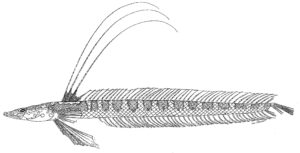
Trichonotus nikii, holotype, 114 mm SL. Illustration by Kay von Schmidt. From: Clark, E. and K. von Schmidt. 1966. A new species of Trichonotus (Pisces, Trichonotidae) from the Red Sea. Contributions to the knowledge of the Red Sea No. 34. Bulletin, Ministry of Agriculture, Department of Fisheries, Sea Fisheries Research Station Haifa No. 42: 29–36.
Trichonotus nikii is a species of sanddiver (Gobiiformes: Trichonotidae) from the Red Sea and Gulf of Aden. It was described by Eugenie Clark and Kay von Schmidt. You may recognize the name of Dr. Clark (1922–2015), most famous as “The Shark Lady” for her pioneering research in shark behavior. See 4 March 2015 NOWT for an overview of her career.
According to the T. nikii description, the fish is named in honor of Niki Konstantinou, the “youngest member on the field trip to the Red Sea” (type locality). When Dr. Clark passed away in 2015, numerous obituaries and tributes were posted online. That’s when I learned the true identity of young Niki and gained a richer understanding of why he was honored.
Niki is Nikolas, Dr. Clark’s youngest son, who was six-years-old at the time. In 1964, while diving near the shore at Eilat, Israel, Dr. Clark spotted a small (20 cm) fish hovering above the sand. When she approached closer, the fish dove into the sand, as all trichonotids do when confronted by predators (hence the common name sanddiver). Dr. Clark dug her fingers into the sand and prodded the fish into a net. She looked up and saw Niki snorkeling nearby. She called Niki over and placed the fish into his dive mask until they could get to shore.
Dr. Clark nicknamed the fish “Tricky Niki” due to its sand-burying behavior. The nickname stuck and inspired the formal scientific name. “Much to my brother’s annoyance,” Nikolas later said.
But there’s more to the story. According to José L. Castro’s book Genie: The Life and Recollections of Eugenie Clark (2020), Dr. Clark and her co-author submitted the description to Copeia (now Ichthyology & Herpetology). The referees rejected it, stating that the species had already been described, and that Clark & von Schmidt had not examined enough specimens. Castro writes, “It is likely they were biased against a woman daring to write a description of a new species without consulting them and daring to name a fish after her son.”
Annoyed, and convinced she had a new species, Dr. Clark submitted the description to an obscure Israeli journal (see image caption). The description was published and the species remains valid to this day.
Dr. Clark never sent an article to Copeia again.
11 Feb.
Linnaeus re-etymologized
Late last year, Mark Sabaj, Collection Manager of Fishes at the Academy of Natural Sciences of Drexel University, sent me a link to an expanded edition of Linnaeus’ Systema Naturae, the starting point of zoological nomenclature, written by German zoologist Philipp Ludwig Statius Müller (the volume on fishes published in 1774). I was unfamiliar with this work and wish I had consulted it years ago because Müller provides explanations for many of the fish names that date to Linnaeus’ foundational treatise.
Linnaeus did not explain the meanings of the names he used in Systema Naturae (the 10th edition of 1758 and the 12th edition of 1766). For several Linnaean names, my ETYFish entries were educated guesses. Thanks to Müller’s work, I am able to bring clarity and historical context to several etymologies. One such etymology, that of Silurus asotus, was the subject of the final NOTW essay for 2025. Here are five more.
Below are my original explanations followed by the revised explanations after consulting Müller’s work.
Muraena helena Linnaeus 1758 … Mediterranean Moray
Muraena helena. From: Bloch, M. E. 1786. Naturgeschichte der ausländischen Fische. Berlin. v. 2: i-viii + 1-160, Pls. 145-180.
ORIGINAL:
etymology not explained, possibly referring to Izaak Walton’s comment that the Romans esteemed this eel as the “Helena of their feasts” (The Compleat Angler, 1653), presumably an allusion to Helen of Troy, the most beautiful woman in Greek mythology (perhaps equating a paragon of beauty with a paragon of palatable pleasure)
REVISED:
etymology not explained; per Müller (1774), named for Helen of Troy, the most beautiful woman in Greek mythology: “Because this fish, due to its black and white marbling, is extraordinarily beautiful, and also has the tenderest and most delicious flesh of all fish, and was therefore considered the most exquisite dish at large banquets among the Romans, it is figuratively called Helena” (translation)
Albula vulpes (Linnaeus 1758) … Bonefish
Albula vulpes (“Vulpes Bahamensis”). From: Catesby, M. 1743. The natural history of Carolina, Florida and the Bahama Islands. v. 2. London: Printed for C. Marsh.
ORIGINAL:
Latin for fox, allusion not explained, possibly referring to its speed (some anglers call them the sprinters of the fish world)
REVISED:
Latin for fox, based on the “Vulpes Bahamensis” of Catesby (1743, The natural history of Carolina, Florida and the Bahama Islands), allusion not explained, possibly referring to its speed (some anglers call them the sprinters of the fish world)
Misgurnus fossilis (Linnaeus 1758) … Weatherfish
ORIGINAL:
Latin for digging or dug up, allusion not explained, probably referring to habit of burying itself in the mud, particularly in cold weather
REVISED:
Latin for digging or dug up, allusion not explained; per Müller (1774), referring to how it “burrows in the swamp and is sometimes found in the swamp after river floods, into which it burrows deeply” (translation)
Clarias batrachus (Linnaeus 1758) … Walking Catfish
ORIGINAL:
from bátrachos (βάτραχος), frog, allusion not explained, perhaps referring to its frog-like ability to leave the water and move across land
REVISED:
from bátrachos (βάτραχος), frog, allusion not explained; per Müller (1774), referring to the frog-like appearance of its head
Synodus foetens (Linnaeus 1766) … Inshore Lizardfish
ORIGINAL:
Latin for smelly or stinking, allusion not explained (Linnaeus examined specimens sent from South Carolina, USA, preserved in rum; perhaps they were in a bad state when he received them)
REVISED:
Latin for smelly or stinking, allusion not explained; per Müller (1774), reflecting the colloquial name “stink salmon,” used by British colonists in 18th-century South Carolina (USA), type locality, referring to its unpleasant odor
4 Feb.
Pimephales vigilax (Baird & Girard 1853)
Bullhead Minnow, Pimephales vigilax. Black Dog Lake, Dakota County, MN, 29 June 2006. Photo by Konrad Schmidt. Courtesy: North American Native Fishes Association.
The United States has arguably the most-studied freshwater fish fauna in the world. Yet the meanings of the names of some U.S. fishes remain obscure. The Bullhead Minnow Pimephales vigilax is a case in point. This minnow, a common baitfish, occurs in the Mississippi River basin and Gulf Slope drainages, where it is usually found in sluggish pools of larger streams that have silty or sandy bottoms, continuous flow, low gradients, and spare vegetation.
Its specific epithet “vigilax” is Latin for watchful or restless. Spencer Fullerton Baird (1823-1887) and Charles Girard (1822-1895) did not explain why they selected the name, nor does their description offer any clue; their brief text is limited to color and anatomic features and does not mention anything about the minnow’s behavior and habitat. Jenkins & Burkhead, in their classic book Freshwater Fishes of Virginia (1994), suggest that the name refers to the vigilance of nest-guarding males. I doubt this explanation because Baird & Girard did not observe the minnow in the wild. The holotype was collected by Randolph B. Marcy (1812-1887) and George B. McClellan (1826-1865) from Otter Creek, a tributary to North Fork of Red River in southwestern Oklahoma. Both Marcy and McClellan were captains in the U.S. Army Corps of Engineers. They collected P. vigilax, and several other species, during an expedition to discover the Red River’s source. I do not know if they provided any field notes. As far as I know, the first behavioral study of Pimephales vigilax was published by Henry L. Parker in 1964, in which the author observed spawning and nest-guarding behavior in aquaria and farm ponds. Parker wrote: “The male protects the eggs from animals small enough to enter the nest to destroy the eggs. He can drive away fish even twice his size.”
In 1856, Girard described another species of minnow from Oklahoma-Texas border that is today considered a subspecies of P. vigilax. He named it Hyborhynchus perspicuus. The specific epithet is Latin for clear, transparent or evident, yet the reason he chose the name is far from clear, transparent or evident.
Interestingly, Girard said that the genus Hyborhynchus (now a synonym of Pimephales) is ”amongst those whose history has most perplexed us.”
In regards to vigilax and perspicuus, we remain perplexed by their names.
Footnote: What does Pimephales mean? Glad you asked. Proposed by Rafinesque in 1820, the name is a combination of pimelḗ (πιμελή), fat, and cephales, from kephalḗ (κεφαλή), head, referring to the head of P. promelas, described as “soft and fat all over,” a clear reference to the fleshy growth on nape of breeding males. Rafinesque twice incorrectly translated name as “Flat-head” in his description of the genus, possibly a typesetting error, but correctly translated it as “Fat-head” in his description of P. promelas.
28 Jan.
Acanthobrama microlepis (De Filippi 1863)
Acanthobrama microlepis from Kura River at Yalnızçam. From: Kaya C, Bayçelebi E, Turan D (2020) Taxonomic assessment and distribution of fishes in upper Kura and Aras river drainages. Zoosystematics and Evolution 96(2): 325-344.
I was surprised to see that the name of this species had recently been changed because of a nomenclatural technicality. The November 2025 edition of Eschmeyer’s Catalog of Fishes (ECoF) reflected this change. I investigated and found evidence that the change was unnecessary. The ECoF editors agreed and changed the name back in their most recent (13 January) posting.
The Caucasian Bream Acanthobrama microlepis is a common species of minnow found in lakes and rivers of the southwestern Caspian Sea drainage basin. Its specific epithet refers to its small scales, 60-82 along the lateral line: micro-, from mikrós (μικρός), small, and lepís (λεπίς), scale. The generic epithet Acanthobrama, proposed by Heckel for A. marmid in 1843, means “spiny bream”: acantho-, from ákantha (ἄκανθα), thorn, referring to the thickened, spine-like, last ray of its unbranched dorsal fin; brama, derived from abramís (ἀβραμίς), ancient name for a bream or mullet.
In the recent book Handbook of Freshwater Fishes of West Asia (a free download), the authors changed the name to Acanthobrama punctulata (Kessler 1877), stating that A. microlepis (De Filippi 1863) is invalid and therefore unavailable for use:
Abramis microlepis is a junior secondary homonym of Alburnus microlepis Heckel, 1843, when placed in Alburnus by Kamensky (1901). It was replaced by Alburnus punctulatus, a former junior synonym, by Berg (1916) and is permanently invalid because junior homonyms and substitute names are still treated as synonyms.
A junior secondary homonym occurs when two identical species-group names, originally described in different genera — in this case Alburnus microlepis Heckel 1843 and Abramis microlepis De Filippi 1863 — are subsequently placed into the same genus, making the later-published (younger) name invalid. The next available name for Abramis microlepis De Filippi 1863 is Alburnus punctulatus Kessler 1877.
This name change didn’t seem right to me. My understanding is that a second-degree homonym can be reinstated if the taxa are placed in different genera. I double-checked the ICZN Code, specifically article 59.3, which reads:
“A junior secondary homonym replaced before 1961 is permanently invalid unless the substitute name is not in use and the relevant taxa are no longer considered congeneric, in which case the junior homonym is not to be rejected on grounds of that replacement.”
Was Abramis microlepis De Filippi 1863 replaced before 1961? Yes. A. microlepis was placed into Alburnus by Kamensky (1901), and replaced by Alburnus punctulatus, a former junior synonym, by Berg (1916). So that provision of ICZN 59.3 applies.
But note that ICZN 59.3 also states that the junior secondary homonym is NOT to be replaced if these two conditions apply: (1) the substitute name is not being used by ichthyologists, and (2) the two competing names are no longer placed in the same genus.
I reviewed the relevant literature and it appears that A. punctulatus has NOT been in use since Berg (1916). In fact, Berg (1949) changed his mind and returned punctulatus to the synonymy of microlepis. As far as I can tell, every reference since 1949 has used A. microlepis over A. punctulatus … that is, until the publication of Handbook of Freshwater Fishes of West Asia late last year.
Note also that the “A. microlepis” homonyms are placed in different genera today: Abramis microlepis De Filippi 1863 is in Acanthobrama, whereas Alburnus microlepis Heckel 1843 remains an available name in Alburnus, where it is currently regarded as a junior synonym of A. sellal Heckel 1843.
Just because the two names were treated as junior secondary homonyms for a short period in the early 20th century doesn’t mean they should be treated that way today.
21 Jan.
Psalidodon paiva Rodrigues-Oliveira, de Assis, Pimentel, Soares, Batista da Silva, Rocha, Menegidio, Pasa & Kavalco 2025
Psalidodon paiva (e) holotype, 62.0 mm SL, and (f) 34.5 mm SL. From: Rodrigues-Oliveira, I. H., P. M. de Assis, L. G. P. Pimentel, R. A. S. Soares, I. Batista da Silva, R. R. Rocha, F. B. Menegidio, R. Pasa and K. F. Kavalco. 2025. Unraveling a 150-year-old enigma: Psalidodon rivularis (Acestrorhamphidae: Acestrorhampinae), a species complex or a polymorphic species? Biology 14: 1-45.
Tomorrow, the Academy of Motion Picture Arts and Sciences will announce the nominees for the 98th Academy Awards, or Oscars. Late month, a new species of fish was named with a connection to a 2024 film that won an Oscar at the 97th Academy Awards. In fact, the film and its Oscar win are mentioned in the section explaining the fish’s name.
Psalidodon paiva is a new species of tetra (Acestrorhamphidae) closely related to the Buenos Aires Tetra P. anisitsi popular in the aquarium trade. It is one of three new species previously identified as P. rivularis but now distinguished by body shape, body measurements, chromosome counts, and DNA. It occurs in the upper and middle São Francisco River basin of Minas Gerais, Brazil.
The species is named in honor of the Paiva family, whose life was “profoundly affected by the imprisonment, disappearance, and execution of the family patriarch, Rubens Paiva, during the Brazilian military dictatorship” in 1971.
 Rubens Paiva (1929-1971) was a Brazilian civil engineer and politician who opposed Brazil’s military dictatorship in 1964. Since his activities and beliefs were deemed subversive by the dictatorial regime, he was arrested by military forces, tortured, and murdered. After Rubens’ disappearance, his wife, Eunice (1929-2018), enrolled and graduated from law school and became a prominent human rights advocate for Brazil’s indigenous peoples and the victims of political repression. Her campaign to open the military dictatorship’s closed records while caring for her five children is the subject of the 2024 film Ainda Estou Aqui (I’m Still Here).
On 23 January 2025, I’m Still Here was nominated for Best Picture, Best Actress, and Best International Feature Film (later winning that Oscar) at the 97th Academy Awards. On the same day, Rubens Paiva’s death certificate was corrected to state that he died from violent causes at the hands of the State. The previous death certificate only stated that he was missing. His body has not been recovered.
14 Jan.
Glyptothorax pulcher Zeng, Lin, Jiang & Chen 2026
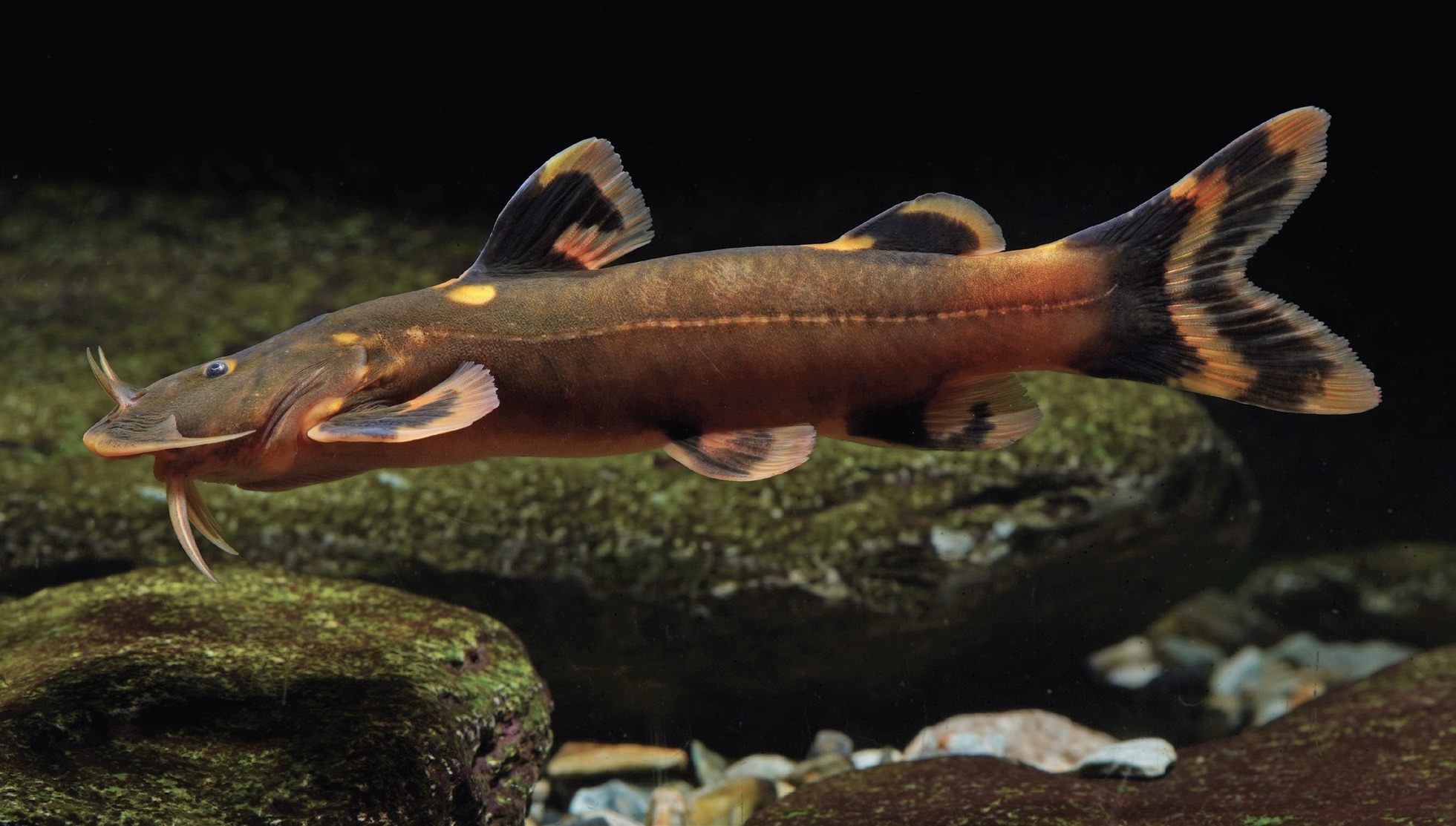
Living view of Glyptothorax pulcher, holotype, 83.5 mm SL. From: Zeng, Y.-Y., F. Lin, H.-F. Yang, X.-R. Pu, W.-S. Jiang and X.-Y. Chen. 2026. Glyptothorax pulcher (Siluriformes, Sisoridae), a new species from the upper Pearl River of Yunnan and Guangxi, southwest China. Zoosystematics and Evolution 102 (1): 17-26.
Every year we highlight the first-described new fish species of the New Year. For 2026 it is Glyptothorax pulcher.
Glyptothorax Blyth 1860 is a genus of small catfishes with a widespread distribution, ranging from the Euphrates and Tigris River Basins in Turkey in the west, to the Yangtze River in China in the east, southwards to Borneo and Java. The name is a combination of two Greek words: glyptós (γλυπτός), engraved, and thṓrax (θώραξ), breast or chest, referring to an adhesive apparatus on the thorax with grooves parallel or oblique to the longitudinal axis of the body. Glyptothorax catfishes — commonly known as hillstream catfishes — use this apparatus to attach themselves to rocks in the fast-flowing streams they inhabit.
Glyptothorax is the largest genus in the family Sisoridae, with 150 species considered valid today. The latest new species, Glyptothorax pulcher, is described from the Tuoniang River, Pearl River Basin, in south-eastern Yunnan Province and western Guangxi Zhuang Autonomous Region, China. Its specific epithet is Latin for beautiful, referring to its attractive color pattern.
By our count, 32 new genera, three new subgenera, and 380 new species of fishes, across 90 families, were described in 2025. Nearly one-third (31%) are from four freshwater families:
Nemacheilidae (Stone or Brook Loaches) … 46 new species
Cyprinidae (Carps) … 26 new species
Sisoridae (Hillstream Catfishes) … 25 new species
Trichomycteridae (Pencil and Parasitic Catfishes) … 22 new species
Note that the first new species of 2026 is from one of these families. Here we go!
7 Jan.
Photoblepharon Weber 1902
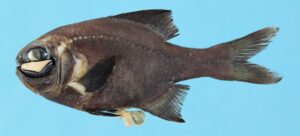
Photoblepharon palpebratum, neotype, 72.6 mm SL. Photo by Daniel Golani. From: Golani, D., R. Fricke and B. Appelbaum-Golani. 2019. Review of the genus Photoblepharon (Actinopterygii: Beryciformes: Anomalopidae). Acta Ichthyologica et Piscatoria 49 (1): 33-41.
In 1967, Israeli soldiers attacked a school of fish. I learned about this last week from Caroline Mason, an ETYFish reader from Tasmania.
Ms. Mason sent me an email pointing out an error in the ETYFish entry for Photoblepharon, a genus of flashlight fishes (Anomalopidae) so called for the patches of living luminescent bacteria underneath their eyes, which they can turn off and on, like a flashlight. They use the light to see by, to communicate, to lure prey, and to confuse predators. The entry incorrectly states that the fish’s eyes, rather than the patches below them, were bioluminescent. The entry now reads:
phōtō– (φωτω-), combining form of phṓs (φῶς), light; blépharon (βλέφαρον), eyelids; Weber was among the first scientists to understand that there is a luminescent patch under each eye and that the fish uses an elastic black skin (functioning like an eyelid) that reveals or conceals this patch, in effect blinking it on and off at will
There are only two species in the genus:
Photoblepharon palpebratum (Boddaert 1781) from the western Pacific Ocean: –atum (L.), provided with: palpebra (L.), eyelid, referring to skin folds that slide up to cover the eyes in the manner of an eyelid (blinking the luminous organs on and off, but this was unknown to Boddaert)
Photoblepharon steinitzi Abe & Haneda 1973 from the western Indian Ocean: in honor of the late Heinz Steinitz (1909–1971), marine biologist and herpetologist (Hebrew University, Jerusalem), who sent specimens to the first author and suggested he describe it
In her email, Ms. Mason included this fascinating anecdote, recalling her days as a volunteer, and later as a Master’s student, for IORL (Israel Oceanographic and Limnological Research, National Institute of Oceanography), which shared the site and facilities at the lab where Heinz Steinitz worked:
“I first came across P. steinitzi in 1980 when I was working at the Heinz Steinitz lab at Eilat. I spent a week sailing my dinghy down the Gulf of Aqaba with a couple of friends. One moonless evening I was brushing my teeth at the water’s edge and a glowing, luminescent blob, about 3m by 2m, drifted past in the water, scaring the bejasus out of me. Back at the lab I recounted the story and was told that it was a school of P. steinitzi that had come to the surface to feed.
“Apparently in the days of the ‘67 war [the Six-Day War, fought between Israel and a coalition of Arab states, including Egypt], Israeli soldiers stationed in Sinai assumed that the glowing patches were a secret Egyptian weapon, and lobbed hand grenades at them – only to find schools of odd little black fish dead on the shore the next day.”
Curious if this incident had been recorded in any journal or history book, I searched my files and found a 1977 article on flashlight fishes from Scientific American magazine written by ichthyologist John E. McCosker of the California Academy of Sciences. His account differs slightly from Ms. Mason’s reminiscence but tells essentially the same story:
“During midnight patrols along the coastline of the Sinai Peninsula after the Six-Day War, Israeli soldiers had observed a faint green glowing mass beyond the coral reef. The soldiers, naturally assuming that they had encountered a team of enemy frogmen, responded by discharging explosives in the glowing shoals. To their surprise the result was a beach littered with the bodies of small, dark fish whose heads continued to blaze with a pair of green, glowing patches.”