NAMES OF THE WEEK from: 2013 2014 2015 2016 2017 2018 2019 2020 2021 2022 2023 2024 2026
31 Dec.
Silurus asotus Linnaeus 1758
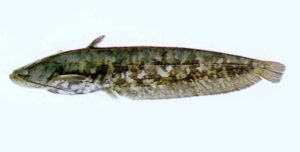
Silurus asotus. Photo by I.-S. Kim. Courtesy: FishBase.
The Amur Catfish Silurus asotus is a carnivorous catfish with a widespread distribution in rivers, ponds of and lakes in China, Japan, the Korean Peninsula, Taiwan, the Amur Basin of Russia, and northern Vietnam. Its name dates from the 10th edition of Linnaeus’ Systema Naturae, the starting point of zoological nomenclature. For fishes, Linnaeus usually borrowed names from his late friend and colleague Petrus Artedi and other early naturalists, but for this fish it appears he coined the name himself after examining a specimen at the Stockholmensis Museum Academiæ Scientiarum. The meaning of the specific name “asotus” is one I’ve struggled with over the years.
In early editions of The ETYFish Project I explained the name this way:
meaning unknown; Jordan & Fowler (1903) say it means “a sot” (i.e., a drunkard), while Latin dictionaries give varying definitions (e.g., lost, profligate, debauched)
In later editions I reworked the explanation:
presumably from ásōtos (ἄσωτος), lustful, licentious, profligate, debauched or dissolute, allusion not explained, perhaps referring to its numerous teeth (“Dentes numerosi”); Jordan & Fowler (1903) say it means “a sot” (i.e., a drunkard)
Last week, Mark Sabaj, Collection Manager of Fishes at the Academy of Natural Sciences of Drexel University, sent me a link to an expanded edition of Systema Naturae written by German zoologist Philipp Ludwig Statius Müller (the volume on fishes published in 1774). I was unfamiliar with this work and wish I had consulted it years ago since it provides explanations for many of the fish names that date to Linnaeus’ foundational treatise. Müller explained the meaning of “asotus” this way (translated from German):
“The name asotus, which means glutton or gourmand, probably refers to the large mouth and voracious nature of this fish.”
Are any of these explanations correct? That depends on how you translate “asotus.”
According to our resident Greek and Latin scholar Holger Funk, the Latin “asotus” is a loanword from the Greek ἄσωτος, meaning a spendthrift (one who spends money in an extravagant, irresponsible way) or a profligate (a licentious, dissolute person). In Latin, Dr. Funk says, the name describes a debauchee or libertine, one given to excessive indulgence in sensual pleasures (but not specifically a drunkard, as suggested by Jordan & Fowler). Achilles Valenciennes, in the 14th volume of Histoire naturelle des poisons (1840), defines “asotus” as “débauché,” which can be translated as both a noun (profligate) ans an adjective (debauched). Valenciennes added that Linnaeus’ reasons for choosing “asotus” as the name “remain unclear” (translation).
And they remain unclear to this day.
All definitions of “asotus” suggest a person who does something in excess, which, when applied to this catfish, could refer to its carnivorous habits. As stated by Müller (but not by Linnaeus), Silurus asotus, like others members of the genus, has a large mouth. The comment about its “voracious nature” is an educated guess. Linnaeus, examining a museum specimen, did not observe the species in the wild, but based on its large mouth and “Dentes numerosi” one can easily and correctly infer that it’s a gluttonous predator, much like its congener Silurus glanis, which Linnaeus no doubt encountered in Sweden.
What about Jordan & Fowler’s explanation that “asotus” means “a sot” or drunkard? According to the Oxford English Dictionary, “sot” is derived from the Medieval Latin sottus, which originally meant a stupid or foolish person in Old English. Its meaning in English shifted over time to mean a person who is habitually or chronically drunk. In addition, “assott” (also spelled “assot”) is an archaic British verb meaning to stupefy, muddle, or captivate, often with drink or infatuation, making someone foolishly obsessed or doting. My guess is that Jordan & Fowler were fooled by the deceptive resemblance of the Latin “asotus” with “sot” and “assott.” Who knows, maybe they were besotted with drink when they penned that explanation.
Here is the new ETYFish entry for Silurus asotus:
presumably from ásōtos (ἄσωτος), meaning a spendthrift or profligate in Greek and a debauchee or libertine in Latin, allusion not explained but perhaps referring to its gluttonous feeding behavior as inferred by its large mouth, numerous teeth and known voracity of the related S. glanis; Jordan & Fowler (1903) say it means “a sot” (from the Medieval Latin “sottus,” a stupid person or fool, especially one who is habitually drunk), perhaps based on the deceptive resemblance of the false Latin cognates “asotus” and “sottus”
24 Dec.
Epizon Campbell & Finger 2025
“Desert fishes rule: To boldly thrive where no other fish can make it!” — Peter Unmack
Making conversation with the person seated next to me on a flight to Arizona, I mentioned that I was heading out to the desert to observe desert fishes. I could see my fellow passenger’s brain skip a beat as he processed this information. Then, trying not to look too surprised (or too stupid), he asked matter-of-factly, “There are fish that live in . . . sand?”
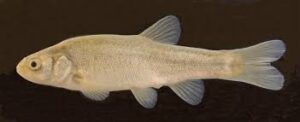
Epizon alvordensis. Photo by Doug Markle, Oregon Department of Fish & Wildlife.
Once I explained to my fellow airline passenger that desert fishes do live in water, he followed with another question: How did fish manage to get into the desert? It’s an obvious question, but it assumes that the desert was there first. Not so. Fact is, the deserts of western North America were once a much different land, characterized by a cooler, wetter climate, woodlands and prairies, and massive glacier-fed lakes and rivers teeming with fishes. Over the last few million years the region’s climate gradually shifted towards increased aridity as mountain ranges continued to rise. Simply put, these mountains rose so high that they began to intercept the eastward flow of moisture from the Pacific Ocean. Water falling on their slopes ran back to the sea, while permanent cells of high atmospheric pressure forced dry, warmer air down the mountains to remove even more water from the land. Meanwhile, shorter cycles of climate change were also taking place. The retreat of glaciers from the region about 10,000 years ago prompted a drying trend in which the lakes contracted and disappeared. As waters receded, their fishes became segregated as one valley after another was cut off from what was once an interconnected system of waterways. The waters that survive to this day—desert streams, springs, marshes and lakes—are veritable “islands” in a “sea” of desert. The fishes that live in them are survivors as well.
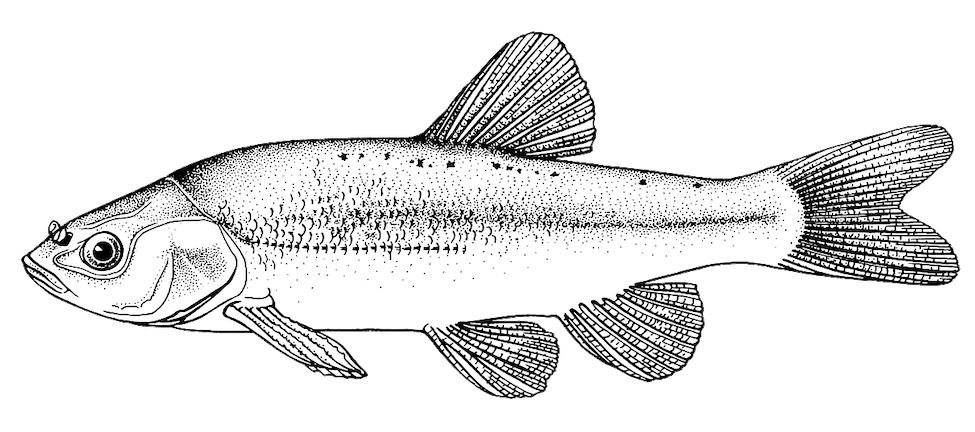
Epizon boraxobius, holotype, tuberculate male, 50.6 mm SL. Illustration by Bonnie Hall. From: Williams, J. E. and C. E. Bond. 1980. Gila boraxobius, a new species of cyprinid fish from southeastern Oregon with a comparison to G. alvordensis Hubbs and Miller. Proceedings of the Biological Society of Washington 93 (2): 291-298.
Two such survivors are the Alvord Chub Siphateles alvordensis (Hubbs & Miller 1972) and the Borax Lake Chub Siphateles boraxobius (Williams & Bond 1980). The Alvord Chub is endemic to the Alvord Basin (hence its name), a desert ecosystem that stretches across southeastern Oregon and northwestern Nevada. The Borax Lake Chub occurs only in Borax Lake (its name means “living in borax”), a small lake of the Alvord Basin in Harney County, Oregon. In fact, it’s the only fish that occurs in the lake, which contains high concentrations of borax (sodium borate), as well as arsenic and lead. Parts of the lake itself can reach 38°C fed from thermal springs, with the average temperature ranging between 16–35°C. The chub, however, avoids the warmest water, favoring the lake’s outflows.
Ichthyologists have suspected that S. alvordensis and S. boraxobius warrant their own genus since at least 2012. Last month, a team of researchers published molecular evidence that these two species represent a deeply diverged lineage from all other fishes classified within Siphateles, and proposed a new name to contain them:
Epizon, from επιζών, Greek for survivor, referring to the persistence of this genus in the “diverse and challenging” desert habitats where it occurs.
17 Dec.
Vanderhorstia supersaiyan Koeda, Hirasaka & Sato 2025
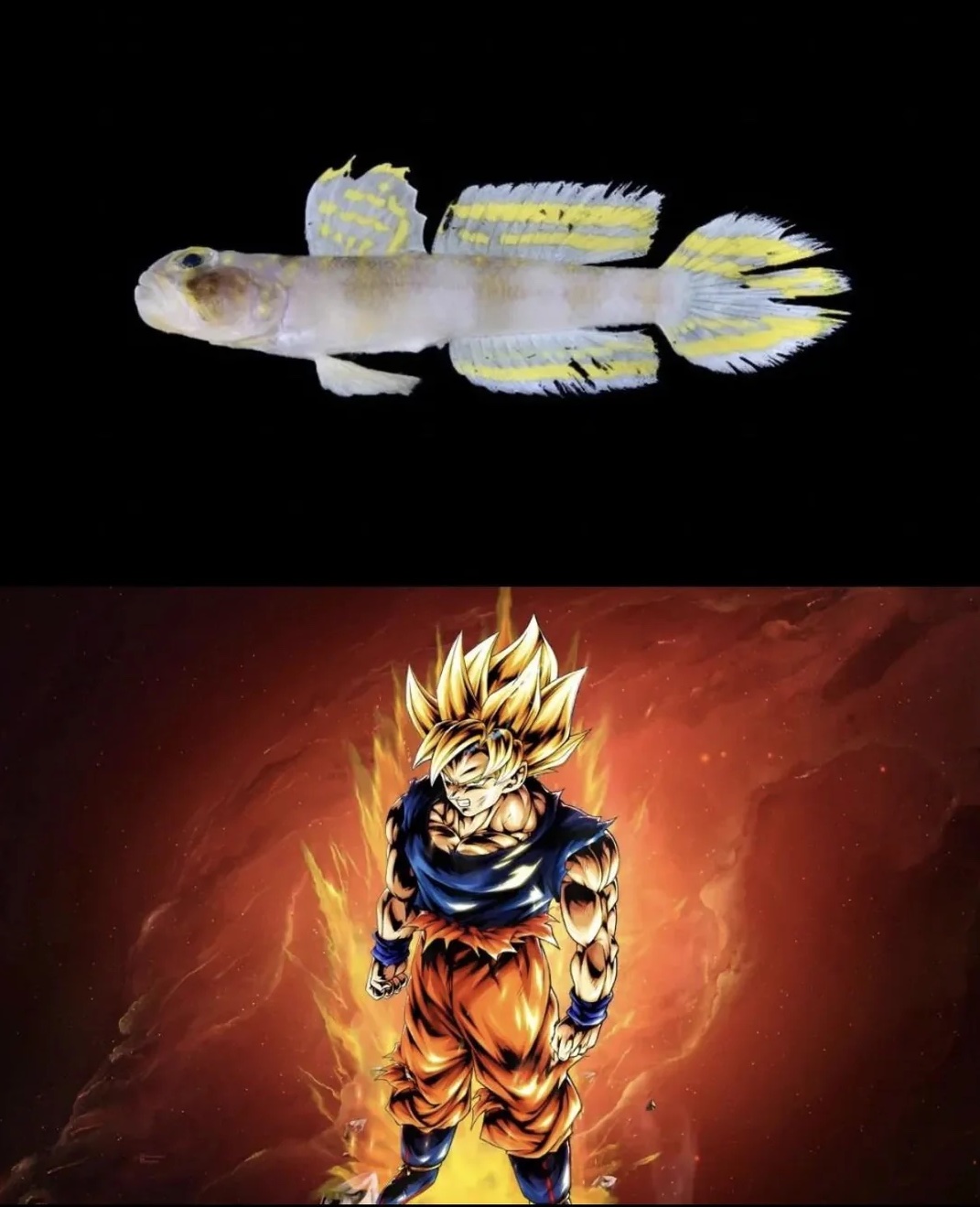
Vanderhorstia supersaiyan, holotype. From: Koeda, K., H. Hirasaka and M. Sato. 2025. Vanderhorstia supersaiyan sp. nov. (Perciformes: Gobiidae) collected from the twilight zone off Ishigaki‐jima Island, Okinawa, Japan. Ichthyological Research. Early view: [1-7].
Vanderhorstia supersaiyan is a new species of goby described from a single specimen (77.0 mm in standard length) collected from 210 m depth off Ishigaki-jima Island, Okinawa, Japan. The new species has two distinct yellow longitudinal stripes on the second dorsal, anal, and caudal fins, which are unique features within the genus.
Because of its unique bright-yellow color, the goby is named after “Super Saiyan,” a fictional transformation from the “Dragon Ball” manga series, famous for its golden yellow hair and glowing aura.
Vanderhorstia supersaiyan isn’t the first time the name of a fish — or fish-like craniate — has been inspired by an anime franchise. Last month, paleontologists described Pochitaserra, a new genus of sawshark (Pristiophoride) from fossil microremains from the Upper Miocene of northern Chile. The name is a combination of serra, Latin for saw, and Pochita, the name of the main character, also known as the Chainsaw Devil, from the hit anime series “Chainsaw Man.” The name was chosen because both sawsharks and the character have elongated, saw-like snouts.
 10 Dec.
Eigenmannia wazowskii Uliam, Ribeiro & Dutra 2025
There are fishes named after characters from Star Wars. The Lord of the Rings. Dr. Who. The Hitchhiker’s Guide to the Galaxy. Batman. Now we can add a new franchise to the list. Monster’s Inc.
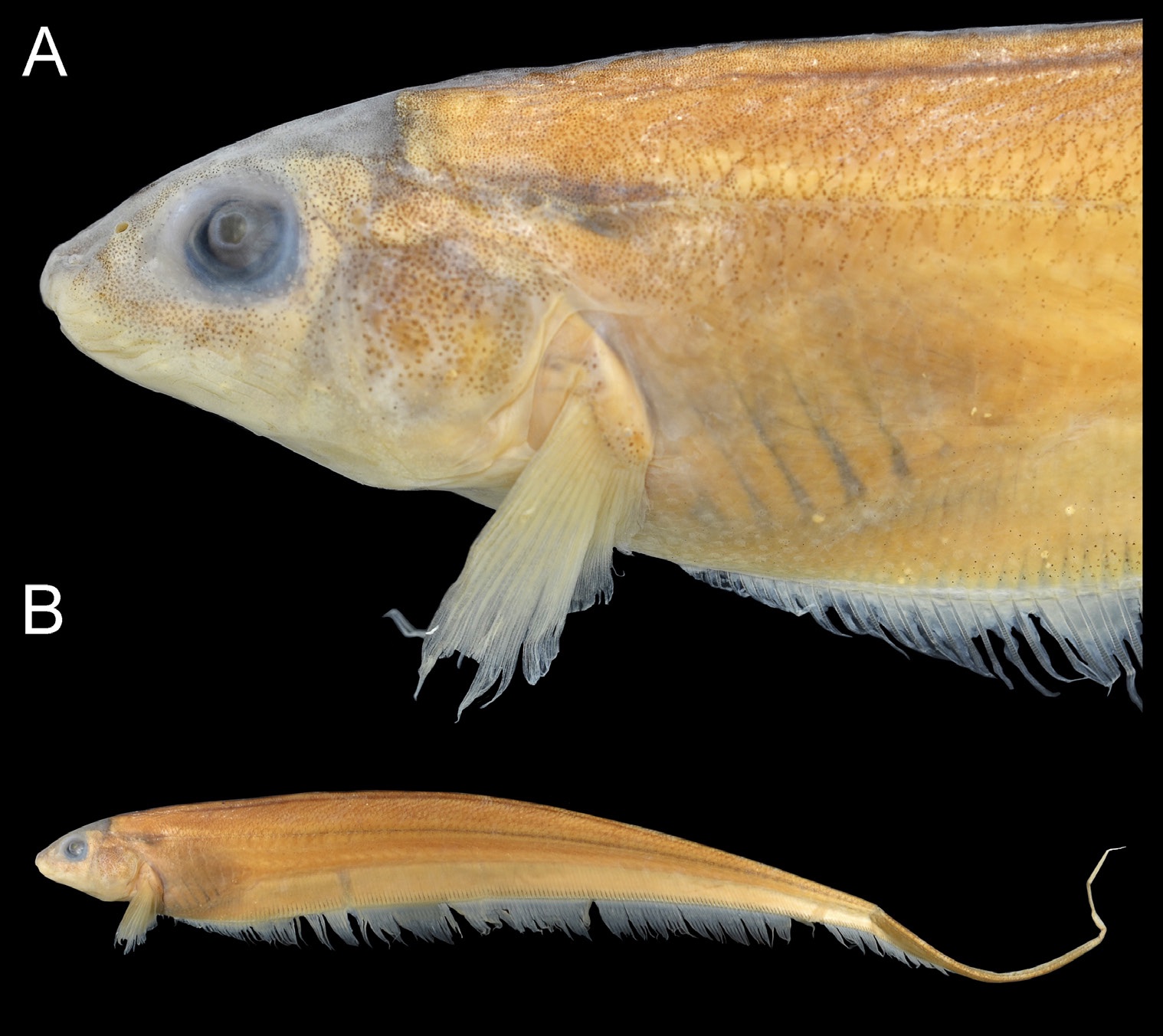
Eigenmannia wazowskii, holotype, 180.9 mm LEA (= length to end of anal-fin base). From: Uliam, M. I. M., H. P. A. Ribeiro and G. M. Dutra. 2025. Description of a new species of glass knifefish genus Eigenmannia (Gymnotiformes: Sternopygidae) from the rio Negro basin, Brazil. Neotropical Ichthyology 23 (3): e250004: 1-18.
Eigenmannia wazowskii is a new species of glass knifefish (Sternopygidae) from the rio Negro basin of Brazil. It is distinguished from its congeners, in part, by its large eyes, with a diameter corresponding to 22.0–29.3% of head length, the fourth largest eyes in the genus.
The species is named for Mike Wazowski, a character from the Disney/Pixar “Monsters. Inc.” franchise, which, like this knifefish, has a large eye.
If I could travel back in time and ask Carl Linnaeus, the “father of modern taxonomy,” his opinion of naming animals after fictional characters in movies, I know precisely what he’d say.
“What’s a movie?”
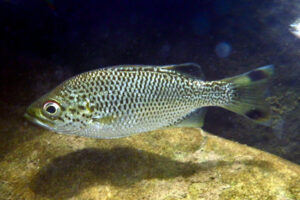
Kuhlia rupestris in the Yuchingawa River, Iriomotejima Island, Japan; photo by Yuichi Kano. Courtesy: Wikipedia
3 Dec.
Kuhlia rupestris Lacepède 1801
Kuhlia rupestris (Kuhliidae), often known as the Rock Flagtail, is a catadromous species native to the Indo-Pacific and northern Australia. Like other members of the family, there is a black blotch or bar on each lobe of the caudal fin, hence the common name “flagtail.” This species entered the scientific literature as Centropomus rupestris, proposed by the French naturalist Bernard Germain de Lacepède in 1801. Lacepède based his description on unpublished notes written by French naturalist Philibert Commerson (also spelled Commerçon), who collected the fish in September 1771. The specific name rupestris is Neo-Latin for “living among rocks,” based on the vernacular name Commerson provided in his notes: “Le poisson de roche à Bourbon.” (Bourbon is an old name for the island now known as Réunion in the Mascarenes; roche is French for rock.)
When I first added Kuhlia rupestris to the ETYFish Project website several years ago, I was not sure why Commerson penned the “Le poisson de roche” epithet. Since I knew that the fish occurred among lava rocks in the tidal pools surrounding Réunion and entered freshwater streams to spawn, I wrote: “allusion not explained, perhaps referring to its occurrence in rocky freshwater streams or pools of Réunion, western Mascarenes, type locality.” Consulting Commerson’s unpublished notes and manuscripts, housed at the Muséum national d’Histoire naturelle, might confirm the meaning of the name. But a trip to Paris is not in the ETYFish budget.
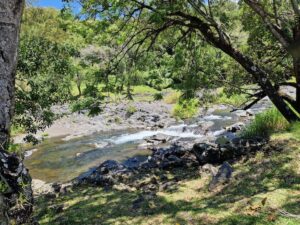
Ravine du Gol, Reunion Island, type locality of Kuhlia rupestris. Photo by Ronald Fricke.
Last year I learned that ichthyologist Ronald Fricke is studying Commerson’s unpublished materials. Dr. Fricke confirmed for me that “Le poisson de roche” refers to the rocky freshwater habitat of the type locality, Ravine du Gol. Commerson collected the fish on his way to the volcano Piton de La Fournaise, which was erupting at the time. The weather was poor, the ascent difficult, and the expedition endured pouring rain for several weeks. Commerson contracted a severe lung infection, which was later the cause of his death on 13 March 1773, at the age of 45. Dr. Fricke also shared a photograph of the Ravine du Gol type locality (shown here), which he took during a visit to La Réunion in October 2024. As you can see, it’s a rocky stream.
The first of Dr. Fricke’s three papers on Commerson’s contributions to ichthyology is expected to be published later this month.
What does “Kuhlia” mean? Glad you asked. American zoologist Theodore Gill (1837–1914) assigned Centropomus rupestris to a new genus, Kuhlia, in 1861. The Latin suffix “-ia” is often used to form taxonomic names when appended to the name of a person, in this case German zoologist Heinrich Kuhl (1797–1821), who collected and provided a manuscript description of the type species Kuhlia ciliata (now regarded as a junior synonym of K. rupestris). Fun fact: Heinrich Kuhl is also the name behind the “Coolie” Loach, Pangio kuhlii.
My thanks to Ronald Fricke for sharing his photograph and unpublished Commerson material.
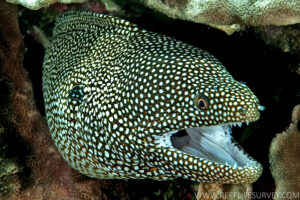
Guineafowl Moray Gymnothorax meleagris at Lord Howe Island, Australia. Photo by Ian V. Shaw / Reef Life Survey. Source: https://fishesofaustralia.net.au
26 Nov.
Guineafowl fishes
Tomorrow is the day when Americans celebrate Thanksgiving, an annual practice of giving thanks for the blessings of a successful harvest. The centerpiece of the American Thanksgiving feast is a roasted domesticated variety of the Wild Turkey Meleagris gallopavo Linnaeus 1758, an upland game bird native to North America. The turkey’s generic name Meleagris is also used in the names of eight fishes:
- Gymnothorax meleagris (Shaw 1795), a moray eel from the Indo-Pacific
- Hypostomus meleagris (Marini, Nichols & La Monte 1933), a “pleco” or suckermouth catfish from Brazil
- Paraplesiops meleagris (Peters 1869), a spiny basslet from Australia
- Istiblennius meleagris (Valenciennes 1836), a rockskipper blenny from the western Pacific
- Anampses meleagrides Valenciennes 1840, a wrasse from the Indian Ocean
- Macropharyngodon meleagris (Valenciennes 1839), a wrasse from the Indo-Pacific
- Arothron meleagris (Anonymous 1798), a puffer from the Indo-Pacific
- Ostracion meleagris Shaw 1796, a boxfish from the eastern Pacific
Are these fishes named for the turkey I am going to cook and eat tomorrow? The answer is “No.”
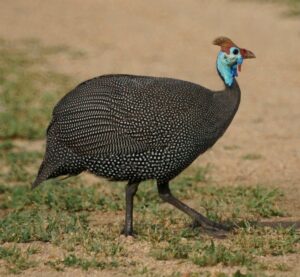
Helmeted Guineafowl Numida meleagris in Kruger National Park, South Africa. Source: Wikipedia.
The word “meleagris” is from the Ancient Greek μελεαγρίς, meaning guineafowl. According to Greek mythology, when Meleager, the king of Calydon, was killed, Artemis, the goddess of the hunt, turned the king’s grieving sisters into guineafowl to ease their suffering. But the sisters never stopped grieving over their dead brother. Their relentless weeping left small white spots on their grey plumage. These white spots are the main color characteristic of the Helmeted Guinea Fowl Numida meleagris Linnaeus 1764, an African species that was domesticated 2,000 years ago and introduced into ancient Greece by the 5th century BC. All of the fishes mentioned above have a color pattern reminiscent of the bird.
Even though the Wild Turkey of North America is not spotted, Linnaeus chose the generic name “Meleagris” anyway because he believed the bird was the New World equivalent of Numida meleagris (which Linnaeus would formally name six years later). Today, the two birds are classified in different families but both belong to the Order Galliformes, heavy-bodied terrestrial birds with around 290 species, including chickens, quails, partridges, and pheasants.
The etymology of “turkey” is interesting as well, and, yes, has a distant historical connection with country that also bears that name. “Turkey” is derived from the Medieval Latin term “Turcus,” Anglicized as “Turks,” a demonym for people from the Ottoman Empire, which originated in Anatolia, a region that now makes up the majority of the land area of Türkiye. As it turns out, the Ottoman Empire was a major source for guineafowl imported into Europe. Europeans called the bird “turkey-cock” or “turkey-hen” because it came from the Turks. When European settlers in North America began sending a similar-looking fowl back to Europe, they called them “turkeys” out of familiarity.
If you’re hosting or attending a Thanksgiving feast tomorrow, feel free to use the information here to impress your family and friends with your knowledge of turkey etymology.
19 Nov.
The case of Labeo ngqikai
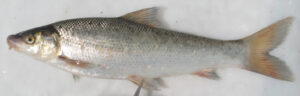
Freshly collected specimen of “Labeo ngqikai” from the Kat River, 185 mm SL. From: Ramoejane, M., F. Zarei, X. Mathebula and A. Chakona. 2025. On the conflict between science and ethics: the case of the moggel, Labeo umbratus (Teleostei:Cyprinidae) from South Africa. Journal of Fish Biology Early view: 1-13.
Last week, four ichthyologists from South Africa and the Journal of Fish Biology openly defied the International Commission of Zoological Nomenclature by publishing a new name for a South African fish whose original specific epithet is offensive to South Africans. According to the paper, Labeo cafer Castelnau 1861 should be replaced by Labeo ngqikai Ramoejane, Zarei, Mathebula & Chakona 2025.
In the 18th and 19th centuries, caffer (also spelled cafer) was a Neo-Latin term for an inhabitant of the Eastern Cape of South Africa, historically known as Kaffraria. In Afrikaans, especially during the Apartheid era, the word took on its modern-day usage as a racial slur, the South African equivalent of the “n-word” in the United States. In 2000, the parliament of South Africa passed laws forbidding hate speech, including the use of this word. Both the generic and specific names of the South African goby Caffrogobius caffer (Günther 1874), inoffensive when they were proposed, now evoke this ugly word. Other animals from southern Africa also have similarly derived names, including (not an exhaustive list) …
- Cape Sugarbird Promerops cafer (Linnaeus 1758)
- African Buffalo Syncerus caffer (Sparrman 1779)
- a tussock-moth Otroeda cafra (Drury 1782)
- Southern African Wildcat Felis lybica cafra (Desmarest 1822)
- a damselfly Pseudagrion caffrum (Burmeister 1839)
- Bushveld Pipit Anthus caffer Sundevall 1850
- Transkei Dwarf Chameleon Bradypodion caffer (Boettger 1889)
Hundreds of plants have similar names (more on that below).
In 2020, biologists began to seriously debate the pros and cons of retroactively replacing biological nomina deemed offensive or misaligned with contemporary values. In 2023, the International Commission of Zoological Nomenclature (ICZN) weighed in on the issue, saying that although “some scientific names might cause discomfort or offence to parts of the community (such as eponyms of dictators or historical figures considered by some as racists, or because a word currently has negative connotations), the commitment to a stable and universal nomenclature remains the priority.”
According to the authors who proposed Labeo ngqikai, the key words in the ICZN statement are “stable” and “universal.” Unlike the animal names listed above, all of which are considered valid and being used today, Labeo cafer Castelnau 1861 had been sunk into the synonymy of Labeo umbratus (Smith 1841) and hadn’t been used since at least 1963. It was only when the authors’ molecular evidence and detailed morphological examinations revealed that specimens of L. umbratus from the Kat River of South Africa warranted recognition as a separate species that the L. cafer name resurfaced. This species was named by French naturalist Francis de Castelnau (1810–1880) in 1861. He wrote that he found the fish in the “river that runs through the Cat-River Settlement, northwest of Kaffraria” (translation). Clearly, there was no offensive intent in Castelnau’s selection of the name. According to the ICZN’s Principle of Priority, the oldest available name for a species — in this case, Labeo cafer Castelnau 1861 — is its correct and valid scientific name.
Had Castelnau given the species a different name — Labeo nataensis, for example — the authors probably would have resurrected it without hesitation. But “cafer” understandably caused them concern. Since the epithet had not been in use, they believe that replacing it does not run afoul of the ICZN’s desire for a “stable and universal” nomenclature: “We see no nomenclatural stability in resurrecting a name that is both offensive and long forgotten, and we argue that retaining such a name undermines universality because it conflicts with ethical and cultural acceptance in the region of endemism.” They accordingly rejected the “derogatory” Labeo cafer and replaced it with Labeo ngqikai “to ensure both nomenclatural stability and cultural sensitivity.” The new name honors King Ngqika (1779–1829), the leader of the Rharhabe-Xhosas, who were the first to settle in the Kat River valley in the early 1800s and probably used this fish for food.
So, if Labeo cafer is a “long forgotten” name, then what’s the harm in replacing it? I’ve shared my thoughts against revisionist nomenclature in previous NOTWs and my essay on the subject, so I won’t repeat them here. For me, the problem is more than replacing “cafer” with “ngqikai.” It’s also replacing “Castelnau 1861” with “Ramoejane, Zarei, Mathebula & Chakona 2025.” This is not to dismiss or diminish the fine scientific contribution of the authors. Nor do I downplay the cultural sensitivities of dealing with an offensive name. I simply dislike the fact that Castelnau’s contribution — he was, after all, the first to scientifically describe the species — is effectively being buried from the nomenclatural record.
I wish the authors had at least suggested the compromise now being used by botanists. In July 2024, at the International Botanical Congress, botanists voted, 351 in favor and 205 against, to change the names of all plants, fungi and algae derived from caffra to derivatives of “afr” (e.g., affra, afrorum, afrum), thereby continuing to denote their African origins. These changes, effective 2026, are expected to affect 218 validly published names of vascular plants and bryophytes, 13 names of algae, and 70 names of fungi. Yes, the names are being changed. But at least it’s a subtle change, simply removing the “c.” And the names retain much of their original meaning. More importantly, the authors and dates of the original names remain unchanged. Nomenclatural stability wobbles a bit, but nomenclatural history is preserved.
I don’t follow the names of other animal taxa very closely. As far as I know, the proposal to rename Labeo cafer to Labeo ngqikai is the first direct challenge to the ICZN’s stance against ethics-based named changes to appear in a reputable, peer-reviewed scientific journal. (Please let me know if there are others.) Critics of revisionist nomenclature, myself included, evoke the “slippery slope” warning: If the name of Labeo cafer is to be erased, then will the names of the animals listed above eventually be erased as well?
It will be interesting to see if “Labeo ngqikai” is accepted by other ichthyologists. (As of 11 November, the name is rejected by Eschmeyer’s Catalog of Fishes in favor of Labeo cafer.) It will also be interesting to see if the ICZN’s new (as of 2025) board of Commissioners will readdress the issue of offensive names, and “cafer”-derived names in particular, in future amendments to or editions of the Code. If the ICZN followed the lead of botanists, I would not disapprove of Labeo cafer Castelnau 1861 becoming Labeo afer Castelnau 1861.
12 Nov.
Acnodon oligacanthus (Müller & Troschel 1844)
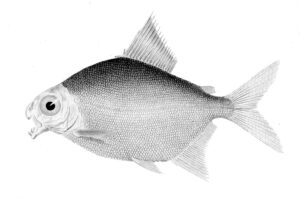
Acnodon oligacanthus. From: Müller, J. and F. H. Troschel. 1845.Horae Ichthyologicae. Beschreibung und Abbildung neuer Fische. Die Familie der Characinen. Erstes und Zweites Heft. Viet & Comp., Berlin. Nos 1 & 2: 1-40, Pls. 1-11.
I dislike making mistakes. But I love it when readers care enough to let me know when I erred and help me set the record straight.
Last week, ichthyologist Donald C. Taphorn emailed me questioning my explanation for the specific name of Acnodon oligacanthus. Commonly known as the Slender (or Sheep) Pacu, this herbivorous member of the piranha family Serrasalmidae occurs in the Maroni and Mana rivers of French Guiana and the Marowijne and Suriname rivers of Suriname.
I had explained the specific name this way: olígos (ὀλίγος), little, small or few; acanthus (L.), from ákantha (ἄκανθα), thorn, referring to its small (and easily overlooked) predorsal spine.
Dr. Taphorn wrote: “So, given that the authors believed there was NO predorsal spine, I think the explanation of the species name, oligacanthus, is in error. Since the authors believed it lacked a predorsal spine, it isn’t logical to presume that the species name referred to a small predorsal spine. I think rather, it refers to the few abdominal serrae. Unlike many if not most other serrasalmids, they have no prepelvic serrae, and only seven or so, behind the pelvics. So, since we can’t ask the authors what they really meant, I think it more reasonable to assume they were referring to the relatively small number of abdominal serrae, not a small predorsal spine (which they thought was absent entirely).”
Müller & Troschel described the species as Myleus oligacanthus in 1844 (republished with an illustration, shown here, in 1845). As per their custom, they did not provide an etymology. Instead, one must infer the meaning of the name by linking a literal translation of the name with a character mentioned in the description. After receiving Dr. Taphorn’s email, I double-checked Müller & Troschel’s description. Sure enough, they made no mention of a small or absent predorsal spine. But they did mention the prepelvic serrae: “Simple abdominal spines before ventral fins none, after ventral fins 7” (translated from Latin).
If Müller & Troschel did not mention a predorsal spine, then why did I consider it for the etymology of the name? I don’t know. I first researched the etymologies of piranha and pacu names 13 years ago, in 2013, so I cannot remember what led me astray. I may have been fooled by Müller & Troschel’s use of the Latin noun acanthus, meaning thorn or spine. So maybe I looked for a spine — specifically a fin spine — overlooking the obvious connection to the thorn-like serrae on the abdomens of all serrasalmid species.
Based on this new explanation for the oligacanthus epithet, I took another look at the generic name Acnodon, proposed by Carl Eigenmann in 1903. I had explained it in the same incorrect way: “ἀ-, Greek privative, i.e., without; knṓdōn (κνώδων), projecting teeth on the blade of a hunting spear, presumably based on the false impression that A. oligacanthus lacks a predorsal spine (it is small and easily overlooked).”
Unlike Müller & Troschel, Eigenmann did in fact mention the predorsal spine or, more accurately, its absence: “No predorsal spine.” Checking more recent accounts of the species, I learned that the predorsal spine is not absent but small and easily overlooked. So maybe that’s why I referenced the predorsal spine in my explanations. But once again I overlooked the obvious: Eigenmann said, “No abdominal serrae in front of the ventrals.” The “nodon” part of Acnodon — the teeth on the blade of a hunting spear — is clearly referring to the relatively small number of abdominal serrae on the fish’s abdomen. None before the ventral fins and only 5–9 or so behind them.
Long story short, I got it wrong. Thirteen years later, thanks to Dr. Taphorn, the ETYFish entries for Acnodon and Acnodon oligacanthus are now correct. Better late than never.
5 Nov.
Happy 125th Birthday, E.T.!

Photo by Ad Konings.
On this day, November 5, 1900, one of the 20th century’s most beloved and honored ichthyologists was born in Penzance, Cornwall, England – Ethelwynn Trewavas, affectionately known among her colleagues as “E.T.”
From Ichthyopedia: “From 1917 to 1921, [Trewavas] was a student at Reading University College (now Reading University), where she received a BSc honours degree. After graduation she worked for some four years as a science teacher and then attended the University of London, where she received her doctor of science degree in 1934. In 1928 Charles Tate Regan (1878–1943), then director of the British Museum (Natural History), hired her as his research assistant, a position she held until she transferred to the regular staff of the museum in 1935. She collaborated with Regan in publishing studies of fishes of several families collected during the Dana expeditions of 1920–1922 and 1928–1930 and worked on a number of other families of fishes on her own, including the Sciaenidae and Mugilidae, but she is best known for her studies of African cichlids, especially those of Lake Nyasa (now Lake Malawi). She has been recognized for her outstanding career by the American Society of Ichthyologists and Herpetologists (Honorary Foreign Member, 1946), Linnean Society of London (Linnean Medal, 1968; Fellow, honoris causa, 1991), and the University of Stirling (DSc, honoris causa, 1986). Trewavas died at her home near Reading, England, on 16 August 1993, from the effects of a heart attack.”
Over the course of her career, “E.T.” produced more than 120 publications, including books, monographs, scientific papers, and popular articles. She was the sole or first author of 95% of these publications. Even more impressive is the large number of taxa she described or co-described, across 16 different families, that are still valid today. By my count …
62 genera
9 subgenera
251 species
9 subspecies
Not surprisingly, may new fishes have been named in her honor:
- A conger eel, Rhynchoconger trewavasae Ben-Tuvia 1993
- Two cyprinids, Garra trewavasae Monod 1950 and Garra ethelwynnae Menon 1958
- A distichodontid, Neolebias trewavasae Poll & Gosse 1963
- A hillstream catfish, Glyptothorax trewavasae Hora 1938
- A scaleless black dragonfish, Eustomias trewavasae Norman 1930
- Seven African cichlids, Petrochromis trewavasae Poll 1948, Labeotropheus trewavasae Fryer 1956, Gobiocichla ethelwynnae Roberts 1982, Aulonocara ethelwynnae Meyer, Riehl & Zetzsche 1987, Tylochromis trewavasae Stiassny 1989, Copadichromis trewavasae Konings 1999, and Placidochromis trewavasae Hanssens 2004
- A priapum fish, Phenacostethus trewavasae Parenti 1986
- A tonguefish, Symphurus trewavasae Chabanaud 1948
- Three drums or croakers, Atrobucca trewavasae Talwar & Sathiarajan 1975, Protosciaena trewavasae (Chao & Miller 1975), and Johnius trewavasae Sasaki 1992
- A leftvent anglerfish, Linophryne trewavasae Bertelsen 1978
In addition, two fish genera have been named for Ethelwynn Trewavas. One is for an extinct pycnodontid fish (Coccodontidae), Trewavasia White & Thomas 1941, from the lower Cenomanian (100.5-93.9 MYA) of what is now Lebanon. The other is based on her “E.T.” nickname.
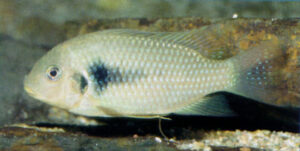
Etia nguti, male, about 60 mm SL. Photo by Jörg Freyhof. From: Schliewen, U. K. and M. L. J. Stiassny. 2003. Etia nguti, a new genus and species of cichlid fish from the River Mamfue, Upper Cross River basin in Cameroon, West-Central Africa. Ichthyological Exploration of Freshwaters 14 (1): 61-71.
In 2003, Ulrich K. Schliewen (Max-Planck-Institute, München, Germany) and Melanie L. J. Stiassny (American Museum of Natural History, New York, USA), described Etia nguti, representing both a new genus and new species of cichlid from the River Mamfue, Upper Cross River basin in Cameroon. The specific name is from Nguti, the name of the village where most of the type series was collected. The generic name honors “E.T.,” whose “ground-breaking work on cichlid biology spanned some 60 years,” and whose “creativity, humility and kindness are legendary.”
Note: Wikipedia inexplicably says “Etia” is from the indigenous Mbo language spoken in Nguti, meaning “located in,” and that the full epithet Etia nguti literally means “located in Nguti.” Wikipedia cites the original description, but I can assure you that is not the explanation provided by the authors.
29 Oct.
Barathrites iris Zugmayer 1911
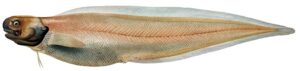
Barathrites iris, watercolor painting by M. L. Tinayre. From: Zugmayer, E. 1911.Poissons provenant des campagnes du yacht Princesse-Alice (1901–1910). Résultats des campagnes scientifiques accomplies sur son yacht par Albert 1er Monaco. Fasc. 35: 1–174, Pls. 1–6.
This fish’s name delights me because its two parts seem at odds with each other. The generic name is grisly and dark, yet the specific name is cheerful and multicolored. Let me explain.
Barathrites iris is a cusk-eel (Ophidiidae) that occurs at abyssal depths from the northeast Atlantic Ocean. (The abyssal zone is between 4000–6000 m, where light does not penetrate.) There is some evidence that the species occurs in the Indian Ocean and the central Pacific as well. It was described by Austrian explorer, herpetologist and ichthyologist Erich Zugmayer (1879–1938), Bavarian State Zoological Collection (Munich), in 1911.
The specific name Barathrites is derived from bárathron (βάραθρον), a bottomless pit or abyss, clearly referring to the fish’s deep and lightless habitat. In Greek mythology, the Barathron was a deep pit at Athens into which living and executed criminals were cast. Dark and grisly, indeed.
The specific epithet, iris, is from the Greek word (ἶρις) for rainbow. For an abyssal fish, Zugmayer was struck by its coloration. He wrote (translated from German): “The coloration is a transparent, milky shade. The head is brownish, the opercular region is purple; the pectoral fins are yellowish, the vertical fins light blue; the black peritoneum shows through the skin. The rest of the body is flesh-colored. Not all of these colors are distinct, but seem to blend like the colors of the spectrum. According to the color note submitted to me, the formalin preserved the nuances very well.”
In other words, Barathrites iris is the “rainbow from the abyss,” where there is no light and rainbows are impossible.
Nice.
22 Oct.
Moxostoma antelunare Akin, Jenkins & Armbruster 2025
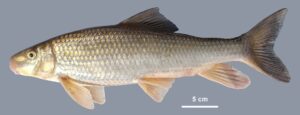
Moxostoma antelunare (327 mm SL, uncatalogued) from the lower Apalachicola River in life. Photograph by D. C. Werneke. From: Akin, D.R., Jenkins, R.E. & Armbruster, J.W. (2025) Description of the Apalachicola Redhorse (Catostomidae: Moxostoma). Zootaxa, 5711 (2), 181–202.
Robert E. Jenkins (1940–2023) was arguably the world’s leading authority on suckers (Catostomidae). When he died (see NOTW, 2 Aug. 2023), he left behind a number of manuscripts and lots of unpublished data on sucker systematics and life histories. Jonathan W. Armbruster of Auburn University has been shepherding their completion and publication. (See NOTW, 12 March 2025.) The “Prologue” of the latest “new” sucker species recognized by Jenkins, the Apalachicola Redhorse, is something rare in contemporary scientific literature — something that actually reads like literature, with an evocative sense of history and time:
“We are presenting another one of a series of new Redhorse species which was recognized by Dr. Robert E. Jenkins in 1968, one year prior to humans setting foot on the moon. While finishing this work, we thought heavily about the times in which Bob began this journey. The United States of America in the 1960s was an era of uncertainty highlighted by the Cold War, Civil Rights movements, involvement in the Vietnam War, political assassinations, and yet was capped off by one of mankind’s most significant scientific achievements—putting a man on the moon. No matter how uncertain the times, Bob’s legacy of love for Redhorses persisted and is a legacy that we hope to carry on.”
The 1969 moon landing is reflected in the fish’s name, antelunare, from ante, Latin for before, and lunare, neuter of the Latin adjective lunaris, of the moon. The authors explain:
“We believe this name is appropriate because it both represents the passage of time by referencing a monumental scientific event, and also reminds us that the Apalachicola Redhorse was still a species before description just as the moon existed before mankind set foot upon it or first recognized it in the sky.”
15 Oct.
Eeyorius Paulin 1986
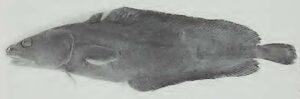
Eeyorius hutchinsi, paratype, 180 mm SL. From: Paulin, C. D. 1986. A new genus and species of morid fish from shallow coastal waters of southern Australia. Memoirs of the Museum of Victoria 47 (2): 201–206.
Eeyorius hutchinsi is a codling (Gadiformes: Moridae) from shallow coastal waters of southern Australia. Both the genus and the species were described by New Zealander marine biologist C. D. Paulin in 1986. The species is named for ichthyologist J. Barry Hutchins (b. 1946), Western Australian Museum, who collected the holotype. The genus is named for Eeyore, described by Paulin as a “literary character who lived in damp places.” Paulin provided no other explanation for the name beyond that sentence.
 It’s almost certain that Eeyore is the gloomy stuffed (with sawdust) donkey in the “Winnie-the-Pooh” books by A. A. Milne. He lives in an area of the forest labeled “Eeyore’s Gloomy Place: Rather Boggy and Sad” on a map. Maybe Paulin’s use of the adjective “damp” reflects the adjective “Boggy.” Even so, the selection of the name appears to make no sense. Eeyorius hutchinsi occurs in the ocean and not in a bog or damp (slightly wet) place. So why name a marine fish for a fictional donkey that lives in the forest? Emails to Paulin either bounced or went unanswered.
My best guess is that “Eeyorius” is a playful allusion to the fact that several gadiform genera (Gaidropsarus, Lyconus, Macruronus, Melanonus) have names that evoke onos (ὄνος), donkey or ass (asellus in Latin), a name dating to Aristotle for an unidentified gadiform fish, posssibly Phycis blennoides (Gadidae).
Why a donkey or ass? At least four explanations have been proposed but no one knows for sure. (1) The color of Hake Merluccius merluccius (Merlucciidae) — grayish-white color above, white below — is like that of an ass (Varro, 1471, De lingua Latina). (2) The Haddock Melanogrammus aeglefinus (Gadidae) is as sluggish as a donkey (Varro, citing Oppian). (3) The dark mark on the shoulder of the Haddock is said to resemble the dark stripe over the withers of an ass (Yarrell, 1836, History of British Fishes, vol. 2). (4) In ancient times, gadiform fishes were carried to market on the backs of asses (Day, 1882, Fishes of Great Britain and Ireland).
Or maybe, just maybe, Paulin thought Eeyorius hutchinsi was a gloomy looking fish.
8 Oct.
The Spelling Police, at your service
Three years ago, at the Joint Meeting of Ichthyologists and Herpetologists in Norfolk, Virginia, I spotted a mistake on a poster during one of the poster sessions. The author of the poster was revising a genus and describing a new species, with its manuscript name mentioned on the poster. However, the spelling of the proposed new epithet, an adjective, did not agree with the gender of the genus as it should per the International Code of Zoological Nomenclature.
ICZN 31.2. Agreement in gender
A species-group name, if it is or ends in a Latin or latinized adjective or participle in the nominative singular, must agree in gender with the generic name with which it is at any time combined.
ICZN 34.2. Species-group names
The ending of a Latin or latinized adjectival or participial species-group name must agree in gender with the generic name with which it is at any time combined [Art. 31.2]; if the gender ending is incorrect it must be changed accordingly (the author and date of the name remain unchanged [Art. 50.3.2]).
Trying not to sound like a pompous know-it-all, I pointed out the error, explaining why the “-a” at the end of the epithet should be changed to “-us.”
The author looked at me with suspicion. He assured me the spelling was correct.
“No, I’m 100% certain it’s not,” I replied. I explained my rationale again but the author stood his ground.
I asked if he was preparing the description for publication. He said yes.
“Before you submit it, do me a favor,” I said. “Ask for a second opinion on the spelling of the name.”
The description was published the following year. The spelling had been corrected.
We met again at the next Joint Meeting of Ichthyologists and Herpetologists, this time in Pittsburgh, Pennsylvania. The author shook my hand and thanked me for catching the error.
Unfortunately, I did not have the opportunity to correct similar errors in the descriptions of two recently described new species.
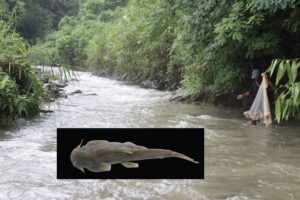
Holotype of Exostoma hajiense, 65.6 mm SL, shown over the type locality for which it is named: Haji stream, a tributary of the Subansiri River, Arunachal Pradesh, India. Photos assembled from: Tenali, D. T., A. Kumar, T. Kumawat, R. K. Singh, and U. K. Sarkar. 2025. Exostoma hajiensis [sic], a new sisorid catfish, (Teleostei: Sisoridae) from Arunachal Pradesh, north-eastern India. Records of the Zoological Survey of India 125 (2S): 1-8. DOI: 10.26515/rzsi/v125/i2S/2025/172954
Heteromormyrus angusticaudata Mutizwa, Kadye, Bragança & Chakona 2025 – This is one of the six new species of stonebasher mentioned in last week’s NOTW. The authors provide a clear etymology and explanation: “The species name means narrow-tailed, and it is a compound word composed of the Latin words angustus, meaning narrow, and cauda, meaning tail. This is a reference to the very thin caudal peduncle of this species.” What the authors do not explain is that while “cauda” is a noun (tail), “caudata” is an adjective (tailed.) The genus Heteromormyrus is masculine. Heteromormyrus angusticaudata should be spelled H. angusticaudatus.
It seems that every year there are two or three misspelled adjectival fish names published in the literature. Sometimes they’re new species, like the two mentioned here. Sometimes they’re previously described species whose spellings have to be adjusted when they are reassigned to a new genus with a different gender. Apparently, many biologists, journal editors and peer reviewers do not understand the basics of Latin grammar in the formation of zoological nomina, nor the ICZN rules mandating how adjectives must be spelled.
Rest assured, the Spelling Police division of the ETYFish Project will continue to seek out orthographic violations and bring them up to Code. 😊
1 Oct.
African fishes, African names
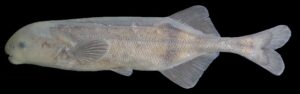
Heteromormyrus chilembwei, paratype, 69.0 mm SL. From: Mutizwa, T. I., Kadye, W. T., Bragança, P. H. N., & Chakona, A. 2025. Review of the southern African slender stonebashers, genus Heteromormyrus Steindachner 1866 (Teleostei: Mormyridae), with description of six new species. Journal of Fish Biology, 1–36. https://doi.org/10.1111/jfb.70191
In the essay Changing Scientific Names on Ethical Grounds: Six Reasons to Say ‘No’, I review several recent papers that argue for major changes to how biological nomina should be named and even re-named. One such paper decries the fact that 9–26% (depending on the country) of all non-fish vertebrates known from Africa are named after people from non-African countries, particularly European colonizers such as Belgium. To remedy this eponymic inequality, the authors propose that all eponyms, not just those named for or by colonists and other non-Africans, be eliminated and replaced with non-eponymic nomina coined by taxonomists from the regions where the taxa live. I present six arguments against such drastic measures, including one that describes how “old” (i.e., colonial) names can coexist with new ones. I also note how the power of bestowing eponyms for new taxa in the Global South is shifting away from Americans and Europeans to local scientists in the countries where most of the world’s undiscovered species live.
A recent revision of the southern African stonebasher* genus Heteromormyrus (Mormyrus) illustrates my point, and demonstrates how current zoological nomenclature is being enriched and invigorated by names honoring a greater diversity of peoples and cultures.
In the paper, six new species of Heteromormyrus are described. Two of them are given traditional “descriptive” names, i.e., names that refer to a prominent or diagnostic physical characteristic possessed by the fish. The other four names are commemorative:

John Chilembwe standing outside his church in Mbombwe village, southern Malawi, Africa, 1914. Source: Library of Congress.
Heteromormyrus chilembwei Mutizwa, Kadye, Bragança & Chakona 2025 in honor of John Chilembwe (1871–1915), Baptist pastor who led the first nationalist uprising in Malawi from 1914 to 1915 protesting against forced labor and African involvement in World War I
Heteromormyrus ndauorum Mutizwa, Kadye, Bragança & Chakona 2025 -orum (L.), commemorative suffix, plural: named for the Ndau people, who historically lived in the Chimanimani district of Zimbabwe, where the species occurs
Heteromormyrus tangwenai Mutizwa, Kadye, Bragança & Chakona 2025 in honor of Rekayi Tangwena (1910–1984), a traditional chief of the Tangwena people in Zimbabwe, where this species occurs; he “fiercely resisted the unlawful eviction of his people from their ancestral lands by the white minority settler government” and “remains a celebrated national hero for his efforts in the liberation of Zimbabwe”
Heteromormyrus xanekweorum Mutizwa, Kadye, Bragança & Chakona 2025 -orum (L.), commemorative suffix, plural: named for the Xanekwe people, who historically lived along the Okavango River, Angola and Namibia, type locality; they were hunter gatherers and fishermen with close ties to the riverine environment
These are wonderful names, each one a mini-lesson in African history and a statement of African pride. They honor people relevant to the areas where the fishes occur and clearly are important to the four biologists (three of them African) who authored their descriptions.
Here are the four previously proposed “Euro-centric” eponyms in the genus:
Heteromormyrus ansorgii (Boulenger 1905) in honor of English explorer and collector William John Ansorge (1850–1913), who collected holotype
Heteromormyrus pappenheimi (Boulenger 1910) in honor of German zoologist Paul Pappenheim (1878–1945), curator of fishes, Königliche Zoologische Museum (Berlin), for his contributions to the knowledge of mormyrids
Heteromormyrus szaboi (Kramer, van der Bank & Wink 2004) in honor of the late Thomas Szabo (1924–1993), Laboratoire de Neurophysiologie Sensorielle Comparée, one of the founding fathers of the field of electroreception and mentor and friend to senior author
Heteromormyrus tavernei (Poll 1972) in honor of Belgian ichthyologist Louis Taverne, Musée Royal de L’Afrìque Centrale (Tervuren, Belgium), whose osteological studies have considerably advanced the classification of mormyrid fishes
These names are worthy as well, honoring individuals important to the collection and study of mormyrid fishes.
As I said in my essay, there is plenty of room and opportunity in biological nomenclature for past and present sensibilities to coexist. To those who seek to rewrite existing nomina, I remind them that the strength of biological nomenclature is its stability. The name is the thread that connects a taxon across the centuries, in multiple references, in any language, country and culture, in classifications old, new and yet to come.
* Why are stonebashers called stonebashers? The best guess is because they occur in swift waters with rocky substrate.
24 Sept.
Nothobranchius taiti Nagy 2019

The original description of this seasonal killifish from Uganda, like most descriptions of new taxa, is dry and clinical, written in the dispassionate language of science. Material and methods. Biostatistical compilations of morphometric and meristic data. Coloration. Distribution. Ecology. Graphs and tables. Everything that is known about this species except …
The exciting tale of obsession and perserverance behind its discovery.
Fortunately, ichthyologist Béla Nagy, who described Nothobranchius taiti in 2019, has supplied that tale — and several others — in an entertaining memoir of his adventures collecting seasonal killifishes in Africa: Rough Road into the Deep Unknown: Adventures of Discovery and Survival in Africa (2025).
The tale begins with museum specimens of a killifish in Uganda collected from a muddy swamp by Colin C. Tait, a fish ranger, in 1969 and 1971 and never seen again. Nagy was haunted by Tait’s field photo of the fish. It was an “enigma,” he said, “a ghost hidden in the waters.”
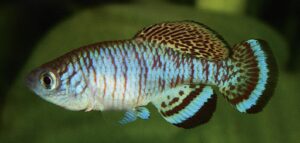
Nothobranchius taiti, paratype, male, 35.3 mm SL. Photographed by Béla Nagy after two weeks in captivity. From: Nagy, B. 2019. Nothobranchius taiti, a new species of annual killifish from the upper Nile drainage in Uganda (Teleostei: Nothobranchiidae). Ichthyological Exploration of Freshwaters 29 (1): 19–31.
“Was it still out there,” Nagy asked himself, “hidden in some forgotten pool?” Had previous explorers, including himself, simply looked in the wrong place? The more he thought about it, the more he realized he had to try again. In June 2017, he returned to Uganda, determined to “chase a mystery that had evaded everyone” for nearly 50 years.
Nagy and his collecting partners drove north through Uganda for several days, retracing the path Tait had taken decades before. The heat was oppressive, as were Nagy’s growing doubts about his chances of success. They stopped at every temporary pool or pond they encountered. Their nets came up empty, or yielding only Notobranchius ugandensis, a common killifish in Uganda. Heavy mud from the ponds clung to their legs. Exhaustion set in. The “weight of repeated failure” pressed on their minds. Just “another day of mud and disappointment,” one of the collectors said. But they kept looking.
They veered down a smaller dirt road to a place where the seasonal Arapi River crossed the track. The water was dark and stagnant. The mud heavy and slick. Nagy smelled the rotting vegetation drifting up from the surface.
“I would regret it for the rest of my life if we did not try,” Nagy said. The first drag of his net came up empty. He swept it again. This time the net contained two “small, wriggling bodies.” Females. Just then, one of the other collectors shouted, “I have the male.” The male has banded fins, different from all other Nothobranchius species in Uganda. They had found it.
“The weight of fatigue lifted,” Nagy writes. “The long hours, the uncertainty the relentless search, had all led us to this magical moment. We stood in the shallow water, the midday heat beating down, grinning like fools.”
Nagy named the species in honor of Colin C. Tait. In addition to first collecting and photographing the fish, Tait had also published field observations about Nothobranchius habitats in Zambia, as well as notes on their behavior in captivity. He was described by a colleague as “marvellous company to have in the long dark nights in the bush, with his love of jokes, and his fund of songs and stories.”
17 Sept.
The Howes who’s who
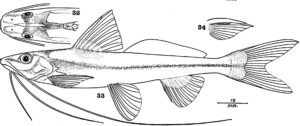
Fowler’s sketch of Pimelodella howesi. #34 is a detail of the pectoral fin. From: Fowler, H. W. 1940. Zoological results of the second Bolivian expedition for the Academy of Natural Sciences of Philadelphia, 1936-1937. Part I. The fishes. Proceedings of the Academy of Natural Sciences of Philadelphia 92: 43-103.
In 1940, ichthyologist Henry Weed Fowler named three new species from Bolivia after members of the Howes family. Based on the information that Fowler included in his descriptions, it was unclear to me who these Howes were. Online information about them — at least back in 2014, when I first worked on these names — was scanty or non-existent. With limited information, here’s how I explained the eponyms:
Pimelodella howesi Fowler 1940
in honor of American naturalist Gordon B. Howes, who collected fishes during an expedition to Bolivia (1937–1938), including holotype of this one
Amblystilbe howesi Fowler 1940
in honor of “Mr. Arthur Howes” (although “Gordon Howes” is credited with collecting holotype and other fishes during a 1937 expedition to Bolivia)
Otocinclus mariae Fowler 1940
in honor of Maria Howes, wife of Arthur Howes, for whom Fowler is “indebted for many American fishes” (although Fowler credits “Gordon Howes” for collecting the types of several Bolivian fishes)
How were the three Howes related? If Gordon B. Howes collected the holotypes, then what did Arthur and Maria do to deserve their eponymic honors? These questions went unanswered until last month, when I received an email from an unexpected source: Pascal Hablützel, Ph.D., a scientist from Brussels who specializes in marine plankton community ecology. Like me, Dr. Hablützel was curious about the Howes. Unlike me, he figured out who they were.
The Howes family lived in Toms River, New Jersey (USA), about 100 km away from the Academy of Natural Sciences of Philadelphia (ANSP), where Fowler worked. Mary (not Maria) Pearsall Howes (1889–1948) was apparently an amateur naturalist. She collected fishes from the Atlantic Coast off New Jersey and sent them to Fowler, along with photographs and notes on their coloration. She was married to Arthur Gordon Howes (1880–1945). Little is known about him except for the fact that he was friends with American biologist Melbourne A. Carriker, Jr. (1879–1965). In 1937 and 1938, Carriker led an ANSP expedition to Bolivia, primarily to collect birds but he collected fishes as well. Mary and Arthur’s teenage son Gordon Tavistock “Mike” Howes (1920–?) accompanied Carriker and helped collect fishes. It’s not clear whether Gordon was a naturalist like his mother or if he joined the expedition simply for the adventure of it. He later pursued a career with the Red Cross. How he lived the rest of his life and when he died is not known.
I thanked Dr. Hablützel for this information, some of which he compiled with the help of a genealogist. But I was curious: Why is a marine plankton biologist from Brussels interested in the eponymic histories of three Bolivian fishes named for people from New Jersey? So, I asked.
Dr. Hablützel has been studying the diversity of Bolivian fishes for over 15 years as a side project. Currently he is working to geo-reference the type localities of every Bolivian fish species, which would enable researchers to collect topotypes — specimens collected from the exact same location where the original type specimen (holotype) was found — for their taxonomic studies. Reconstructing the location of the type localities with reasonable accuracy often involves knowing the what, where, when — and who — of the original collecting expeditions. Identifying the individual members of these expeditions, Dr. Hablützel says, is sometimes critical.
Here are the rewritten ETYFish entries:
Pimelodella howesi Fowler 1940
in honor of Gordon Tavistock “Mike” Howes (1920–?), Toms River, New Jersey (USA), who as a teenager collected fishes with his parents’ friend, American biologist Melbourne A. Carriker Jr. (1879–1965), during an expedition to Bolivia (1937–1938), including holotype of this one
Amblystilbe howesi Fowler 1940
in honor of Arthur Gordon Howes (1880–1945), Toms River, New Jersey (USA), friend of American biologist Melbourne A. Carriker Jr. (1879–1965) and father of Gordon Tavistock “Mike” Howes (1920–?), both of whom collected holotype during an expedition to Bolivia (1937–1938)
Otocinclus mariae Fowler 1940
in honor of Mary Pearsall Howes (1889–1948), Toms River, New Jersey (USA), for whom Fowler is “indebted for many American fishes” from the Atlantic Coast
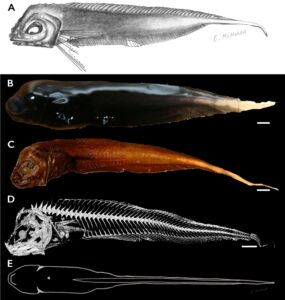
Paraliparis em, new species, Sleek Snailfish, based on the holotype. Standard length 101.2 mm. (A) Lateral view drawing. (B) Photograph of specimen upon collection. (C) Photograph of specimen fixed in 4% formaldehyde, then stored in 70% ethanol. (D) Lateral view of micro-computed tomography (micro-CT scan) of the holotype. (E) Ventral view drawing. Artist (A, E): Emily McMahon. Photograph (C) and CT scan (D) by Mackenzie Gerringer. Photograph (B) by Jeffrey Drazen. Scale bars 5 mm. From: Gerringer, M. E., et al. 2025. Descriptions of three newly discovered abyssal snailfishes (Liparidae) from the Eastern Pacific Ocean. Ichthyology & Herpetology 113(3), 487–506.
10 Sept.
Paraliparis em Gerringer 2025
To paraphrase Sesame Street, “This week’s name is brought to you by the letter M.”
Paraliparis em is a newly described snailfish (Liparidae) from the Pacific Ocean nearly 300 km off the coast of Santa Barbara, California, USA. The holotype and only known specimen was collected on 3 May 2019 with a suction sampler by the human-occupied vehicle (HOV) Alvin at an abyssal depth of 4,115 m. It has an elongate black body, a translucent tail, and a large eye. The species is named for Station M, its collection site and where it has regularly been observed.
According to Smith et al. (2017), “Station M is one of three abyssal time-series stations in the world ocean today. This station was established in 1989 to study the influence of seasonal pulses of particulate organic matter reaching the seafloor from the highly productive overlying waters of the California Current. Long time-series monitoring at Station M began with sequencing sediment traps moored in the benthic boundary layer and a time-lapse camera system taking hourly photographs of the seafloor. This monitoring has now expanded to include high-temporal-resolution recording of sedimenting particulate matter and estimated consumption of organic carbon on the seafloor. Persistent monitoring at Station M has revealed the importance of daily to weekly episodic deposition of pelagically derived organic matter that sustains the benthic community over decades.”
Paraliparis em, plus two other new snailfish species (Careproctus colliculi and C. yanceyi), were described in an open-access paper by Mackenzie E. Gerringer, Associate Professor of Biology, State University of New York at Geneseo. She says the name honors the “invaluable contribution of time series data, such as those from Station M, and the many people who make long-term monitoring of biological communities possible.”
Learn more deep-sea physiology and ecology at Dr. Gerringer’s website.
3 Sept.
Xenocephalus Kaup 1858
In a recent issue of Ichthyology & Herpetology, the Deepwater Freckled Stargazer, Xenocephalus egregius, the only member of the genus that occurs in the Atlantic, is redescribed. It’s a superb paper, detailing how the fish changes in color and anatomy as it grows, and how these changes have confused its taxonomic history over the decades. In the second sentence of the opening paragraph, the authors attempt to explain of the meaning of the generic name:
“The name Xenocephalus may allude to a defining trait of the genus, a pair of converging bony flanges that project anteriorly from the dentary (Kishimoto, 1989; Pietsch, 1989; Vilasri, 2013).” (Note: The three cited references discuss the dentary flanges, not the meaning of the name.)
I have no doubt that these bony flanges are a distinctive trait. But I seriously doubt that Kaup named the genus because of them. Instead, I believe that Kaup selected Xenocephalus — from the Greek xénos (ξένος), strange or foreign (i.e., different), and cephalus from the Greek (kephalḗ, κεφαλή), head — due to the overall strangeness of the head, flanges included.
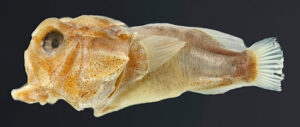
Xenocephalus armatus, neotype, 31 mm TL. NMNZ P.30131. Courtesy: Museum of New Zealand Te Papa Tongarewa, Wellington.
Kaup described Xenocephalus — specifically the type species X. armatus — as having an “abnormally” large head, cuirassed with plates and armed with spines, “to which the body is attached like an appendage” (translations). What’s more, Kaup based much of his description of X. armatus on an unpublished manuscript by Quoy & Gaimard, who also singled out its “excessively large, bony, boxlike head” (translation).
Kaup believed the fish was a member of the cod family Gadidae, which made the size and structure of its head that much more “xenós.” In fact, the familial placement of the species remained uncertain until 1994, when it was aligned with the stargazer family Uranoscopidae. What Kaup didn’t know, and which the new study illustrates, is that the heads of Xenocephalus — indeed, their entire bodies — change shape as they mature. Kaup’s specimen was a juvenile. The “abnormally” large “boxlike” heads of juveniles become more rounded and proportionally balanced as adults.
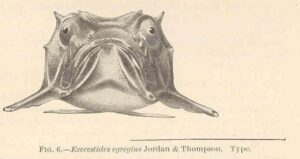
Execestides (now Xenocephalus) egregius, anterior view of holotype. From: Jordan, D. S. and J. C. Thompson. 1905. The fish fauna of the Tortugas Archipelago. Bulletin of the Bureau of Fisheries 24 (for 1904): 229–256.
The authors of the Xenocephalus egregius redescription do not mention the etymology of the fish’s specific name, originally described as Execestides egregius by Jordan & Thompson in 1905, but it’s worth exploring. “Egregius” is Latin for several adjectives: select, extraordinary, distinguished, surpassing, excellent, eminent, surprising. Jordan & Thompson do not explain why they selected this name but one can hazard to guess that it refers to its head, described as “monstrous in form,” with “preopercular angle developed as a long flattened wing-like appendage.” The generic name Execestides, now a synonym of Xenocephalus, is named for Execestides, a “citizen of Athens, with a strange and barbarous lineage.” Maybe Jordan & Thompson thought this species, with its “monstrous” head, was “strange and barbarous” as well?
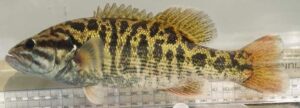
Micropterus pucpuggy, holotype, 194.5 mm SL. From: Freeman, B.J., Scott, M.C., Petersen, K.N., Bayona-Vásquez, N.J., Taylor, A.T., Hilburn, B.G., Freeman, M.C. & Wares, J.P. (2025) Two new species of Micropterus (Centrarchidae) endemic to Atlantic Slope river drainages in Georgia, South Carolina and North Carolina, U.S.A. Zootaxa, 5683 (1), 67–89.
27 August
Micropterus pucpuggy Freeman & Freeman 2025
What a wonderful name!
Micropterus pucpuggy is a new species of black bass (Centrarchidae) from the upper Savannah Basin in Georgia and South Carolina (USA), east to the Broad River system of the Santee Basin in the Carolinas. Prior to this description, the species had been informally known among anglers and fish-and-game agencies as Bartram’s Bass, then regarded as a distinct population of Redeye Bass M. coosae. Senior author Byron (Bud) Freeman coined the name “Bartram’s Bass” in 2001 when talking to a journalism student who was writing about this “new bass” that anglers were targeting. (Freeman first noticed visual differences between Redeye Bass and Bartram’s Bass in the late 1980s.) The student asked what Freeman called it and the name stuck. The first publication using that name was published in Georgia Outdoor News in 2001.

Frontispiece of Bartram’s “Travels” (1791), illustrated by Bartram himself. The person depicted is Mico-Chlucco, a Seminole and Muscogulge (Creek) war chief known as the “Long Warrior.” The feathered headband indicates Mico-Chlucco’s high status.
William Bartram (1739–1823) was an American naturalist who trekked through the Southern Colonies of British North America from 1773 to 1776, including the native range of this species. His 1791 account of his travels, in which he described the plants and animals he encountered, including fishes previously unknown to North American colonists, was one of the first books by an American to receive literary acclaim in Europe. Unfortunately, none of Bartram’s descriptions are considered valid or available because he did not use binomial nomenclature. Bartram did not describe nor mention this bass. Instead, he is honored for his contributions to American natural history.
So, if the bass is named after Bartram, then why is the specific epithet “pucpuggy” and not “bartrami”? According to Bartram’s account, Puc Puggy, meaning “flower hunter,” is the name bestowed upon him by the Chief of Cuscowilla, a Seminole (or Seminole-Creek) village in Florida. Bartram wrote:
After the usual compliments and enquiries relative to our adventures, &c. the chief trader informed the Cowkeeper [Ahaya,the first recorded chief of the Alachua band of the Seminole tribe], in the presence of his council or attendants, the purport of our business, with which he expressed his satisfaction. He was then informed what the nature of my errand was, and he received me with complaisance, giving me unlimited permission to travel over the country for the purpose of collecting flowers, medicinal plants, &c. saluting me by the name of PUC PUGGY, or the Flower hunter, recommending me to the friendship and protection of his people.
In choosing the name “pucpuggy,” the husband-and-wife team of Bud and Mary Freeman, both with the University of Georgia’s Odum School of Ecology, are honoring both Bartram and the Seminole-Creek people.
Freeman and Freeman described a second bass species in the same paper, Micropterus calliurus (Altamaha Bass), endemic to the upper Ocmulgee and Oconee watersheds of the Altamaha Basin and to the headwaters of the Ogeechee basin in Georgia. The name is a Latinization of the Greek kállos (κάλλος), beauty, and ourá (οὐρά), tail. The etymology section of the description does not mention why the Freemans selected that name, but Bud Freeman tells me it refers to how the fish’s caudal fin often has “concentrations of melanophores and the absence of them too, giving the fin a spotted appearance.” Although many (but not all) compound names ending with a Latinized Greek word are adjectives (pretty-tailed), the Freemans treat this one as a noun (pretty tail).
 20 August
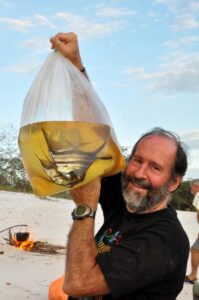
Heiko Bleher (1944–2025)
Two days ago, German explorer and ornamental fish wholesaler and supplier Heiko Bleher passed away. He was 80 years old. Bleher was well-known in the aquarium hobby for his expeditions throughout fresh and brackish waters of the world in search of aquarium fishes. He was also the owner of Aquapress, which published numerous aquarium books and magazines and “aqua, International Journal of Ichthyology” (1994–2021).
One genus and eight species have been named in Bleher’s honor, all for fishes for which he collected and supplied holotype or topotype specimens:
Chilatherina bleheri Allen 1985, a rainbowfish (Melanotaeniidae) from Irian Jaya, Indonesia
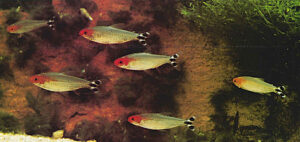
Petitella bleheri at the Nancy Aquarium, France. These specimens were sacrificed and represent part of the type series. Photo by Denis Terver. From: Géry, J. and V. Mahnert. 1986. A new rummy-nose tetra from the Rio Negro, Brazil: Hemigrammus bleheri n. sp. (Characidae, Tetragonopterinae), with comments on Paracheirodon. Tropical Fish Hobbyist 34 (11) [July]: 37, 40–41, 44–45, 48–49, 52.
Channa bleheri Vierke 1991, a snakehead (Channidae) from Assam, India
Steatocranus bleheri Meyer 1993, a cichlid from the Democratic Republic of the Congo
Alestopetersius bleheri (Géry 1995), an African tetra (Alestidae) from the Democratic Republic of the Congo
Leporinus bleheri Géry 1999, a toothed headstander (Anostomidae) from the Amazon River basin of Bolivia and Brazil
Kiunga bleheri Allen 2004, a blue-eye (Pseudomugilidae), from Papua New Guinea
Moenkhausia heikoi Géry & Zarske 2004, a tetra (Acestrorhamphidae) from the Río Xingu basin of Pará, Brazil
Bleheratherina Aarn & Ivantsoff 2009, a monotypic genus of silversides (Atherinidae) from New Caledonia
Heiko Bleher’s wife, Natasha Khardina, posted this on her Facebook page:
“Well known and respected in the world of aquaristics and natural exploration, Heiko left a lasting mark through his tireless passion, his travels, and the many discoveries he shared with an international community of friends and colleagues.
“His legacy lives on not only in the countless publications, expeditions, and biotopes he documented, but also in the inspiration he gave to aquarists, explorers, and nature lovers around the world. Through his advocacy for authentic biotope aquaristics, he encouraged hobbyists everywhere to recreate real underwater habitats – promoting awareness and respect for freshwater ecosystems as they exist in nature.
“His memory will live on through the people he touched, the stories he helped to tell, and the biotope legacy he leaves behind – a true gift to future generations and a meaningful path forward for Amanda.
“As he always said: ‘My life belongs to fishes.’”
13 August
Aulotrachichthys prosthemius (Jordan & Fowler 1902)
It’s hard figuring out the meaning of a name based on a Greek word when that word doesn’t exist.
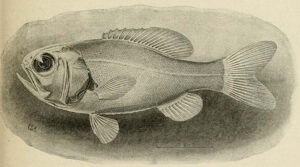
Aulotrachichthys prosthemius. Illustration by Charles Bradley Hudson. From: Jordan, D. S. and H. W. Fowler. 1902. A review of the berycoid fishes of Japan. Proceedings of the United States National Museum 26 (1306): 1–21.
In 1902, David Starr Jordan and his student Henry Weed Fowler described a new species of roughie or slimehead (Trachichthyidae) from Suruga Bay, Japan. They named it Paratrachichthys prosthemius. (It has since been moved to the genus Aulotrachichthys.) Jordan and Fowler explained the etymology and meaning of the specific epithet: from the Greek prosemiós (προσεμιός), meaning forward, referring to the anterior insertion of the fish’s vent, in front of the abdominal serrae and between the ventral fins.
Trouble is, “prosemiós (προσεμιός)” does not exist in Greek. I consulted with our resident Greek and Latin scholar Dr. Holger Funk and he agreed. We eventually settled on a similarly spelled Greek word, prothesmios (προθέσμιος), meaning set beforehand, forward or at the front. Our best guess is that when Jordan and Fowler attempted to Latinize prothesmios they misspelled it as prosemiós (προσεμιός), thus creating the additionally misspelled prosthemius.
Jordan and Fowler may have borrowed the “prosthemius” spelling from Edward Drinker Cope. In 1867, he described a minnow from Michigan, USA, which he named Ceratichthys prosthemius (now a junior synonym of the Lake Chub Couesius plumbeus). Per his custom, Cope, one of the masters of the enigmatic name, did not provide an etymology.
Dr. Funk sums up the “prosthemius” situation this way. “It’s further evidence of the difficulty of coining meaningful scientific Latin fish names,” he said. “When you add the ambition to derive the names from Greek, it can become quite hazardous. Even Linnaeus wasn’t well-versed in Greek.”
6 August
Pseudobarbus vulneratus (Castelnau 1861)
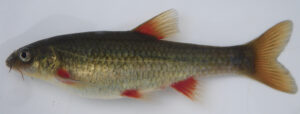
Fresh specimen of Pseudobarbus vulneratus from Riviersonderend, Breede River system, South Africa. Note the “wounded” pectoral, anal and ventral fins (dorsal fin also but Castelnau described it as chestnut, perhaps from a juvenile specimen). From: Zarei F., M. B. Martin, P. H. Skelton, and A. Chakona. 2025. Systematic review of Pseudobarbus burchelli (Teleostei, Cyprinidae), with revalidation of P. vulneratus and description of a new species. Zoosystematics and Evolution 101(3): 1271–1296.
Last week, a team of ichthyologists led by Fatah Zarei published a systematic review of Pseudobarbus burchelli (Smith 1841), a redfin minnow (Cyprinidae: Smiliogastrinae) previously considered to have a wide distribution range across four isolated river systems in the Cape Fold Ecoregion of South Africa. P. burchelli was named in honor of English explorer-naturalist William John Burchell (1781–1863), who collected over 50,000 specimens (plants, animal skins, skeletons, insects, seeds, bulbs and fishes) in South Africa between 1810 and 1815.
Based on both genetic and morphological distinctiveness, Zarei et al. identify three lineages within P. burchelli. One of them is described as a new species, Pseudobarbus agulhas, named for Cape Agulhas, the southernmost point of the African continent, where the Atlantic and Indian oceans meet, and the region in which it occurs. In addition, the specific epithet recognizes the region’s “distinct biogeographic boundary and ecological significance, which supports a rich diversity of both marine and freshwater species.”
For the third species, Zarei et al. resurrect Gnathendalia vulnerata Castelnau 1861 from synonymy, now known as Pseudobarbus vulneratus (Castelnau 1861). In the etymology section of their redescription of the species, the authors write: “Castelnau (1861) did not clarify the origin or reasoning behind the specific name.”
While it’s true that Castelnau did not explain the name, it is an easy one to figure out. Here, for the record, is the meaning of the name:
“Vulneratus” is Latin for wounded and almost certainly refers to the “carmine red” (translation) spots at the base of the pectoral, anal and ventral fins, hence the common name “redfins.”
Just another value-added service of The ETYFish Project.
30 July
Gila cypha Miller 1946

Grand Junction Chubs teammates Isaac Nunez, left, and Kendall Foster take the field before the start of a game against the Idaho Falls Chukars, Wednesday, June 4, 2025, at Suplizio Field in Grand Junction, Colorado. Photo by William Woody for CPR News.
Last week’s baseball-themed NOTW inspired me to write another. Earlier this year, the Grand Junction Jackalopes, a minor league baseball team in Grand Junction, Colorado, announced that they would adopt the name Grand Junction Humpback Chubs for Wednesday home games, in part to draw attention to the need for the fish’s conservation. The Humpback Chub is known scientifically as Gila cypha, described by the legendary Robert Rush Miller in 1946.
Species of the genus Gila, collectively known as western chubs, range throughout the western half of the United States into Mexico. The most distinctive members of the genus are those that inhabit the faster-flowing waters of the Colorado River basin. Fishes in other parts of the world—such as various catfishes in the Andes of South America and hillstream loaches in Asia—have adapted to torrential waters by evolving various organs of suction they use to cling to rocks. But the instability of bottoms and channels in the turbulent Colorado (that is, before dams slowed most of the river) have forced some Gila minnows to develop a different solution to living in rushing water. These adaptations include fewer, deeply embedded scales to decrease water resistance, greatly streamlined bodies and larger, falcate (sickle-shaped) fins for more efficient propulsion, and concave heads followed by humped or crested backs that serve as keels to help the fish stabilize itself on the bottom against strong currents. The most exaggerated demonstration of these adaptations belongs to the Humpback Chub, which lives in the fastest, most turbulent waters of the Green and Colorado Rivers.
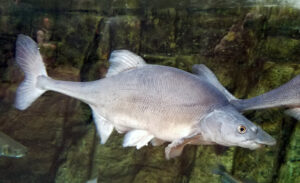
A captive Gila cypha. Photo by Paddy Ryan.
Gila cypha is one of the most bizarre-looking fishes in North America. Its most obvious feature is its nearly scaleless, muscle-filled hump—called a nuchal hump—that rises at a steep angle directly behind its disproportionately small and concave head. This hump is what gives the species its name, from the Greek kyphós (κυφός), meaning hunchbacked. Pronounced grooves on both sides of the hump lead downward to the fish’s gills, presumably to channel water over the gills when the fish hugs the bottom. An overhanging fleshy snout protects its subterminal mouth from the onrushing current. And like other fishes that live in the turbid waters of the mighty Colorado, Gila cypha eyes are small, indicating that taste, smell and pressure awareness (mechanoreception) play a greater role in locating food than sight. Adding to the fish’s peculiar appearance is the way the stoutness of its nuchal hump tapers off into a long, pencil-shaped caudal peduncle and a large, deeply-forked tail.
Despite their streamlined shape, Gila cypha do not have tremendous swimming speed or strength. Instead, they use their large, falcate fins to “glide” through slower-moving stretches of water, feeding on insects trapped in water pockets.
Gila cypha is a federally threatened species in the United States. Its population has been reduced by more than 70 percent as a result of the overall modification of the Colorado River and the introduction of exotics. Today, the Little Colorado River population in Grand Canyon is now estimated at more than 11,000 fish, and the Westwater Canyon population in Utah is estimated to exceed 3,300 fish. Actions being taken to recover the species include boosting and protecting river flows in the spring, managing stocking of nonindigenous fishes to avoid conflicts with the chub, and maintaining refugia populations in hatchery ponds in case wild populations disappear. All in all, prospects for this remarkable member of America’s fish fauna appear to be promising.
A few words about the etymology and meaning of the generic name Gila (pronounced hee-la). Proposed by Baird & Girard in 1853, the authors did not explain why they selected that name. We can presume that it refers to the Gila River of Arizona and western New Mexico, USA, but Baird & Girard said the three taxa they included in the genus were all from the Zuni River of New Mexico. Maybe they believed that the Zuni was part of the nearby but separate Gila basin, or selected Gila (reportedly derived from a Spanish contraction of Hah-quah-sa-eel, a Yuma Indian word meaning “running water which is salty”) as nothing more than a locally flavored name from the American Southwest.
Back to baseball. According to Harrison Shapiro, the owner of the Grand Junction Jackalopes, the “Humpback Chubs” are what minor league baseball is all about. “It’s about fun, it’s about wackiness and it’s about connecting with the local community,” he said. It’s also good business. The team has sold more Humpback Chub merchandise in the last few months than they have Jackalope merch in the last two years.
Melissa Trammell, a retired fishery biologist with the National Park Service, is a Humpback Chubs fan, both the fish and the team. “Threatened and endangered and native species are worth cherishing and saving and celebrating,” she said. “So to see the community come together like this, to celebrate the humpback chub, is just really endearing and hopeful to me.”
Spectrolebias shoheiohtanii, male. © Roger D. Brousseau. From: Brousseau, R. D. 2025. A new species of annual killifish, Spectrolebias shoheiohtanii (Cyprinodontiformes: Rivulidae: Cynolebiatinae) from the Mamoré River basin, Bolivia. Journal of the American Killifish Association 58 (2): 72–82.
23 July
Spectrolebias shoheiohtanii Brousseau 2025
Here’s a first. A species of fish named after a baseball player.
Spectrolebias shoeiohtanii is an annual killifish (Rivulidae: Cynolebiatinae) discovered early this year in a temporary pool, approximately seven meters wide, located between two soybean farms in the San Pablo River floodplain, lower Mamoré River basin, Bolivia. Killifish hobbyist Roger D. Brousseau discovered the species and penned its description. Brousseau is from California and apparently is a fan of the Los Angeles Dodgers because he named the species after the Dodgers’ superstar pitcher and designated hitter Shohei Ohtani (b. 1994). Brousseau described Ohtani as an “exceptionally accomplished Japanese and American baseball player and a humanitarian who helps make the world a better place.”

Shohei Ohtani, nicknamed “Shotime.”
Unfamiliar with Ohtani’s humanitarian or philanthropic efforts, I looked them up. In January 2025, he donated $500,000 to support those affected by the L.A. wildfires, including firefighters and displaced individuals. In January 2024, he and the Dodgers donated $1 million to support victims of earthquakes in Japan. Back when he played in Japan, Ohtani donated baseball gloves to schools and contributed to COVID-19 relief efforts.
I know of two other animals named for baseball players.
Diolcogaster ichiroi Fernandez-Triana 2018 is a parasitoid wasp from Florida, USA. It is named for Ichiro Suzuki, an outfielder who sustained a long and successful career in both Japanese and American baseball leagues. “At the time the research for this paper was being conducted,” Fernandez-Triana wrote, “Ichiro was still playing for a Florida team [Marlins] and thus naming a species endemic from Florida after him made complete sense.”
Sicoderus bautistai Anderson 2018 is a weevil from the island Hispaniola. Is named for Joey Bautista, a Dominican right fielder who spent most of his 15-year major league career with the Toronto Blue Jays. Anderson, a Blue Jays fan, described the honor as a “spur of the moment decision” inspired by Bautista’s bat flip after a home run in game five of the 2015 American League Division Series. When asked if some aspect of the weevil relates to Bautista, Anderson replied, “Not really.”
Eviota vader, fresh holotype, male, 11.5 mm SL. Photo by Mark V. Erdmann. From: Greenfield, D. W., M. V. Erdmann and N. K. Ishida. 2025. Eviota vader, a new western Pacific dwarfgoby from Papua New Guinea (Teleostei: Gobiidae). Journal of the Ocean Science Foundation 43: 39–44.
16 July
Eviota vader Greenfield, Erdmann & Ishida 2025
What’s a sure-fire way of getting your new species of fish featured as the Name of the Week? Easy. Name it after a character from “Star Wars.”
Eviota vader, the Black Dwarfgoby (Gobiidae), is known only from McLaren Fjord, a volcanic fjord area in Tufi, Papua New Guinea. Because of its purplish-black coloration, the darkest of all the dwarfgobies described to date, the authors named it after Darth Vader, the “fictional dark figure” of the “Star Wars” galaxy.
Darth Vader joins Luke Skywalker (Romanogobio skywalkeri) and Greedo, the bounty hunter killed by Han Solo in Chalmun’s Spaceport Cantina (Peckoltia greedoi), in the “Star Wars” eponymicon of fishes.
What’s next? A fish with stylophthalmine eyes named for Jar Jar Binks?
9 July
Barbershop fishes
A pair of Elacatinus figaro cleaning a Sergeant Major Abudefduf saxitilis in dark-color phase, off Rio de Janeiro, Brazil. Photo by A. Amarante. From: Sazima, I., R. L. de Moura and R. S. Rosa. 1997. Elacatinus figaro sp. n. (Perciformes: Gobiidae), a new cleaner goby from the coast of Brazil. aqua, Journal of Ichthyology and Aquatic Biology 2 (3): 33–38.
Fishes have been named for lots of different things. Tools. Weapons. Farming equipment. Musical instruments. Even a meteorite. But you wouldn’t expect barbers and barbershops to be on the list. But they are. Several times.
Two fishes that practice cleaning behaviors have “barber-ous” names. Diplecogaster tonstricula Fricke, Wirtz & Brito 2015 is a clingfish (Gobiesocidae) from the Eastern Atlantic waters Senegal and the Canary Islands. Its specific name is Latin for “little female barber,” referring to its facultative cleaning of larger fishes. And Elacatinus figaro Sazima, Moura & Rosa 1997, a cleaner goby (Gobiidae) from the Southwestern Atlantic, is named for Figaro, the “smart and joyful” barber in Rossini’s opera “The Barber of Seville” (1816).
Caesioperca rasor (Richardson 1839) from the fairy basslet family Anthiadidae, is known as “Barber Perch” in Australia. When Richardson described it as Serranus rasor in 1839, locals called it “Tasmanian Barber.” Richardson selected the Medieval Latin noun rasor for its name, meaning barber. Richardson later (1842) said he wanted to use the “more classical” Latin word tonsor for the name been but couldn’t because it was “previously appropriated to another species,” presumably
Liopropoma tonstrinum at Peleliu, Koror Island, Palau. Source: Mark Rosenstein / iNaturalist. Courtesy: Fishes of Australia, https://fishesofaustralia.net.au/home/species/5093
Serranus tonsor Valenciennes 1828, an unidentifiable species with no known types. No one knows for sure why this and several related species are called “barbers.” Caesioperca rasor has been said to pick parasites off other fishes in the aquarium, but I seriously doubt that this behavior was known to early 19th-century fishers and naturalists.
My favorite tonsorially derived name is that of the Redstriped Basslet Liopropoma tonstrinum Randall & Taylor 1988 (Liopropomatidae) from the eastern Indian and western Pacific oceans. Lewis & Short’s Latin dictionary say tonstrinum is the “act or calling of a barber” (tonstrina in Latin). Randall & Taylor say the name refers to the fish’s red-and-white striped pattern, reminiscent of a barber’s pole.
2 July
The Hanson icefishes
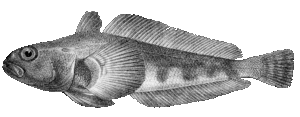
Pseudotrematomus hansoni. Illustration by Joseph Smit. From: Boulenger, G. A. 1902. Pisces. Pt 5: 174-189, Pls. 11-18. In: Lancester, E.R. (ed.): Report on the collections of natural history made in the Antarctic regions during the voyage of the “Southern Cross.” British Museum (Natural History), London: ix + 344 pp., 53 leaves of plates.
Here’s a nomenclatural oddity. Two fishes now in the same genus, discovered in the same location at the same time, described by the same ichthyologist in the same publication, named for the same person, Nicolai Hanson, but using different specific epithets — nicolai and hansoni — utilizing the honoree’s first and last names.
The fishes are cod icefishes (Nototheniidae), collected during the Southern Cross Expedition (1898–1900), the first expedition to over-winter on the Antarctic mainland. They were among 200 specimens of fishes, referable to 16 species, eight of them new, collected at the time. Since this was a British expedition, the task of sorting through the fishes and describing the new species fell to George A. Boulenger (1858–1937) of the British Museum (Natural History).
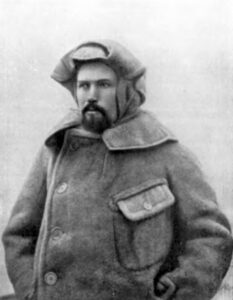
Nicolai Hanson, 1898 or 1899. Photographer unknown.
Boulenger named them after Norwegian zoologist Nicolai Hanson (1870–1899), a member of the expedition. On page 180 of his 1902 report, he described Trematomus (now Pseudotrematomus) hansoni based on 17 specimens from Cape Adare and one from Duke of York Island. Four pages later, Boulenger described Notothenia (now Pseudotrematomus) nicolai based from Cape Adare (four specimens) and Duke of York Island (one specimen).
Eponyms are usually named for the subject’s surname, so it’s a bit odd that Boulenger chose Hanson’s given name for the second species. As it turned out, it’s a good thing he did. In 1982, both species were moved to a new genus, Pseudotrematomus. If Boulenger had named both species “hansoni” then one of the two species would have needed a replacement name to avoid homonymy.
Boulenger did not explain why he named both species after Nicolai Hanson except to say that Notothenia nicolai was named “in memory” of the man. Nicolai Hanson died, apparently of an intestinal disorder, at the expedition’s winter camp at Cape Adare. His grave was dynamited from the frozen ground at the summit of the Cape. Fellow expedition member Louis Charles Bernacchi wrote: “There amidst profound silence and peace, there is nothing to disturb that eternal sleep except the flight of seabirds.”
Nicolai Hanson was the first person to be buried at Antarctica.
25 June
Tyson R. Roberts (1940–2025)
Although he sent me a copy of his unpublished autobiography, I cannot explain nor easily the summarize the life and career of Tyson R. Roberts. I knew him only through email. A few years ago, he described himself to me as a wheelchair-bound “cripple” and sent me a photo to prove it, showing him hunched over a table filled with specimen bottles in his Bangkok apartment, taking a photo of what appears to be a swamp eel pinned on balsa wood. I know that others who’ve met and worked with him over the decades have more accurate insights into his personality. Colleagues have called him “colorful” and a “character.” Many have stories to tell, both good and bad. From my limited perspective, it seems to me that Dr. Roberts exiled himself from the broader ichthyology community. Except for early in his career, he had no formal institutional or academic ties or affiliations. In life and in science he followed his own path. Indeed, his autobiography is subtitled “Roads Less Traveled.” Tyson R. Roberts died last Friday at Nakhon Pathom Hospital in central Thailand, 20 days after his 85th birthday.
My correspondence with Dr. Roberts began in 2017 when I asked him to explain the etymology of Glossamia narindica, a freshwater cardinalfish (Apogonidae) he described from Papua New Guinea in 1978 (see NOTW, 6 Sept. 2017). He fielded many other such queries in the years since. In 2024 he told me, “I used to think that it was my own business to know why I gave a fish a particular name, but my attitude changed and since then I always provide etymologies for new names.” Dr. Roberts then sought my help clarifying the etymologies of the names of swamp eels (Synbranchidae, he preferred to the common name “perch-eels”). He recently completed a worldwide revision of the family, describing 115 new species. The manuscript is in review at Memórias do Museu Zoológico da Universidade de São Paulo.
If anything, Dr. Roberts was certainly prolific. Not counting the new species of “perch-eels,” he described 23 new genera (across 17 families) and described or co-described 159 new species (across 43 families) that remain valid today. In addition, 18 currently valid species, spanning four continents, have been named in his honor:
Acanthopsoides robertsi Siebert 1991 … a loach (Cobitidae) from Southeast Asia
Schistura robertsi Kottelat 1990 … a loach (Nemacheilidae) from Thailand
Psilorhynchus tysoni Conway & Pinion 2016 … a mountain carp (Psilorhynchidae) from Thailand
Garra robertsi Thoni & Mayden 2015 … a minnow (Cyprinidae: Labeoninae) from Borneo
Labeobarbus robertsi (Banister 1984) … a barb (Cyprinidae: Torinae) from the Democratic Republic of the Congo
Argonectes robertsi Langeani 1999 … a halftooth (Hemiodontidae) from Brazil
Synodontis robertsi Poll 1974 … a squeaker catfish (Mochokidae) from the Democratic Republic of the Congo
Glossogobius robertsi Hoese & Allen 2009 … a goby from Papua New Guinea
Limbochromis robertsi (Thys van den Audenaerde & Loiselle 1971) … a cichlid (Cichlidae) from Ghana
Tylochromis robertsi Stiassny 1989 … a cichlid (Cichlidae) from Central Africa
Chanda robertsi (Datta & Chaudhuri 1993) … an Asiatic glassfish (Ambassidae) from Myanmar
Omobranchus robertsi Springer 1981 … a blenny (Blenniidae) from Australia and New Guinea
Neostethus robertsi Parenti 1989 … a priapum fish (Phallostethidae) from the Philippines
Dermogenys robertsi Meisner 2001 … a viviparous halfbeak (Zenarchopteridae) from the Philippines
Zenarchopterus robertsi Collette 1982 … a viviparous halfbeak (Zenarchopteridae) from Papua New Guinea
Synbranchus royal Sabaj, Arce H. & Sousa 2022 … a swamp eel (Synbranchidae) from Brazil (named for Dr. Roberts’ middle name, Royal)
Mastacembelus robertsi (Vreven & Teugels 1996) … a freshwater spiny eel (Mastacembelidae) from the Democratic Republic of the Congo
Leptachirus robertsi Randall 2007 … a sole (Soleidae) from Papua New Guinea
One genus has been named for Dr. Roberts: the simply named Tyson, for Tyson belos Springer 1983, a spinycheek sleeper (Eleotridae). Roberts discovered the species in 1975 in the Trobriand Islands of Papua New Guinea and passed it on to goby and blenny specialists at the Smithsonian Institution for identification and description. The specific name belos is from the Greek βέλος, meaning arrow or dart, referring the fish’s arrow-like shape, but rumor has it that the name is also a homonym of bellows, referring to how Dr. Roberts often spoke authoritatively with a roaring voice.
As evidenced by the number of new taxa he described, Dr. Roberts’ CV is long, with at least 136 ichthyological publications to his name, from 1966 to 2022. He also published extensively on the environment, conservation biology, and the art of the Khmer Empire. Perhaps his most famous publication is his 2012 monograph “Systematics, biology, and distribution of the species of the oceanic oarfish genus Regalecus (Teleostei, Lampridiformes, Regalecidae).” Prosanta Chakrabarty, in his 2013 review of the book, wrote: “The oarfish may be the most enigmatic of fishes, and so it might be fitting that the most enigmatic of ichthyologists has chosen it for his latest subject. I’ll leave the topic of the man to his [unpublished but widely circulated] autobiography (Roberts, 2005), and to the many tales told of him by others; I will mostly only praise him here for his masterful monograph.” In 2012, French filmmakers released a documentary about the oarfish, “Giant Sea Serpent: Meet the Myth.” Dr. Roberts is prominently featured in the film.
The wide diversity of fishes covered in his taxonomic works reflects the “Roads Less Traveled” theme of his autobiography, which begins with a quote from the famous Robert Frost poem:
Two roads diverged in a wood and I—
I took the road less traveled by;
And that has made all the difference
– The Road Not Taken, Robert Frost, 1920
“My woods are the tropical rain forests of South America, Africa, Southeast Asia and New Guinea,” he wrote. “My roads the rivers flowing through them including but not limited to Amazon, Congo Ogooué, Prah, Tano, Irrawaddy, Chao Phraya, Tenasserim, Mekong, Meklong, Kapuas, Barito, and Fly. I spent prolonged periods of time wading in these rivers with a scoop net, collecting, photographing and preserving fishes and observing their ecology and behavior. Nearly all the specimens of fishes and other organism collected by me have been deposited in museum collections where they can be studied and reported on by me and other ichthyologists and systematists working on other groups for generations to come.”
18 June
Solsticial fishes
For folks in the Northern Hemisphere, this Friday, June 20, at 10:41 pm, marks the summer solstice and the beginning of the summer season. Here are three fishes explicitly named for summer.
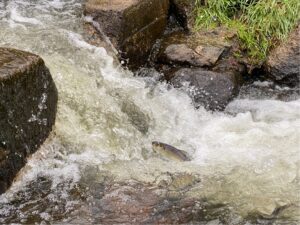
Blueback Herring spawning run, Cape Cod, Massachusetts, USA. Photo by Kyle Price, courtesy inaturalist.org
Alosa aestivalis (Mitchill 1814) — The Blueback Herring is an anadromous species of herring (Alosidae) from the east coast of North America. “Aestivalis” is Latin for “of the summer” or “summer-like.” Mitchill did not explain the name but he called the fish “Summer Herring,” presumably referring to its later spawning run (usually mid-May to mid-July) compared with the Alewife Alosa pseudoharengus (usually April to June).
Sedercypris calidus (Barnard 1938) — The Clanwilliam Redfin is a minnow endemic to the Western Cape Province of South Africa. Its specific epithet is Latin for fiery or hot. Barnard did not explain the name in the original description but did so in a follow-up paper published five years later. “Calidus” has a double meaning. It refers to the bright-red patches on its fins and to the summertime heat of the Olifants River valley, its type locality.
Salmo letnica (Karaman 1924) — The Ohrid Trout (Salmonidae) occurs in Lake Ohrid and in its tributaries and outlet, the Black Drin river, in North Macedonia and Albania. Its name is a Slavic word meaning “summer fish” because it is caught mainly in the summer, compared with S. dentex, called zimnica (“winter fish”) by the locals, which is mainly caught in the winter.
Speaking of winter, this weekend also marks the winter solstice for those of you in the Southern Hemisphere. While there are several currently valid fish species named for cold or snowy weather, I have found only one explicitly named for winter (albeit winter in the Northern Hemisphere). It is:
Coregonus hiemalis Jurine 1825 — The Gravenche or Lake Geneva Whitefish occurred in Lake Geneva of Switzerland and France. Last seen in the early 1900s, it went extinct due to overfishing and eutrophication. Its name is Latin for “of winter” or “wintry,” referring to its December spawning run from the deeper parts of Lake Geneva to shallow areas near shore.
Wherever you live, Happy Solstice!
11 June
Pangio juhuae Sreenath, Pradeep, Ajui, Sukumaran, Sebastian, Anto & George 2025
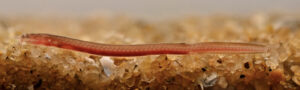
Pangio juhuae, holotype. From: Sreenath, K. R., B. Pradeep, K. R. Aju, S. Sukumaran, W. Sebastian, A. Anto and G. George. 2025. Discovery of a new species of troglobitic eel loach from southern India. Indian Journal of Fisheries 72 (1): 36–41.
Last year, almost to the day, we examined four fish taxa named for the young explorers (children) who discovered them (NOTW, 12 June 2024). Today we add a fifth taxon to the list.
Pangio juhuae is a new subterranean species of eel loach from Kozhikode District, Kerala State, India. The following account is quoted from a 5 May 2025 news story from The New Indian Express.
“In a remarkable blend of childhood curiosity and scientific curiosity, a four-year-old girl has become the unlikely face behind the discovery of a new subterranean fish species from Kerala. Dhanvi Dheera, fondly called Juhu, first noticed the unusual fish while playing with water collected from a well in their house during a visit to Naduvannur in Kozhikode district. Her observation prompted her mother Aswani Lalu to investigate further, which eventually led to a groundbreaking scientific revelation.

Dhanvi Dheera, nicknamed Juhu. From: The New Indian Express.
“Aswani, who used to draw water from a dugout perennial well owned by Malol Karthiayani Amma, noticed the tiny eel-like fish and informed local experts. The well, situated at an elevation of 150 m above sea level, receives continuous underground water flow from the hilly terrains of Vallora Mala and drains through a natural subterranean channel, making it an ideal habitat for rare aquatic life.
“Responding to the find, a scientific team led by Dr K R Sreenath, Director General of the Fisheries Survey of India, and Dr B Pradeep of Krishi Vigyan Kendra, Kozhikode, collected specimens. Detailed morpho-meristic and genetic analysis confirmed that the fish represented an entirely new species. The eel loach was officially named Pangio juhuae, in honour of little Juhu who first spotted it.”
Pangio juhuae is the third subterranean eel loach species discovered in Kerala in recent years. Compared with Pangio bhujia (2019) and P. pathala (2022), P. juhuae is distinguished by the presence of a dorsal fin and more pronounced eyes, suggesting it has retained more surface-dwelling traits than the other two species and might still be in the process of evolving towards a fully underground life.
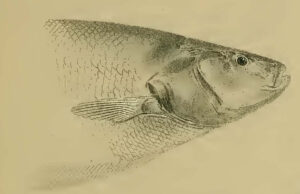
Steindachner included an illustration of the head of Sternarchella schotti with his original description, but later said that illustration needed to be corrected. The new illustration, by Eduard Konopicky, is shown here. From: Steindachner, F. 1881. Beiträge zur Kenntniss der Flussfische Südamerika’s. II. Denkschriften der Kaiserlichen Akademie der Wissenschaften in Wien, Mathematisch-Naturwissenschaftliche Classe 43: 103–146, Pls. 1–7.
4 June
Sternarchella schotti (Steindachner 1868)
I hate getting the etymology of a fish name wrong. But I love it when readers care enough to let me know when I do and point me in the right direction. David Kelly is one such reader. He’s uncovered several mistakes in the ETYFish database over the years, some of them minor, this one major.
Austrian ichthyologist Franz Steindachner proposed many eponymic names over his long career. He usually did not identify the honorees behind these names, leaving me to make educated guesses about their identities. This time I guessed wrong.
Sternarchella schotti is an apteronotid knifefish from the Amazon River basin of Brazil, Bolivia, Colombia and Peru. Here is what I had posted about the name: “patronym not identified, probably in honor of German-American cartographer, botanist and geologist Arthur Schott (1814–1875).” I thought it was a solid guess. Based on other Steindachner eponyms I had studied, I noticed that he had a habit of naming fishes after European colleagues even if they had nothing to do with the fishes in question. Arthur Schott was the only scientist named Schott I could find who Steindachner conceivably knew and admired.
David Kelly found another Schott who has a direct connection to the knifefish that Steindachner described. And the amazing thing is, the identity of this scientist was hidden in plain sight on my computer screen. When I consulted Steindachner’s description of the fish in volume 58 of the journal Sitzungsberichte der Kaiserlichen Akademie der Wissenschaften. Mathematisch-Naturwissenschaftliche Classe via the Biodiversity Heritage Library, I confined my attention solely to Steindachner’s paper. If I had searched “Schott” throughout the entire volume, I would have found numerous mentions of a different Schott: Heinrich Wilhelm Schott.
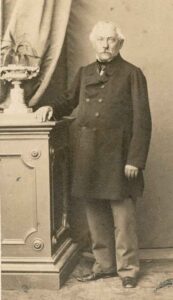
Undated photograph of Heinrich Wilhelm Schott.
Heinrich Wilhelm Schott (1794–1865) was an Austrian botanist who participated in the Austrian Brazil expedition of 1817–1821. The expedition was organized and financed by the Austrian Empire to celebrate the marriage of Austrian Archduchess Maria Leopoldine to Dom Pedro, Crown Prince (and later Emperor) of Brazil.
A contingent of 14 naturalists were part of the expedition, including Heinrich Wilhelm Schott and Johann Natterer (1787–1843). Natterer was a prolific collector who explored South America for 18 years. Steindachner named several fishes after him, including a related apteronotid knifefish, Sternarchogiton nattereri, that same year (1868) in a different publication. Even though Steindachner credited Natterer for collecting the holotype of Sternarchella schotti during the Austrian Brazil expedition, he almost certainly named it after Schott, who had passed away three years earlier.
My thanks to David Kelly for the correction. My apologies to Heinrich Wilhelm Schott for overlooking his connection to the fish that bears his name.
28 May
Galeus eastmani (Jordan & Snyder 1904)
Galeus eastmani. Illustration by W. S. Atkinson. From: Jordan, D. S. and J. O. Snyder. 1904. On a collection of fishes made by Mr. Alan Owston in the deep waters of Japan. Smithsonian Miscellaneous Collections 45: 230–240, Pls. 58–63.
The Gecko Catshark Galeus eastmani is a species of deepwater catshark (Pentanchidae) from the northwestern Pacific Ocean from southern Japan to Taiwan, and possibly also off Vietnam. David Starr Jordan and his student John Otterbein Snyder did not reveal for whom they named the shark. My best guess is that the eponym honors American geologist and paleontologist Charles Rochester Eastman (1868–1918), a specialist in fossil fishes.
Since posting that explanation about this name in 2013, I gave no more thought to Charles Rochester Eastman. That changed recently upon reading The Secret History of Sharks (2024) by paleontologist John Long. (Highly recommended.) Long includes biographical sketches about the many scientists, collectors and explorers who’ve contributed to paleoichthyology over the centuries. His account of Eastman’s life, summarized below, illustrates the sad truth that even great scientists can lead troubled and tragic lives.
Charles Eastman was born in Cedar Rapids, Iowa. He traveled to Germany to study one particular fossil shark, Cretoxyrhina mantelli, from the Late Cretaceous of Kansas, for his doctoral degree. Long describes this fossil as a “Rosetta Stone shark.” By studying this one fossil, Eastman was able to sink more than 30 scientific names of other fossil sharks that were based on isolated teeth thought to be belong to different species. Eastman’s monograph (1895) demonstrated that they all belong to different parts of this one specimen.
After Germany, Eastman took a job at Harvard University, where he published more than 100 scientific papers on fossil fishes. In October 1900, his life took a major detour when he was indicted for the murder of his brother-in-law. The two men were shooting rifles at targets. An argument broke out. The brother-in-law was shot and killed. Eastman claimed it was an accident. Eastman spent several months in prison awaiting trial. Even behind bars, Long says, Eastman was able to accomplish some “great” paleontological research. He eventually won the case and was released.
In 1918, Eastman’s life came to a sudden and tragic end. He fell from a boardwalk on Long Island, New York, and drowned. The New York Times noted the cause of death as presumed to be the result of overwork for the War Trade Board while recovering after the influenza outbreak known as Spanish flu, and that he had fallen into the sea fully clothed after fainting at the end of a boardwalk.
Long concludes his account: “Also tragic was the loss, some twenty-five years after his death, of his Cretoxyrhina fossil from Kansas that he spent several years working on in Germany. The German museum housing the fossil was totally destroyed by bombing during World War II. Eastman will always be remembered for his magnificent work on Cretoxyrhina.”
21 May
Fishes and the Piltdown Man

Group portrait of the Piltdown skull being examined. Back row (from left): F. O. Barlow, G. Elliot Smith, Charles Dawson, Arthur Smith Woodward. Front row: A. S. Underwood, Arthur Keith, W. P. Pycraft, and Ray Lankester. The portrait on the wall is of Charles Darwin. Painting by John Cooke, 1915.
In 1912, an amateur archaeologist named Charles Dawson (1864–1916) claimed that he discovered the “missing link” between apes and man. His evidence was a section of a human-like skull in Pleistocene gravel beds near Piltdown, East Sussex, England. Dawson contacted paleontologist Arthur Smith Woodward (1864–1944) of the British Museum. Woodward accompanied Dawson to the site. Although the two worked together, Dawson alone recovered more bones and artifacts, including a jawbone, more skull fragments, a set of teeth, and primitive tools. Woodward reconstructed the skull fragments and claimed that they belonged to a human ancestor from 500,000 years ago. He named the species Eoanthropus dawsoni (“Dawson’s dawn-man”).
In 1953, Piltdown Man was exposed as a fraud. The mandible and teeth were from an orangutan, which were combined with the skull of a fully developed, though small-brained, modern human. In addition to Dawson and his collaborators, one suspect for the fraud was Arthur Conan Doyle (1859–1930), the creator of Sherlock Holmes, who played golf at the Piltdown site.
In 2016, researchers used modern scientific methods (DNA analyses, high-precision measurements, spectroscopy and virtual anthropology) to show the bones came from two or three humans and one orangutan. The researchers concluded that the forged fossils were probably made by one man, the prime suspect and “discoverer” Charles Dawson, although others may have helped.
No fishes are named after Dawson, but two taxa have been named for others connected to the hoax.
Doboatherina woodwardi (Jordan & Starks 1901) is a silverside (Atherinidae) from the Ryukyu Islands of Japan. It’s named for Arthur Smith Woodward, the paleontologist who officially described the Piltdown man 11 years later. Woodward, author of Catalogue of the Fossil Fishes in the British Museum (1889–1901), was honored for his work on fish osteology. Although Woodward’s reputation was stained by the Piltdown scandal, and perhaps should have been more skeptical about the fossils he examined, he appears to have been an innocent victim of Dawson’s deception.
Hintonia candens, holotype, 83 mm SL. Illustration by Alec Fraser-Brunner. From: Fraser-Brunner, A. 1949. A classification of the fishes of the family Myctophidae. Proceedings of the Zoological Society of London 118 (4): 1019–1106, Pl. 1.
Hintonia Fraser-Brunner 1949 is a genus of lanternfishes (Myctophidae) with only one species, H. candens. The genus is named for Martin Alister Campbell Hinton (1883–1961), Keeper of Zoology, Natural History Museum (London), for “friendly help and encouragement of the most practical kind.” In 1970, a trunk belonging to Hinton was discovered at the British Museum. In it were animal bones and teeth stained and carved in a manner similar to the Piltdown finds, raising the possibility that Hinton was involved in the deception.
14 May
Ostracion Linnaeus 1758*
Juvenile Yellow Boxfish Ostracion cubicum, photographed by at the Schönbrunn Zoo (Vienna). Courtesy: Wikipedia.
Ostracion is a genus of boxfishes found in reefs and lagoons in the Indian and Pacific Oceans from the Red Sea and eastern coast of Africa to the Eastern Pacific between Mexico and Ecuador. Linnaeus proposed the genus in the 10th edition of his Systema naturae (1758), the starting point of zoological nomenclature. As was his custom, Linnaeus did not explain the meaning of the name. Nor did he coin it. Linnaeus retained the name used by his friend and colleague Peter Artedi, regarded as the father of modern ichthyology, in his Ichthyologia of 1738. Artedi had retained the name as well, used by a number of earlier scholars, including the Italian naturalist Ulisse Aldrovandi (1522–1605).
Many references, including previous versions of The ETYFish Project, tell you that Ostracion is from the Greek ὀστράκιον, meaning “little box.” The source of this explanation is Jordan and Evermann’s Fishes of North and Middle America (1896–1900). The “little box” translation makes sense since the type species, Ostracion cubicum, as its trivial name suggests, has a box-like shape. But I believe “little box” is not the correct translation and that the genus is not named for its shape despite the common name boxfish.
The Greek ὀστράκιον (ostrákion), Latinized ostracion, is a diminutive of ὄστρακον (óstrakon), meaning shell, tile, potsherd or earthen vessel in classical ancient Greek and, more specifically, shellfish in post-classical (Hellenistic) Greek. Therefore, ὀστράκιον (ostrákion), can be translated as “small earthen vessel.” But is a small “vessel” the same as a Jordan and Evermann’s “little box”? I guess that depends on how you define “vessel.” The Oxford English Dictionary defines vessel as “Any article designed to serve as a receptacle for a liquid or other substance, usually one of circular section and made of some durable material; esp. a utensil of this nature in domestic use, employed in connection with the preparation or serving of food or drink.” That doesn’t sound very box-like to me.
Adult Yellow Boxfish Ostracion cubicum, photographed by J. Petersen off Bunaken Island, North Sulawesi, Indonesia. Courtesy: Wikipedia.
Still, I’d be willing to accept the “little box” translation were it not for the fact that Ulisse Aldrovandi provides a different translation and explanation that seems definitive to me. As stated above, ὄστρακον (óstrakon) can also mean shell or shellfish. In his De piscibus marinis (1554-1555), Aldrovandi mentions “Ostracione,” a fish reportedly from the Nile River. Aldrovandi believes it to be a marine fish, however, “from the hardness of its skin, which almost imitates the shell of oysters, hence this name” (translation). (The species in question may be a related boxfish, Tetrosomus gibbosus.) The “shell” explanation nicely fits the genus, which is notable for the hard encasement of their bodies, consisting of juxtaposed hexagonal plates.
Word geeks like me are delighted to discover unexpected connections between seemingly unrelated words and names. In this case, Ostracon is etymologically linked to a word used today in English, Spanish, Portuguese, Italian and French. As mentioned above, the Greek ostracon can also mean tile or potsherd. In ancient Greece, a potsherd — a broken piece of ceramic material — was used as a writing surface, especially when voting to banish a citizen whose power or influence threatened the stability of the state. Voters write that citizen’s name on a potsherd. Those receiving enough votes would then be subject to temporary exile from the state. The practice was named for the potsherd and was called “ostracism.”
Today, we use the word “ostracize” to exclude someone from a society or group.
* Sincere thanks to Dr. Holger Funk, for helping with the Greek and reviewing an early version of the text.
7 May
The swashbuckling kelpfish
From: Hubbs, Clark. 1952. A contribution to the classification of the blennioid fishes of the family Clinidae, with a partial revision of eastern Pacific forms. Stanford Ichthyological Bulletin 4 (2): 41–165.
In 1952, ichthyologist Clark Hubbs (1921–2008), son of the legendary ichthyologist Carl L. Hubbs (1894–1979), proposed a new subspecies of Spotted Kelpfish, Gibbonsia elegans erroli, from Guadalupe Island, Baja California, Mexico. Last November, the subspecies was validated and elevated to a full species by Daniel B. Wright and ETYFish friend Giacomo Bernardi. Wright and Bernardi did not mention for whom the species is named: The swashbuckling movie actor Errol Flynn (1909–1959), the star of Captain Blood (1935), The Adventures of Robin Hood (1938), The Sea Hawk (1940), and many other Hollywood films.
Errol Flynn apparently grew up with some awareness and appreciation for marine life since his father, Theodore Thomson Flynn (1883–1968), was a marine biologist, interested in the distribution of plankton in relation to commercial fishes such as tuna. And, like many of the nautical heroes he portrayed, Errol Flynn also was a sailor. In 1946, he invited his father and Carl Hubbs, then with the Scripps Institution of Oceanography, for a cruise aboard his yacht, the Zaca.
The major purpose of the cruise was to take film footage, including underwater shots, that Flynn hoped to sell to movie companies. (Should that fail, the cruise would at least be a tax write-off.) Flynn was delighted to have Hubbs aboard. “Be assured that every possible thing will be done to make our expedition a success,” he wrote to Hubbs. “I mentioned my gratification at being able to contribute anything which in the least way might result in a step forward in the field of Marine Biology.” Flynn covered Hubbs’ expenses.
Carl L. Hubbs and Errol Flynn aboard the yacht Zaca (1946). Special Collections & Archives, UC San Diego, La Jolla, CA.
In August, the expedition stopped along the west coast of Guadalupe, where Hubbs was excited to discover that many of the shore fishes were endemic to the island. That was the scientific highlight of the cruise. The rest of the expedition was “eventful,” Hubbs wrote. “Drunkenness, 2 men with broken ribs, wife beating followed by a frustrated suicide [Hubbs did not elaborate], mutiny, virtual running out of water (with tanks of water closed off somehow), engine stoppage, a very close escape from shipwreck here in Acapulco, [and] something wrong with almost everything mechanical about the ship …”. In addition, a boy-aged crewmember drove a harpoon into his foot, requiring emergency surgery.
None of this drama was shown in the 17-minute short subject, “Cruise of the Zaca,” that Flynn produced. Hubbs is given screen time and Flynn himself is seen sorting through fishes and bottles of alcohol (the preserving, not the drinking, kind). The film, released in 1952, is available as a bonus feature on the DVD of The Adventures of Robin Hood.
Carl Hubbs offered the clinid specimens to his son Clark, then a Ph.D. student at Stanford University. In his doctoral dissertation, published in 1952, the younger Hubbs described Gibbonsia elegans erroli, noting rather plainly: “Named erroli for Errol Leslie Flynn.”
According to Elizabeth N. Shor (1930–2013), Carl Hubbs’ lab assistant and Scripps historian, the elder Hubbs enjoyed re-watching Flynn’s film of the expedition in his later years. He “always chucked heartily,” Shor said, no doubt recalling the many less-than-honorable moments that weren’t filmed.
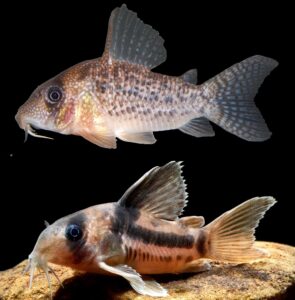
Top: Hoplisoma noxium. Photo by Steven Grant. Bottom: Hoplisoma tenebrosum. Photo by Hans Evers. Both from: Tencatt, L. F. C., W. M. Ohara, V. Carvalho, S. Grant and M. Britto. 2025. Two exquisite new species of Hoplisoma (Siluriformes: Callichthyidae) from the rio Tapajós basin, Brazil, with a discussion on the morphology of the mesethmoid within Corydoradinae. Neotropical Ichthyology v. 23 (no. 1): e240100: 1-76.
30 April
Two “noxious” catfishes
Aquarists who specialize in corydoradine catfishes have long discussed the possibility that when distressed, some species release a toxin, presumably as a defensive mechanism. This toxin poses a problem when the fishes are bagged and moved from one location to another. The water in the bag turns milky and the fish end up poisoning themselves and dying. Some aquarists dismissed this as a rumor. Others swear it’s real and has happened to them. It is most definitely real.
Earlier this month, ichthyologists reported what some aquarists have called the “cory transport toxin” in the descriptions of two new Hoplisoma species, both named for how they release a “powerful” toxin under stress, which kills any fish kept in the same bag or container during transport.
Hoplisoma noxium is so far known from three localities, the igarapé do Buriti (=igarapé Sonrizal), igarapé Miuçuzinho and igarapé do Pinto, in Pará State, Brazil. Its name is Latin (neuter) for hurtful, harmful, injurious or noxious.
Hoplisoma tenebrosum is so far known from its type locality, the igarapé Água-branca (=igarapé Ipixuna), and one of its tributaries, the igarapé Palomita, and also from the igarapé do Roncador, in Amazonas State, Brazil. Its name is Latin (neuter) for dark or gloomy, often used to describe something that is frightening or malevolent.
The authors confirmed the behavior through personal observations in the field and discussions with local fishermen, who report that specimens of H. noxium “must be separated from any other fish species just after capture, otherwise they can rapidly kill them, making the transport water milky and foamy on the surface …”.
Despite the phrase “any other fish species,” the toxin can kill conspecifics and themselves as well, especially if they’re confined to a small bag or container for an extended period of time. This is called “self-poisoning” in the aquarium hobby. This information I confirmed with two of the paper’s authors (and ETYFish fans), Steven Grant and Luiz Tencatt.
In addition, the same fisherman report that getting “stung” by them (via their dorsal and pectoral spines) is clearly more painful than any other corydoradine catfishes in the region, eventually causing “minor allergic/inflammatory processes.”
Many fishes have been named for their behavior in the wild. This is the first time that any have been named for their behavior in transport containers.
The paper in which these species are described — written by Luiz F. C. Tencatt, Willian M. Ohara, Vandergleison Carvalho, Steven Grant and Marcelo Britto — is open access. It’s vividly detailed, copiously illustrated and well worth checking out even if you’re not into corydoradine catfishes. Also worth mentioning is that the expeditions to collect the new species were funded by fishkeeping hobbyists from all around the world in crowdfunding initiatives. A round of applause to everyone involved.
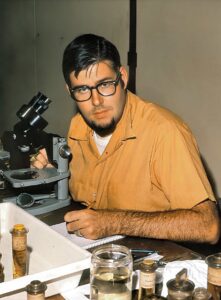
Paul V. Loiselle at the British Museum (Natural History), Sept. 2, 1971, examining West African cichlids. Photo by Michael K. Oliver, used with his permission.
23 April
Paul V. Loiselle (1945–2025)
I never met Paul Loiselle, who passed away last week at his home in New York. I never heard him speak at an aquarium show. I never had the occasion to discuss a fish name with him via email. But from the outpouring of love and praise that appeared on social media upon news of his death, it’s clear I missed out on one of the most beloved persons in fishdom.
Born in Leominster, Massachusetts, in 1945 (another source gives his birth year as 1948), Dr. Loiselle earned his B.S. in biology from the University of California. Upon graduation, he entered the Peace Corps and helped the people of Togo cultivate tilapia for food. His experience there was probably the beginning of his love for Africa and African freshwater fishes. Dr. Loiselle completed his doctoral dissertation, “An Experimental Analysis of Pupfish (Teleostei: Cyprinodontide: Cyprinodon) Reproductive Behavior,” at the University of California, Berkeley, in 1982.
I can’t improve upon the obituary posted by Tropical Fish Hobbyist, so I quote it here:
“Paul served for many years as the curator of freshwater fishes at the New York Aquarium, and was a lifelong advocate for the conservation of freshwater species, particularly in Madagascar, where he helped bring attention to the plight of endangered endemic fish. He discovered and described numerous species during his fieldwork and was honored with several named after him—a quiet testament to the depth of his contributions to ichthyology. The American Cichlid Association named the Paul V. Loiselle Conservation Fund in his honor.
“Though best known for his work with cichlids, Paul’s interests ranged broadly—including rainbowfish, killifish, and more. His deep knowledge and boundless enthusiasm made him a friend and mentor to generations of aquarists, friendships that included other giants in the aquarium hobby, such as Wayne Leibel, George Barlow, and more. For many, he was the voice of reason, always ready to offer insight, encouragement, or a well delivered joke.
“He had strong opinions—especially about scientific names and how they ought to be pronounced—no matter how everyone else on Earth said it. But that same precision and conviction fueled his dedication to the hobby and to the fish he loved.
“More than anything, Paul was a storyteller. Whether he was presenting at a conference, chatting with hobbyists, or writing for an aquarium magazine, he had a way of weaving together humor, science, and deep personal experience. He leaves behind a legacy not just of academic work and conservation victories, but of friendships, mentorships, and a better-informed, more thoughtful aquarium community.”
Here are the fish taxa that Dr. Loiselle described or co-described, most of them from Africa or Madagascar.
CYPRINIDAE
Enteromius guildi (Loiselle 1973)
Enteromius sylvaticus (Loiselle & Welcomme 1971)
ANCHARIIDAE
Gogo atratus Ng, Sparks & Loiselle 2008
CICHLIDAE
Amatitlania myrnae (Loiselle 1997)
Chromidotilapia cavalliensis (Thys van den Audenaerde & Loiselle 1971)
Cribroheros bussingi (Loiselle 1997)
Iodotropheus and Iodotropheus sprengerae Oliver & Loiselle 1972
Limbochromis robertsi (Thys van den Audenaerde & Loiselle 1971)
Paretroplus tsimoly Stiassny, Chakrabarty & Loiselle 2001
Rubricatochromis cristatus (Loiselle 1979)
Rubricatochromis lifalili (Loiselle 1979)
Rubricatochromis paynei (Loiselle 1979)
Rubricatochromis stellifer (Loiselle 1979)
BEDOTIIDAE
Bedotia leucopteron Loiselle & Rodriguez 2007
Rheocles vatosoa Stiassny, Rodriguez & Loiselle 2002
APLOCHEILIDAE
Pachypanchax arnoulti Loiselle 2006
Pachypanchax patriciae Loiselle 2006
Pachypanchax sparksorum Loiselle 2006
Pachypanchax varatraza Loiselle 2006
NOTHOBRANCHIIDAE
Pronothobranchius seymouri (Loiselle & Blair 1971)
Epiplatys togolensis Loiselle 1971
Here are the two fishes named for Dr. Loiselle, both cichlids from his beloved Madagascar:
Paretroplus loisellei Sparks & Schelly 2011 — in honor of Paul V. Loiselle, Emeritus Curator of Freshwater Fishes at the New York Aquarium, for directing the authors’ attention to this new taxon, and for his efforts to document, preserve, and educate the public regarding Madagascar’s unique and severely threatened freshwater ichthyofauna
Ptychochromis loisellei Stiassny & Sparks 2006 — in honor of Paul V. Loiselle, Emeritus Curator of Freshwater Fishes at the New York Aquarium, who collected type, for his many contributions to the understanding and conservation of Madagascar’s freshwater fishes
A third species, Cichlasoma loisellei Bussing 1989 from Costa Rica, is now considered a synonym of Parachromis friedrichsthalii (Heckel 1840).
 16 April
Metriaclima vs. Maylandia
I call it the longest-running nomenclatural standoff in ichthyology.
In 1984, two aquarists, Meyer & Foerster, proposed Maylandia as a subgenus for members of the Pseudotropheus zebra complex of cichlids from Lake Malawi. They named it for cichlid enthusiast and aquarium-fish author Hans Joachim Mayland (1928–2004). In 1997, Maylandia was deemed a nomen nudum — a scientific name of an organism proposed without a sufficient diagnosis or description, i.e., a “naked name” — and replaced by Metriaclima Stauffer, Bowers, Kellogg & McKaye 1997 (metrios, moderate; clima, slope, referring to the “moderately sloped head” of its members).
Both Maylandia and Metriaclima continue to be used in both academic and aquarium references, with taxonomists and cichlid aquarists on both sides seemingly disregarding or disbelieving the other. In January 2007, the late William N. Eschmeyer recorded Metriaclima as a junior synonym of Maylandia at his Catalog of Fishes (ECoF) website, noting that Maylandia is “Incorrectly regarded as an unavailable name by Stauffer et al. 1997” and that “purported differentiated features were provided in the original description,” a decision that stands to this day. Despite the ECoF imprimatur, proponents of Metriaclima continue to use that name, describing 16 new species of Metriaclima since 2007, which ECoF editors reassign to Maylandia without comment, placing the authors’ name in parentheses to signify that the original genus has been changed. FishBase uses Maylandia. The IUCN Red List uses Metriaclima. Wikipedia redirects Metriaclima to a page on Maylandia. The Cichlid Room Companion (https://cichlidae.com), a popular resource for cichlid aquarists, recognizes Metriaclima. The Global Biodiversity Information Facility lists both genera as “accepted,” with 39 nominal species in Maylandia and five in Metriaclima, including one species listed in both genera (Maylandia nkhunguensis and Metriaclima nkhunguense). Clearly there is confusion or indecision about which name to use.
This has dragged on for 28 years. So I decided to investigate, with an open-mind, with no pre-set agenda, to see if I can bring this nomenclatural stand-off to an end.
The first thing I discovered is that quite a bit has been written about this controversy, but almost all of it in cichlid hobbyist publications and websites, most of them European, largely outside the view of professional taxonomists and the ichthyological community at large. Which may explain, at least in part, why this standoff has persisted for so long.
Last week, Zootaxa published my analysis of the debate. I find that the original description of Maylandia, although imperfectly written, does provide differentiating characters and that the publication is available per the ICZN Code (second edition, 1964) in force at the time, and that arguments against Maylandia are based on an uncompromisingly strict or literal reading of Meyer and Foerster’s original description and impractically narrow interpretations and applications of article 13a(i) of the 1964 Code. My analysis confirms that Metriaclima is a junior synonym of Maylandia.
My paper is behind a paywall. If you’d like a copy, please email me at chris@etyfish.org.
9 April
The Cyprinion corrections
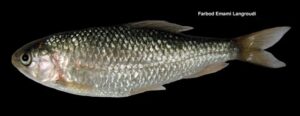
Cyprinion macrostomus from Iranian waters. Photo by Farbod Emami Langroudi. Courtesy: Wikipedia.
15 April
CORRECTION to the CORRECTIONS:
According to Greek and Latin scholar Holger Funk, my statement — “In Latin, diminutives of masculine nouns are also masculine, meaning the gender of the original noun is preserved in the diminutive form; the diminutive suffix simply indicates a smaller version of the same gender” — is incorrect. While it is generally true that the gender of the diminutive matches the gender of the original noun, there are exceptions. A diminutive formed by –ion is one of them. According to Dr. Funk, the suffix –ion is always neuter, regardless of the gender of the original word. Therefore, we should disregard the changes suggested below and retain the spellings of mhalense, microphthalmum and muscatense in their original neuter forms. Heckel’s spelling of Cyprinion microstomus remains a problem. Dr. Funk suggests emending it to the neuter microstomum. Several ichthyologists dating to Berg (1949) have already adopted this spelling.
Cyprinion is a western Asian genus of minnows with nine species distributed from western Syria and the south of the Arabian Peninsula to the western tributaries of Indus River in Punjab (Pakistan). The genus was proposed by Austrian ichthyologist Johann Jakob Heckel (1790–1857) in 1843. Scholars have long treated the name as neuter in gender, which affects the spellings of specific names that are adjectives:
Cyprinion mhalense
Cyprinion microphthalmum
Cyprinion muscatense
The suffixes (-ense, –um) are neuter.
Oddly, the spelling of the type species of the genus, Cyprinion macrostomus, has remained unchanged, leading some to speculate that the specific name is an indeclinable noun (“large mouth”) rather than a declinable adjective (“large-mouthed”). Since Heckel proposed the species along with the genus, it seems his spelling was intentional, that is, he meant it to be a noun not an adjective. Some recent ichthyologists have disagreed and emended the spelling to the neuter “macrostomum.” Eschmeyer’s Catalog of Fishes retained the original spelling, stating that “macrostomus” is an indeclinable noun.
As part of my ongoing overhaul of all ETYFish entries, I reexamined Heckel’s description of Cyprinion and found compelling evidence that the name is masculine, not neuter. The evidence is a phrase at the beginning of Heckel’s German-language section of the description: “Mit der Gestalt eines jungen Karpfen” (“With the shape of a young carp”). This phrase clearly explains the meaning of Cyprinion: Cyprinus (carp genus) + –ion, from the Greek diminutive suffix –idion (-ἴδιον).
In Latin, diminutives of masculine nouns are also masculine, meaning the gender of the original noun is preserved in the diminutive form; the diminutive suffix simply indicates a smaller version of the same gender. Since Cyprinus is a masculine name, Cyprinion must be a masculine name too. The correct spellings of the three adjectival names must be:
Cyprinion mhalensis
Cyprinion microphthalmus
Cyprinion muscatensis
The suffixes (-ensis, –us) are masculine. (Note: –ensis can also be a feminine suffix.)
Based on this explanation, we can surmise that “macrostomus” is an adjective (its most common application) and not an indeclinable noun (a rare exception). Heckel knew what he was doing and spelled the name correctly.
Eschmeyer’s Catalog of Fishes accepted my explanation and changed the spellings in their database beginning with the 5 February 2025 edition.
This leaves us with a question: Who decided that Cyprinion was neuter and why? I do not know for sure, but I suspect the guilty party was the Swiss-born American zoologist-geologist Louis Agassiz (1807–1873). For reasons known only to him, Agassiz changed the spelling of Heckel’s Cyprinion to the neuter Cyprinium in 1846 (now regarded as an unjustified emendation). This may have tricked subsequent scholars into thinking that Cyprinion was neuter.
1 April
The Gulf of America!
 On 20 January 2025, the President of the United States issued Executive Order 14172, officially titled “Restoring Names That Honor American Greatness,” in which the the Gulf of Mexico is renamed as the “Gulf of America.” Today, on 1 April, Executive Order 14250 has been issued, in which the names of the following fish species have been “restored” on U.S. government websites and publications:
Mustelus sinusmexicanus Heemstra 1997
Gulf Smoothhound … –anus (Latin suffix), belonging to: sinus, Latin for bay or gulf, referring to the Gulf of Mexico, type locality
New name: Mustelus sinusamerica.
Fenestraja sinusmexicanus (Bigelow & Schroeder 1950)
Gulf Skate … –anus (Latin suffix), belonging to: sinus, Latin for bay or gulf, referring to the Gulf of Mexico, type locality
New name: Fenestraja sinusamerica.
Bathyanthias mexicanus (Schultz 1958)
Yellowtail Bass … named for the Gulf of Mexico, type locality
New name: Bathyanthias america.
Coryphaenoides mexicanus (Parr 1946)
Mexican Grenadier … presumably named for its occurrence in the Gulf of Mexico
New name: American Grenadier, Coryphaenoides usa!
Also note the removal of the offensive and, frankly, very disgraceful “-anus” from all biological toponyms honoring the USA.
26 March
Salmo carpio Linnaeus 1758
Salmo carpio, female, ~28 cm TL. Photo by Bo Delling. From: Schöffman, J. 2021. Trout and salmon of the genus Salmo. American Fisheries Society, Bethesda, Maryland. ix–xxi + 1–303.
Carpio is Latin for carp, but carp have nothing to do with the Garda Lake Trout from Lake Garda in northern Italy.
The trout’s specific name is almost certainly derived from carpione, its Italian vernacular. Our resident scholar of early fish names, Holger Funk, informs us that carpione is the combination of two words, caro and pione. The origin story of the name is recounted by the Italian naturalist Hippolito Salviani in his Aquatilium animalium historiae (1558).
According to Salviani, a guest at an Italian inn or restaurant is paying his bill. He mentions that the price of the fish he just ate — a local delicacy called pione — is rather high. A diner at a nearby table overhears the conversation and jokes that the fish should be called “car-pione” instead, adding the Italian word “caro” — meaning dear, costly or expensive —to the name, i.e., “expensive pione.” After that the name pione dropped out of use and, so legend has it, was gradually replaced in favor of the nickname carpione.
My guess is that the local delicacy called pione was Garda Lake Trout. Today, that species is known as carpione del Garda in Italy.
It’s likely that Linnaeus assigned the specific epithet carpio to the species believing that was its local name, repeating a mistake made by his late colleague Peter Artedi (1705–1735), now known as the father of modern ichthyology. Linnaeus cited Artedi with information about the fish. Artedi described it “Carpio lacús Benaci,” the carp from Lake Benaco. “Benacus” was the name for Lake Garda in Roman times and is sometimes still used today. On the surface, carpio appears to be a reasonable translation of carpione. Reasonable, yes. Correct, no.
Today, “in carpione” refers to a traditional Italian method of preserving and preparing food, particularly fish, by marinating it in a vinegar- and wine-based sauce, often served cold. I wonder if the Italian diner who complained about the price was eating Salmo carpio prepared in this way.
19 March
William F. Smith-Vaniz (1941–2025)
Opistognathus rufilineatus, adult partially out of its burrow, Triton Bay, Bird’s Head Peninsula, western New Guinea. Photo by Mark V. Erdmann. From: Smith-Vaniz, W. F. and G. R. Allen. 2007. Opistognathus rufilineatus, a new species of jawfish (Opistognathidae) from the Bird’s Head Peninsula, western New Guinea. aqua, International Journal of Ichthyology 13 (1): 35–42.
I was saddened to learn that William “Bill” F. Smith-Vaniz passed away last Wednesday. We had corresponded via email several times over the years, discussing the arcana of various fish names. Then I met him in person last July at the annual meeting of the American Society of Ichthyologists and Herpetologists. We were both staying at a different hotel than most attendees, and I found myself sitting next to him at breakfast one morning. When I caught a glimpse of the name tag on his lanyard I introduced myself. Then we pushed our tables together and chatted about – what else? – fishes. He was soft-spoken, kind, and genuinely curious about my work. He promised to attend my talk. He did. And I remember how delighted he was when he won a book he wanted at the book raffle. He did not seem sick or fragile to me. I was looking forward to seeing him again this year. A true scholar and gentlemen.
I’ve entered his name into the ETYFish database many times. By my count, he has described or co-described 129 marine-fish taxa across nine families:
Apogonidae (Cardinalfishes) – 1 species
Plesiopidae (Roundheads) – 2 species
Opistognathidae (Jawfishes) – 1 genus and 55 species
Blenniidae (Blennies) – 1 genus, 1 subgenus, 36 species
Chaenopsidae (Pikeblennies or Tubeblennies) – 4 species
Gobiesocidae (Clingfishes) – 2 species
Carangidae (Jacks and Pompanos) – 3 species
Pomacentridae (Damselfishes) – 2 species
Cepolidae (Bandfishes) – 21 species
And, as one would expect for such a renowned ichthyologist, several species have been named after him:
Pyronotanthias smithvanizi (Randall & Lubbock 1981) – the Princess Anthias of the Indo-Pacific; Dr. Smith-Vaniz, then with the Academy of Natural Sciences of Philadelphia, “kindly” made his Cocos-Keeling specimens of this species available to the authors, and which he independently determined represented an undescribed species
Helcogramma billi Hansen 1986 – a triple-fin blenny from Sri Lanka; Dr. Smith-Vaniz collected all the specimens Hansen examined
Opistognathus smithvanizi Bussing & Lavenberg 2003 – the Eye-spot Jawfish, in honor of Dr. Smith-Vaniz, for his “wide variety of studies, especially dealing with carangids and for setting the standards for the systematic treatment of opistognathids”
Starksia smithvanizi Williams & Mounts 2003 – the Brokenbar Blenny from the Caribbean Sea, in honor of Dr. Smith-Vaniz, for his many contributions to our knowledge of the taxonomy of marine shorefishes and for collecting and photographing representatives of this species at St. Croix (U.S. Virgin Islands)
Percina smithvanizi Williams & Walsh 2007 – the Muscadine Darter, from the Tallapoosa River system in eastern Alabama and western Georgia (USA), in honor of Dr. Smith-Vaniz for his “outstanding” contributions to ichthyology in general and specifically for his authorship of the first book (1968) on the freshwater fishes of Alabama
Decapterus smithvanizi Kimura, Katahira & Kuriiwa 2013 – the Slender Red Scad, from the eastern Indian Ocean and West Pacific; Dr. Smith-Vaniz gave the authors morphological data of specimens belonging to the red-fin Decapterus group and made many “valuable” comments on their initial draft
Which species do I select to illustrate this entry? Since it seems Dr. Smith-Vaniz’ favorite group of fishes were the jawfishes, I selected one of the many he described (this one with Gerald R. Allen): Opistognathus rufilineatus, the Red-lined Jawfish (rufus = red or reddish; lineatus = lined) from the Bird’s Head Peninsula of western New Guinea.
Learn more about the life and career of William F. Smith-Vaniz at this memorial page.
12 March
Moxostoma ugidatli Jenkins, Favrot, Freeman, Albanese & Armbruster 2025
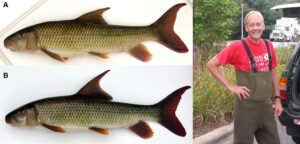
Moxostoma ugidatli, holotype and paratype, and Robert E. Jenkins, at the locality, North Carolina, Cherokee County, Hiwassee–Tennessee River basin, 12 August 2003.
Robert E. Jenkins (1940–2023) was arguably the world’s leading authority on suckers (Catostomidae). When he died (see NOTW, 2 Aug. 2023), he left behind a number of manuscripts and lots of unpublished data on sucker systematics and life histories. Jonathan W. Armbruster of Auburn University has been shepherding their completion and publication. The recent (18 Feb.) description of the Sicklefin Redhorse Moxostoma ugidatli is the first of these posthumous publications.
The Sicklefin Redhorse occurs in the Blue Ridge portions of the upper Hiwassee and Little Tennessee river systems of North Carolina and Georgia (USA). It’s a large sucker, with males reaching 463.2 mm SL and 2.024 kg. The authors described it as “perhaps the largest truly new North American species discovered in the last century …”.
Dr. Jenkins first encountered the Sicklefin Redhorse in 1992. He chose the “Sicklefin” moniker for the fish’s moderate to strongly falcate (sickle-shaped) dorsal fin, which easily distinguishes it from other members of the genus. Dr. Jenkins’ choice for its Latin or scientific name, falcatus, also referenced this feature. But the authors who completed and published Dr. Jenkins’ description opted for a different name: ugidatli (pronounced ooh-gee-dacht’-lee), the Cherokee word for the species, meaning “it wears a feather,” referring to this being the only species in the region where the dorsal fin is exposed above the water when spawning and its feather-like shape.
According to the authors, “We felt it important to honor the Cherokee name as it occurs on the unceded territory of the Eastern Band of Cherokee Indians and it is right and proper to refer to the species using the name spoken by its true discoverers.” The Sicklefin Redhorse has been known by the Cherokees Indians for centuries, and it probably served (along with other Moxostoma species) as an important food resource.
The description of Moxostoma ugidatli is open access.
5 March
Latropiscis Whitley 1931
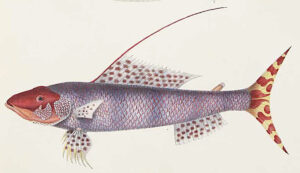
Latropiscis purpurissatus. Illustration by James B. Emery, upon which description was based. From: Richardson, J. 1843. Icones piscium, or plates of rare fishes. Part I. Richard and John E. Taylor, London. 1–8, Pls. 1–5.
I have two explanations for this name. One that’s reasonable. One that’s far-fetched … but much more fun to ponder.
Right now I am revising the etymologies of all the genus- and species-level names in the Order Aulopiformes. In doing so, I am re-researching names I couldn’t figure out during my first pass through the order. Here’s how I explained the generic name of Latropiscis purpurissatus, the Sergeant Baker, a species of flagfin (Aulopidae) endemic to Australia:
etymology not explained, perhaps latro, hireling, robber or brigand, and piscis, fish, or perhaps la-, very, tropis, keel and piscis, fish; in either case, allusion not evident
British-born Australian ichthyologist and malacologist Gilbert Percy Whitley (1903–1975) proposed the genus Latropiscis in 1931. Whitley has been the subject of several NOTW entries. He is a master of the enigmatic name.
Revisiting my 2016 entry for Latropiscis, I dispensed with the amateurish la + tropis explanation. Instead, I focused on the meaning of the Latin word latro. In addition to hireling, robber or brigand, the word can also mean mercenary or hunter. With an expanded definition of the word, I then scoured subsequent publications by Whitley that I had acquired since first researching the name. Sometimes Whitley, years after the fact, explained the meaning of one of his enigmatic names (see Milyeringa veritas, NOTW 8 March 2017). Such was not the case with Latropiscis. But in a 1966 publication written for a popular audience (Marine Fishes of Australia Volume I, Jacaranda Press, Brisbane, 142 pp.), Whitley said the Sergeant Baker “lurks amongst rocks and weeds.” Indeed, the fish is a benthic ambush predator that feeds on molluscs, crustaceans, and other fishes that live on the reef and soft-bottomed inshore waters up to 250 m deep. Since “latro” can mean “hunter,” that seems a reasonable explanation for Latropiscis: hunter + fish. “Lurks amongst rocks and weeds” evokes an image of a hunter lying in wait for the game.
As reported in previous NOTWs, Whitley was fond of coining names with historical and literary references (see Kyphosus cornelii, NOTW 9 Dec. 2020, and Malvoliophis, NOTW 7 Feb. 2024). Since Latropiscis purpurissatus has long been known among Australian anglers as the Sergeant Baker, might the name be a nod to Sergeant Baker, whoever he might be? Was Sergeant Baker a hireling? A robber? A brigand? A mercenary or a hunter? And why was this fish named after him?
Based on various Australian sources, I learned that the Sergeant Baker is believed to have been named for William Baker (c. 1761—1836), a New South Wales Marine and member of the First Fleet that founded the European penal colony of New South Wales. Described as an enthusiastic fisherman, Baker may have been the first European to catch this fish. While not a mercenary, Baker, after his Marine service, was something of a “robber.” In 1797, he was convicted of stealing a boat, and, in 1810, was dismissed from a government post for misappropriating supplies from the government store. Whitley mentioned Baker in the above-cited work but had only this to say: “Sergeant William Baker, an early colonist of Norfolk Island, must have been a florid and perhaps choleric gentleman for this rubicund fish to have been named after him.”
While I like the idea of Latropiscis being named for Sergeant Baker, the evidence is flimsy and the connection far-fetched. The evidence for the hunter + fish explanation, while still circumstantial, at least connects the behavior of the fish with Whitley’s “lurks amongst rocks and weeds” comment published 35 years later. Still, I enjoyed learning about Sergeant Baker’s obscure role in early Australian history. Even when an etymological lead is a dead-end, it is still fun to pursue.
Note: the specific epithet purpurissatus, proposed by Scottish surgeon-naturalist John Richardson (1787–1865) in 1843, is Latin for clothed or painted in purple, referring to its “general” body coloration.
26 February
Merluccius merluccius (Linnaeus 1758)
European Hake, Merluccius merluccius. Hand-colored copperplate drawn and engraved by Edward Donovan from his Natural History of British Fishes (1808).
The European Hake Merluccius merluccius occurs in the eastern North Atlantic and Mediterranean. The etymology of its tautonymous name has long been reported as “sea pike”: a combination of mare, Latin for sea, and lucius, Latin for an undetermined species of fish, usually applied to the pike. The name is said to refer to the hake’s superficial resemblance to the Northern Pike Esox lucius. But according to Holger Funk, our resident scholar of ancient fish names, this interpretation is almost certainly incorrect.
The “sea-pike” explanation dates to two important early works on ichthyology: Belon’s De aquatilibus (1553) and Rondelet’s Libri de piscibus marinis (1554). But Dr. Funk notes that some Latin texts — e.g., Pliny’s Naturalis Historia, Ovid’s Halieuticon and Varro’s Lingua Latina — refer to the fish as “merula.” In Renaissance Europe, the fish was known as merle, merlan and regional variations thereof. What does “merula” mean? It’s the Latin word for the Common Blackbird Turdus merula, another example of the frequent transfer of a terrestrial animal’s name to the name of a fish (which, by the way, has never occurred in the opposite direction).
The obvious question is: Why did the ancients name a fish that is brownish-gray for a bird that is black? Dr. Funk’s answer is that blackbirds exhibit sexual dimorphism. Males are black, females are brownish-gray.
So how did merula become merluccius? And how did “blackbird” become “sea-pike”? The answer for both appears to be the Italian version of merula — merluzzo (and other similar spellings). One can imagine that “merluccius” is a Latinization of “merluzzo.” And from there it’s easy to mistranslate “merluccius” as mare (sea) + lucius (pike). Since the European Hake is superficially similar to a pike, the explanation seems reasonable. But as Dr. Funk tells us, the “sea-pike” explanation is, linguistically, “based on very thin ice.”
“Merula” appears in the name of another gadiform (cod-like) fish from the eastern North Atlantic and Mediterranean, the Whiting or Merling Merlangius merlangus (Linnaeus 1758). The name is also applied to the Brown Wrasse Labrus merula Linnaeus 1758. In this case, the name appears to refer to the blackbird’s male (rather than female) coloration. Older specimens of Labrus merula are blackish-blue.
19 February
Channa amphibeus (McClelland 1845)
Channa amphibeus, showing live coloration. (A) 205.0 mm SL, female (B) ca. 270.0 mm SL, male (C) ca. 350 mm SL, male (D) ca. 500 mm SL, adult male. From: Praveenraj, J., T. Thackeray, N. Moulitharan, B. Vijayakrishnan, and G. K. Nanda. 2025. Lost for more than 85 years—rediscovery of Channa amphibeus (McClelland, 1845), the world’s most elusive snakehead species (Teleostei, Labyrinthici, Channidae). Zootaxa 5583 (1): 087–100.
Last month, a team of researchers from India reported the rediscovery of the Chel Snakehead Channa amphibeus, which they describe as the “world’s most elusive snakehead species.” The snakehead was officially described by John McClelland, a British medical doctor who worked for the East India Company between 1830 and 1850, based on a specimen collected from the vicinity of the Chel River basin at the foot of the Boutan mountains in Bengal, India. Channa amphibeus was last recorded from specimens collected in the years between 1918 and 1933, leading to fears that it had gone extinct. One explanation for the apparent rarity of the species is reflected in the name McClelland chose for it: amphibeus, from amphi– (ἁμφί), double, and bíos (βίος), life.
McClelland was struck by the fact that the fish appears to live both on land and in water. It occurs near the Chail (now Chel) River, he writes, but “sometimes it is met with as much as two miles from the bank of the river, where it penetrates into holes in the ground. From these it probably emerges when the ground is inundated during heavy rain, like the species of this genus so frequently found on the surface of the earth, as if they had fallen from the clouds.” (I love this image, “as if they had fallen from the clouds.” Such colorful writing is eschewed in contemporary taxonomic descriptions.)
McClelland continues:
The natives of Boutan [now Bhutan] know so well the ground in which to find these fish, that they dig them out from their holes in the following manner: a stick is passed into the suspected hole, and the earth raised sometimes to a depth of nineteen feet. When water makes its appearance the operations are suspended, and a little cow-dung is dropped into the well, this attracts the fish from their hiding place into the well, when they are easily secured. They are said to be usually found in pairs, each fish weighing about 4 lbs., and sometimes as much as two feet in length.
As you can see from the photograph, Channa amphibeus is a beautiful fish. Aquarium traders and fish hobbyists have been searching for it for decades, with no success, leading to fears that it was “lost” or extinct. But sometimes “lost” species are just exceptionally difficult to find. During a field survey in September and November 2024, three specimens of C. amphibeus were procured from a local fisher. Its apparent rarity in collections is due to a poor understanding of its fossorial (burrowing) behavior — adults live as pairs during the dry season in submerged holes originally created (and later abandoned) by crabs — and an absence of comprehensive and targeted surveys throughout its natural range. Based on information from local fishers in the region where C. amphibeus was rediscovered, the species is relished as a local delicacy.
For details on the etymological enigma of the generic name Channa, see the Name of the Week for 19 August 2020.
12 February
Leporinus lignator Boaretto, Ohara, Souza-Shibatta & Birindelli 2025
Leporinus lignator, (A) holotype, 152.96 mm SL, (B) paratype, 117.01 mm SL, (C) holotype in life, and (D) type-locality, Machado River, Madeira River basin, Brazil. From: Boaretto, M. P., W. M. Ohara, L. Souza-Shibatta and J. L. O. Birindelli. 2025. New banded Leporinus (Characiformes: Anostomidae) from the Madeira River basin, Brazil, and redescription of L. bleheri, based on integrative taxonomy. Neotropical Ichthyology 22 (4) [for 2024]: 1–32.
In the authors’ words:
“The specific epithet, lignator, is allusive to its type-locality, the Machado River, part of the Madeira River basin. In Portuguese, Machado means axe, and Madeira means wood. Lignator is Latin (m.) for a lumberjack who cuts trees into logs, often using axes. A noun in apposition.”
While I admire the cleverness behind the name, I still had fears about the conservation status of the species. After all, the formal descriptions of many Neotropical fishes conclude with dire words about their long-term survivability in the wild due to deforestation, dams or other anthropogenic impacts. Is Leporinus lignator subject to the same fate? Again, the authors allayed my fears. They write:
“Leporinus lignator is known only from a few specimens collected in a few sites, all of which are located in areas relatively well-preserved and close to several preservation areas, including the Parque do Aripuanã, the Parque Estudual de Corumbiara, and many indigenous regions. Therefore, although the species distribution is poorly known, we suggest that the conservation status of Leporinus lignator is likely to be Least Concern (LC) at this moment, according to IUCN criteria (IUCN, 2022).”
5 February
Apistus shaula Matsunuma, Seah & Motomura 2024
Fresh specimens (ca. 13 cm SL) of Apistus shaula from Karachi, Pakistan (a 15 Feb. 2014, b 4 Sept. 2018), photos by H. B. Osmany. From: Matsunuma, M., Y. G. Seah and H. Motomura 2024. Review of Apistus (Synanceiidae: Apistinae) with description of a new species from the Arabian Sea and taxonomic status of Apistus balnearum Ogilby 1910, a junior synonym of Apistops caloundra (De Vis 1886). Ichthyological Research: [1-30]. [First published online, 11 Dec. 2024.]
“The name shaula, treated as a noun in apposition, refers to the second brightest object in the constellation Scorpius.”
That’s an interesting name. But what does it mean? Why is this fish — only the second species of its genus and a distant relative of the venomous Stonefish Synanceia horrida — named for a celestial object?
When the author(s) of enigmatic names are deceased, I try to make an educated guess about their meanings, analyzing textual clues, other taxa that have the same name, or later publications by the same author(s) in which explanations or additional clues may be given. Such names have formed the subjects of many “Names of the Week.” But when the authors are alive and well, I simply send them an email. One well-known ichthyologist (I won’t say who) routinely ignores my inquiries. Another well-known ichthyologist tells me his names are “personal” and that he prefers them to remain enigmatic (but often explains them anyway). In the case of Apistus shaula, the first author, Mizuki Matsunuma of the Kyoto University Museum in Japan, wrote me back almost immediately.
According to Dr. Matsunuma, “shaula” has two explanations relative to the fish: (1) the name alludes to the adjective “second” — the second species of Apistus and the second-brightest star in the constellation Scorpius. (2) “Shaula” comes from the Arabic language and this new species is most likely endemic to the Arabian Sea.
I noticed another possible though tenuous connection between the celestial and ichthyological names. Shaula is also known as Lambda Scorpii (its Bayer designation, a Greek or Latin letter followed by the genitive form of the parent constellation’s Latin name). The constellation is Scorpius. Until 2017 or so, the stonefishes (including Apistus) had been considered a subfamily (Synanceiinae) of the scorpionfishes (Scorpaenidae).
Scorpii. Scorpius. Scorpionfish.
Coincidence?
29 January
Opistognathus cryos Su & Ho 2024
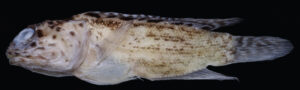
Preserved specimen of Opistognathus cryos, holotype, 65.1 mm SL. Photo by Y.-C. Hsu. From: Su, Y, and H.-C. Ho. 2024. A new species of the jawfish genus Opistognathus from Taiwan, northwestern Pacific Ocean (Perciformes, Opistognathidae). In: Ho, H.-C., B. Russell, Y. Hibino and M.-Y. Lee (Eds.) Biodiversity and taxonomy of fishes in Taiwan and adjacent waters. ZooKeys 1220: 165–174 https://doi.org/10.3897/zookeys.1220.123541
Last week we stated that the clingfish Melanophorichthys priscillae is the first (and only) fish species named after a movie. This recently described species of jawfish from Taiwan also has a nomenclatural connection to the cinema.
Opistognathus cryos was discovered on a beach in the northern portion of Peng-hu, a group of small islands in the Taiwan Strait off western Taiwan in the Pacific Ocean. The holotype had washed ashore, along with many other coral-reef fishes, frozen to death when a February 2022 cold snap hit Penghu. For this reason, the authors named the fish cryos, from the Greek krýos (κρύος), meaning icy cold, chill or frost, but used by the authors as an adjective (cold or chilled). The authors also proposed the common name “Frozen Clingfish” for obvious reasons, but mentioned another, perhaps superfluous, reason as well.
“Frozen Clingfish” also refers to the 2013 animated Disney film “Frozen.”
Let it go, let it go
And I’ll rise like the break of dawn
Let it go, let it go
That perfect girl is gone
Here I stand in the light of day
Let the storm rage on
The cold never bothered me anyway
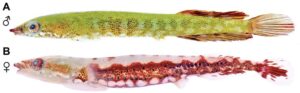
Melanophorichthys priscillae, male (A) and female (B), photographed soon after collection, showing life colors. Photographs by Barry Hutchins. From: Conway, K. W., G. I. Moore and A. P. Summers. 2024. A new genus and four new species of seagrass-specialist clingfishes (Teleostei: Gobiesocidae) from temperate southern Australia. Zootaxa 5552 (1): 1–66.
22 January
Melanophorichthys priscillae Conway, Moore & Summers 2024
Three fishes have been named after characters in movies: two from Star Wars: A New Hope (Romanogobio skywalkeri, Peckoltia greedoi) and one from a 2010 Japanese animated fantasy film The Secret World of Arrietty (Malthopsis arrietty). This newly described clingfish is, I believe, the first time a fish has been named not after a character in a movie, but the movie itself.

Hugo Weaving, Terence Stamp and Guy Pearce in The Adventures of Priscilla, Queen of the Desert. Photograph: Allstar/Polygram.
Melanophorichthys priscillae inhabits dense seagrass meadows in waters up to 15 m along the coast of Western Australia. It is named for the 1994 Australian road comedy film The Adventures of Priscilla, Queen of the Desert, which details the journey of three heroines (two drag queens and a transgender woman) as they travel across the Australian continent in a bus named Priscilla. The name, per the authors, alludes to the bright life colors of males. As a still (shown here) from the film indicates, the male characters are indeed brightly attired.
The proposed common name is Queen Grass Clingfish.
One could make the case that Melanophorichthys priscillae is not named after the film, but for the eponymous bus in the film. If that’s the case, I can say without hesitation that this would be the first fish species in the history of fishes to be named … after a bus.
15 January
Cobitis beijingensis Sun & Zhao 2025
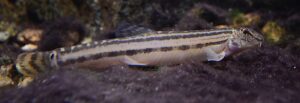
Cobitis beijingensis, paratype, male, in an aquarium. Photo by Zhi-Xian Sun. From: Sun, Z.-X., X.-Y. Li, X.-J. Li, J.-Y. Hao, D. Sheng and Y.-H. Zhao. 2025. Cobitis beijingensis, a new spined loach from northern China (Cypriniformes, Cobitidae). Zoosystematics and Evolution 101 (1): 55–67.
Every year we highlight the first-described new fish species of the New Year. For 2025 it is Cobitis beijingensis.
Cobitis is a genus of loaches (Cobitidae) found in temperate and subtropical waters from Europe and Northern Africa to Asia. ETYFish records 124 species and four currently valid subspecies in the genus. With the addition of C. beijingensis, the total is now 125 species (with more to be described). As the Latin suffix –ensis (from) suggests, C. beijingensis hails from Beijing, the capital city of China. You can read the original description here.
The generic name Cobitis is from kōbī́tis (κωβῖτις), an ancient Greek name for small fishes that bury in the bottom and/or are like a gudgeon or a goby. The name was first applied to loaches — for what is now known as Cobitis taenia Linnaeus 1758 — by the Renaissance scholar Rondelet in 1555.
According to Eschmeyer’s Catalog of Fishes, 406 new species were described in 2024. By our unofficial count, 37.4% of these new species belong to these five families:
Nemacheilidae … 39 new species
Oxudercidae … 38 new species
Gobiidae … 31 new species
Trichomycteridae … 24 new species
Cyprinidae … 20 new species
These diverse families keep us very busy every year updating the ETYFish Project website and database. We don’t expect that to change in 2025.
8 January
William N. Eschmeyer (1939–2024) and “Cofish”
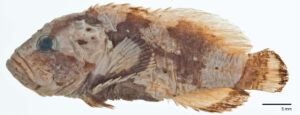
Eschmeyer nexus, holotype, USNM 233855. Photo by Sandra J. Reardon.
William N. “Bill” Eschmeyer passed away peacefully on 30 December after a long illness. I wrote about Dr. Eschmeyer and his achievements when the “Name of the Week” celebrated his 80th birthday in 2019 (11 Feb. entry). His obituary, prepared by his family, is presented in its entirety below. Today I would like to honor Dr. Eschmeyer and his magisterial “Catalog of Fishes” by solving a nomenclatural mystery of sorts: the origin and meaning of the common name “Cofish” for the monotypic genus Eschmeyer Poss & Springer 1983, the only member of the stonefish subfamily Eschmeyerinae.
Eschmeyer nexus is known from only one specimen, a mature female 41.3 mm SL, taken in 27-43 m from Ono-i-lau in the Lau Islands, Fiji. Stuart G. Poss and Victor G. Springer named the genus in honor of Dr. Eschmeyer for his contribution to the study of scorpaenid fishes. The specific name nexus is from the Latin nectere, to tie or connect, referring to a combination of features that suggest a close relationship to several groups of scorpaenoids. The genus was placed into its own family, Eschmeyeridae, by S. A. Mandrysta in 2001. The family is now considered a subfamily of the stonefish family Synanceiidae.
Poss & Springer did not propose a common name for Eschmeyer nexus. I first encountered the common name “Cofish” for the family in the fifth edition of Nelson’s Fishes of the World (2016). I immediately noticed that the name included what appears to be an acronym of the Catalog of Fishes, COF. Is this a tribute to Dr. Eschmeyer and, if so, who came up with it? I asked Mark V. H. Wilson, one of the authors of Fishes of the World, where he got the name. He said I was not the first person to ask him this question. In fact, a previous enquirer wondered if “Cofish” is a typo. If so, a typo of what? Dr. Wilson could not say for sure where he saw the name, but guessed that he consulted FishBase and used the common name found there.
I posed the same question to Stuart Poss, who co-described the genus in 1983. Neither he, nor his co-author, proposed the common name. It “sounds like an Internet-generated error,” Dr. Poss wrote me. “Cofish – a fish that is not quite a fish but rather a cofish.”
I asked FishBase about the name and, yes, someone associated with the site coined the name as a tribute to Eschmeyer’s Catalog of Fishes. The person responsible asked that their identity not be revealed.
Note: The Wikipedia entry for Eschmeyer nexus says Mandrysta suggested the English common name “Cofish” in his 2001 monograph, citing The ETYFish Project as the source. This is incorrect. Mandrytsa did not propose any common names and we’ve never credited him with this one.
William N. Eschmeyer (1939–2024)
 Bill Eschmeyer was born in 1939 in Knoxville, TN to Reuben and Ruth Eschmeyer. He spent his early years in Norris, TN where his father was the head of fisheries for the Tennessee Valley Authority, a major project of the New Deal. After Reuben suffered a fatal heart attack in 1955, Bill’s mother moved Bill and his two sisters to Maryland. Ruth raised her three children as a single mother, working full time to put all three of her children through college. Bill spent his undergrad years at the University of Michigan where he followed in his father’s footsteps to pursue a degree in marine biology. He went on to complete his doctorate at the University of Miami. In 1967, he married and moved to California, where he began his career with the California Academy of Sciences. He spent 40 years at the Academy as curator of fishes.
During his career, Bill co-wrote a popular book on fish, the Peterson Field Guide to Pacific Coast Fishes, and a total of 61 scholarly articles on fish taxonomy, but his true life’s work was creating the worldwide fish database known as the Catalog of Fishes, first published in 1990. It is difficult to underestimate the Catalog’s importance for Ichthyology, as it is the resource that everyone relies on in the field and is unique in being the only such database for vertebrate animals. For his work in systematics, Bill was awarded two lifetime achievement awards. The first was the Bleeker Award for Excellence in Indo-Pacific Ichthyology in 2009 for a “lifetime distinguished accomplishments and great contributions in the study of fish systematics in the Indo-Pacific region.” In 2019, he was awarded the Joseph S. Nelson Lifetime Achievement Award in Ichthyology from the American Academy of Ichthyologists and herpetologists. The California Academy of Sciences renamed the Catalog to Eschmeyer’s Catalog of Fishes in 2019.
Bill was especially proud that he visited every museum in the world that held a collection with type specimens (the original specimens used when describing new species). He traveled to 6 continents and well over 100 countries. He enjoyed sharing the world with his three children. He took his younger daughter on a 6-week research trip to Europe while she was in college, and later, he took all his children and their partners on several international adventures, including a memorable trip to Tahiti in 1999.
Outside of work, Bill was an avid golfer, and he even returned to Tennessee to live on a golf course for several years in the early 2000s before neuropathy in his hand forced him to give up golf for good. But the thing that he never wanted to give up was the Catalog of Fishes. In 2011, well after his official retirement, he moved to Gainesville, FL where the Florida Museum of Natural History at the University of Florida gave him an office and a computer and the title of research associate. He continued to work on keeping the Catalog updated until 2018, when his health challenges made the work too difficult. Colleagues continue to keep the Catalog up to date and it continues to be hosted by the California Academy of Sciences.
Bill moved to Massachusetts in 2018 to spend his final years near his youngest child and his three grandchildren. He was honored to learn that his eldest granddaughter is interested in fisheries biology and spent the past summer studying salmonid diseases at the University of Maine. She was equally delighted to find her grandfather’s name referenced in a paper she was reading for her internship.
Bill is survived by his two sisters, Barbara Richards and Jane Marrs; his children Lisa Eschmeyer and husband Mark Meehan; David Eschmeyer; and Lanea Tripp and husband Simon; as well as his three grandchildren Nora, Braden, and Elizabeth Tripp.
1 January
Chromis abadhah Rocha, Pinheiro, Najeeb, Rocha & Shepherd 2024
Chromis abadhah in its natural habitat in Faadhippolhu Atoll, Maldives, at approximately 110 m depth. Photo by Luiz Rocha. From: Rocha, L. A., H. T. Pinheiro, A. Najeeb, C. R. Rocha and B. Shepherd. 2024. Chromis abadhah (Teleostei, Pomacentridae), a new species of damselfish from mesophotic coral ecosystems of the Maldives. ZooKeys 1219: 165–174.
In naming this new species of damselfish, the authors express a hope for the future that seems appropriate for this, the first day of 2025.
“We also hope that this species and its habitat remain perpetual.”
The specific name of the species — abadhah (pronounced aa-BAH-duh) — means “perpetual” in Dhiveli, the local language of the Maldives. The fish occurs in deep-sea coral reefs throughout the Maldivian Archipelago, often in areas with small crevices and caves located close to large numbers of sponges. The holotype was caught using a hand net at approximately 101 m below the water’s surface, in the mesophotic zone, where sunlight is limited.
The authors chose the name in recognition of the Rolex Perpetual Planet initiative, which funded the expedition that led to its discovery. The grant was awarded to the study’s lead author, Luiz Rocha, the Follett Chair of Ichthyology and Curator of Fishes at the California Academy of Sciences. The fish’s proposed English common name is Perpetual Chromis.
Despite being relatively unexplored and hard to reach, deep-sea coral reefs in the eastern Pacific, eastern Atlantic and Indian Ocean are far from pristine. Every time they dive there, Dr. Rocha and his team see the impact of human beings. Fishing lines. Nets. Ropes. Coral bleaching. Hence the authors’ “hope that this species and its habitat remain perpetual.”
Just so you know, Rolex’s Oyster Perpetual Deepsea watches start at $14,150. The 44 mm yellow-gold model sells for $54,200.
Happy New Year!