NAMES OF THE WEEK from: 2013 2014 2015 2016 2017 2018 2019 2020 2021 2022 2023 2024 2025
4 March
Garra widdowsoni (Trewavas 1955)
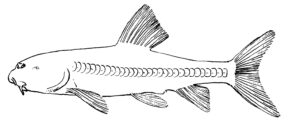
Holotype of Garra widdowsoni. From: Trewavas, E. 1955. A blind fish from Iraq, related to Garra. Annals and Magazine of Natural History (Series 12) 8 (91): 551-555.
This story involves corn flakes and an eyeless, colorless fish from Haditha, Iraq.
A. G. Widdowson was a refrigeration engineer for the Iraq Petroleum Company Ltd. In 1953, he wrote a letter to British writer and explorer Anthony Smith (1926–2014), who had just published a travelogue, Blind White Fish in Persia, recounting his unsuccessful efforts to find blind, white fishes that lived in the qanats of Iran. (Qanats are underground tunnel systems that transport groundwater from mountain aquifers to arid plains in Iran and Iraq.)
Widdowson explained that “he happened down a pot-hole 300 feet deep” in Haditha, where he found a some “blind white fish.” He had read Smith’s book and thought they might be of interest to him. Widdowson said he kept the fish alive “on one corn flake each every other day, but they are now dead.”
Smith sent Widdowson’s note to the Natural History Museum in London. The Museum’s Fish Department contacted Widdowson, suggesting that if he happened to be down the same pot-hole again, he should (in Smith’s words) “refrain from pisciculture in general and corn flakes in particular.” Instead, the Fish Department instructed, Widdowson should “place his catch forthwith inside the tubes of alcohol enclosed for that purpose.”
Widdowson apparently put those tubes to good use. He procured two more specimens and sent them to the Natural History Museum, where they were described by Ethelwynn Trewavas in 1955. She named the species in honor of Widdowson. She also proposed a new genus for the fish, Typhlogarra (typhlós = blind), but recent DNA studies indicate that the species’ closest relative is Garra rufa, so Typhlogarra is now a junior synonym of Garra.
Today, G. widdowsoni is known from three wells near Haditha, connected to underground rivers in the Euphrates River drainage. Once abundant, the species is now on the verge of extinction because of water extraction. It feeds on layers of bacteria and ciliates from rock surfaces and also grazes upside-down from the water’s surface.
Corn flakes do not appear to be part of its natural diet.
As for Anthony Smith, he finally discovered a “blind white fish from Persia” in 1976. See the 4 January 2023 NOTW for the full story (including a link to a fascinating video).
25 Feb.
Lepusigobius pallida or Lepusigobius pallidus?
I’ve made my fair share of spelling and grammatical mistakes over the years, in these posts and in the peer-reviewed papers I’ve written. It’s reassuring to know that I am not alone. Consider this unfortunate mistake in a recently described genus.
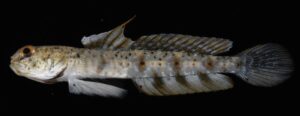
Lepusigobius pallidus. From: Suzuki, T., H.-E. Li and I-S. Chen. 2025. Lepusigobius, a new generic name proposed for Gobiosoma pallida Herre, 1934 (Gobiiformes: Gobiidae) from west Pacific with re-description of the species. Zootaxa 5738 (1): 13-26.
Lepusigobius Suzuki, Li & Chen 2025 is a new genus proposed for Gobiosoma pallida Herre 1934, a goby from the Philippines and Okinawa, Japan. The name is a combination of Lepus, the genus for hares and jackrabbits, referring to the goby’s distinct clefted upper lip, and gobius, goby. The specific name pallida is an adjective meaning pale or colorless, referring, based on Herre’s original description, to the goby’s “old ivory” color in alcohol and/or its “colourless” fins.
In biological nomenclature, Latin or Latinized adjectives must agree with the gender of the genus. In this case: pallidus (masculine), pallida (feminine), and pallidum (neuter). The authors of Lepusigobius correctly state the genus is masculine and correctly spell it pallidus 12 times throughout the paper. Yet the name is also spelled pallida twice, including in the main subject header introducing the new combination: “Lepusigobius pallida comb. nov.” This is where the fish is officially (o-fishily?) renamed. It’s clear the authors know that pallidus is the correct spelling but for some reason their brain-to-finger-to-keyboard connection typed pallida twice, including the most conspicuous and important mention of the name in the text.
I can understand the authors overlooking this mistake. Based on my experience, authors are the worst proofreaders of their own words. (There’s probably a typo above.) But the editor and peer reviewers should have caught it.
It seems this goby is cursed by poor spelling. Even its original name, Gobiosoma pallida, is incorrect. Gobiosoma is a neuter genus. So Herre should have spelled it “pallidum” back in 1934.
18 Feb.
Trichonotus nikii Clark & von Schmidt 1966
Sometimes the authors of a taxon do not tell you the full story behind the meaning or relevance of a name. Trichonotus nikii is a prime example.
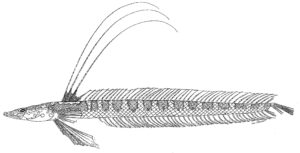
Trichonotus nikii, holotype, 114 mm SL. Illustration by Kay von Schmidt. From: Clark, E. and K. von Schmidt. 1966. A new species of Trichonotus (Pisces, Trichonotidae) from the Red Sea. Contributions to the knowledge of the Red Sea No. 34. Bulletin, Ministry of Agriculture, Department of Fisheries, Sea Fisheries Research Station Haifa No. 42: 29–36.
Trichonotus nikii is a species of sanddiver (Gobiiformes: Trichonotidae) from the Red Sea and Gulf of Aden. It was described by Eugenie Clark and Kay von Schmidt. You may recognize the name of Dr. Clark (1922–2015), most famous as “The Shark Lady” for her pioneering research in shark behavior. See 4 March 2015 NOWT for an overview of her career.
According to the T. nikii description, the fish is named in honor of Niki Konstantinou, the “youngest member on the field trip to the Red Sea” (type locality). When Dr. Clark passed away in 2015, numerous obituaries and tributes were posted online. That’s when I learned the true identity of young Niki and gained a richer understanding of why he was honored.
Niki is Nikolas, Dr. Clark’s youngest son, who was six-years-old at the time. In 1964, while diving near the shore at Eilat, Israel, Dr. Clark spotted a small (20 cm) fish hovering above the sand. When she approached closer, the fish dove into the sand, as all trichonotids do when confronted by predators (hence the common name sanddiver). Dr. Clark dug her fingers into the sand and prodded the fish into a net. She looked up and saw Niki snorkeling nearby. She called Niki over and placed the fish into his dive mask until they could get to shore.
Dr. Clark nicknamed the fish “Tricky Niki” due to its sand-burying behavior. The nickname stuck and inspired the formal scientific name. “Much to my brother’s annoyance,” Nikolas later said.
But there’s more to the story. According to José L. Castro’s book Genie: The Life and Recollections of Eugenie Clark (2020), Dr. Clark and her co-author submitted the description to Copeia (now Ichthyology & Herpetology). The referees rejected it, stating that the species had already been described, and that Clark & von Schmidt had not examined enough specimens. Castro writes, “It is likely they were biased against a woman daring to write a description of a new species without consulting them and daring to name a fish after her son.”
Annoyed, and convinced she had a new species, Dr. Clark submitted the description to an obscure Israeli journal (see image caption). The description was published and the species remains valid to this day.
Dr. Clark never sent an article to Copeia again.
11 Feb.
Linnaeus re-etymologized
Late last year, Mark Sabaj, Collection Manager of Fishes at the Academy of Natural Sciences of Drexel University, sent me a link to an expanded edition of Linnaeus’ Systema Naturae, the starting point of zoological nomenclature, written by German zoologist Philipp Ludwig Statius Müller (the volume on fishes published in 1774). I was unfamiliar with this work and wish I had consulted it years ago because Müller provides explanations for many of the fish names that date to Linnaeus’ foundational treatise.
Linnaeus did not explain the meanings of the names he used in Systema Naturae (the 10th edition of 1758 and the 12th edition of 1766). For several Linnaean names, my ETYFish entries were educated guesses. Thanks to Müller’s work, I am able to bring clarity and historical context to several etymologies. One such etymology, that of Silurus asotus, was the subject of the final NOTW essay for 2025. Here are five more.
Below are my original explanations followed by the revised explanations after consulting Müller’s work.
Muraena helena Linnaeus 1758 … Mediterranean Moray
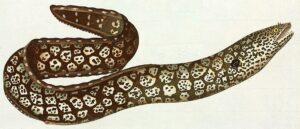
Muraena helena. From: Bloch, M. E. 1786. Naturgeschichte der ausländischen Fische. Berlin. v. 2: i-viii + 1-160, Pls. 145-180.
ORIGINAL:
etymology not explained, possibly referring to Izaak Walton’s comment that the Romans esteemed this eel as the “Helena of their feasts” (The Compleat Angler, 1653), presumably an allusion to Helen of Troy, the most beautiful woman in Greek mythology (perhaps equating a paragon of beauty with a paragon of palatable pleasure)
REVISED:
etymology not explained; per Müller (1774), named for Helen of Troy, the most beautiful woman in Greek mythology: “Because this fish, due to its black and white marbling, is extraordinarily beautiful, and also has the tenderest and most delicious flesh of all fish, and was therefore considered the most exquisite dish at large banquets among the Romans, it is figuratively called Helena” (translation)
Albula vulpes (Linnaeus 1758) … Bonefish
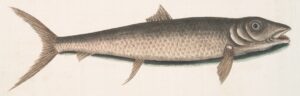
Albula vulpes (“Vulpes Bahamensis”). From: Catesby, M. 1743. The natural history of Carolina, Florida and the Bahama Islands. v. 2. London: Printed for C. Marsh.
ORIGINAL:
Latin for fox, allusion not explained, possibly referring to its speed (some anglers call them the sprinters of the fish world)
REVISED:
Latin for fox, based on the “Vulpes Bahamensis” of Catesby (1743, The natural history of Carolina, Florida and the Bahama Islands), allusion not explained, possibly referring to its speed (some anglers call them the sprinters of the fish world)
Misgurnus fossilis (Linnaeus 1758) … Weatherfish
ORIGINAL:
Latin for digging or dug up, allusion not explained, probably referring to habit of burying itself in the mud, particularly in cold weather
REVISED:
Latin for digging or dug up, allusion not explained; per Müller (1774), referring to how it “burrows in the swamp and is sometimes found in the swamp after river floods, into which it burrows deeply” (translation)
Clarias batrachus (Linnaeus 1758) … Walking Catfish
ORIGINAL:
from bátrachos (βάτραχος), frog, allusion not explained, perhaps referring to its frog-like ability to leave the water and move across land
REVISED:
from bátrachos (βάτραχος), frog, allusion not explained; per Müller (1774), referring to the frog-like appearance of its head
Synodus foetens (Linnaeus 1766) … Inshore Lizardfish
ORIGINAL:
Latin for smelly or stinking, allusion not explained (Linnaeus examined specimens sent from South Carolina, USA, preserved in rum; perhaps they were in a bad state when he received them)
REVISED:
Latin for smelly or stinking, allusion not explained; per Müller (1774), reflecting the colloquial name “stink salmon,” used by British colonists in 18th-century South Carolina (USA), type locality, referring to its unpleasant odor
4 Feb.
Pimephales vigilax (Baird & Girard 1853)
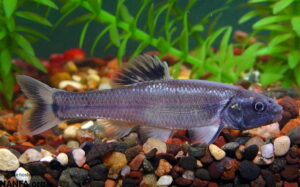
Bullhead Minnow, Pimephales vigilax. Black Dog Lake, Dakota County, MN, 29 June 2006. Photo by Konrad Schmidt. Courtesy: North American Native Fishes Association.
The United States has arguably the most-studied freshwater fish fauna in the world. Yet the meanings of the names of some U.S. fishes remain obscure. The Bullhead Minnow Pimephales vigilax is a case in point. This minnow, a common baitfish, occurs in the Mississippi River basin and Gulf Slope drainages, where it is usually found in sluggish pools of larger streams that have silty or sandy bottoms, continuous flow, low gradients, and spare vegetation.
Its specific epithet “vigilax” is Latin for watchful or restless. Spencer Fullerton Baird (1823-1887) and Charles Girard (1822-1895) did not explain why they selected the name, nor does their description offer any clue; their brief text is limited to color and anatomic features and does not mention anything about the minnow’s behavior and habitat. Jenkins & Burkhead, in their classic book Freshwater Fishes of Virginia (1994), suggest that the name refers to the vigilance of nest-guarding males. I doubt this explanation because Baird & Girard did not observe the minnow in the wild. The holotype was collected by Randolph B. Marcy (1812-1887) and George B. McClellan (1826-1865) from Otter Creek, a tributary to North Fork of Red River in southwestern Oklahoma. Both Marcy and McClellan were captains in the U.S. Army Corps of Engineers. They collected P. vigilax, and several other species, during an expedition to discover the Red River’s source. I do not know if they provided any field notes. As far as I know, the first behavioral study of Pimephales vigilax was published by Henry L. Parker in 1964, in which the author observed spawning and nest-guarding behavior in aquaria and farm ponds. Parker wrote: “The male protects the eggs from animals small enough to enter the nest to destroy the eggs. He can drive away fish even twice his size.”
In 1856, Girard described another species of minnow from Oklahoma-Texas border that is today considered a subspecies of P. vigilax. He named it Hyborhynchus perspicuus. The specific epithet is Latin for clear, transparent or evident, yet the reason he chose the name is far from clear, transparent or evident.
Interestingly, Girard said that the genus Hyborhynchus (now a synonym of Pimephales) is ”amongst those whose history has most perplexed us.”
In regards to vigilax and perspicuus, we remain perplexed by their names.
Footnote: What does Pimephales mean? Glad you asked. Proposed by Rafinesque in 1820, the name is a combination of pimelḗ (πιμελή), fat, and cephales, from kephalḗ (κεφαλή), head, referring to the head of P. promelas, described as “soft and fat all over,” a clear reference to the fleshy growth on nape of breeding males. Rafinesque twice incorrectly translated name as “Flat-head” in his description of the genus, possibly a typesetting error, but correctly translated it as “Fat-head” in his description of P. promelas.
28 Jan.
Acanthobrama microlepis (De Filippi 1863)
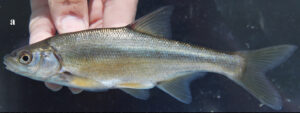
Acanthobrama microlepis from Kura River at Yalnızçam. From: Kaya C, Bayçelebi E, Turan D (2020) Taxonomic assessment and distribution of fishes in upper Kura and Aras river drainages. Zoosystematics and Evolution 96(2): 325-344.
I was surprised to see that the name of this species had recently been changed because of a nomenclatural technicality. The November 2025 edition of Eschmeyer’s Catalog of Fishes (ECoF) reflected this change. I investigated and found evidence that the change was unnecessary. The ECoF editors agreed and changed the name back in their most recent (13 January) posting.
The Caucasian Bream Acanthobrama microlepis is a common species of minnow found in lakes and rivers of the southwestern Caspian Sea drainage basin. Its specific epithet refers to its small scales, 60-82 along the lateral line: micro-, from mikrós (μικρός), small, and lepís (λεπίς), scale. The generic epithet Acanthobrama, proposed by Heckel for A. marmid in 1843, means “spiny bream”: acantho-, from ákantha (ἄκανθα), thorn, referring to the thickened, spine-like, last ray of its unbranched dorsal fin; brama, derived from abramís (ἀβραμίς), ancient name for a bream or mullet.
In the recent book Handbook of Freshwater Fishes of West Asia (a free download), the authors changed the name to Acanthobrama punctulata (Kessler 1877), stating that A. microlepis (De Filippi 1863) is invalid and therefore unavailable for use:
Abramis microlepis is a junior secondary homonym of Alburnus microlepis Heckel, 1843, when placed in Alburnus by Kamensky (1901). It was replaced by Alburnus punctulatus, a former junior synonym, by Berg (1916) and is permanently invalid because junior homonyms and substitute names are still treated as synonyms.
A junior secondary homonym occurs when two identical species-group names, originally described in different genera — in this case Alburnus microlepis Heckel 1843 and Abramis microlepis De Filippi 1863 — are subsequently placed into the same genus, making the later-published (younger) name invalid. The next available name for Abramis microlepis De Filippi 1863 is Alburnus punctulatus Kessler 1877.
This name change didn’t seem right to me. My understanding is that a second-degree homonym can be reinstated if the taxa are placed in different genera. I double-checked the ICZN Code, specifically article 59.3, which reads:
“A junior secondary homonym replaced before 1961 is permanently invalid unless the substitute name is not in use and the relevant taxa are no longer considered congeneric, in which case the junior homonym is not to be rejected on grounds of that replacement.”
Was Abramis microlepis De Filippi 1863 replaced before 1961? Yes. A. microlepis was placed into Alburnus by Kamensky (1901), and replaced by Alburnus punctulatus, a former junior synonym, by Berg (1916). So that provision of ICZN 59.3 applies.
But note that ICZN 59.3 also states that the junior secondary homonym is NOT to be replaced if these two conditions apply: (1) the substitute name is not being used by ichthyologists, and (2) the two competing names are no longer placed in the same genus.
I reviewed the relevant literature and it appears that A. punctulatus has NOT been in use since Berg (1916). In fact, Berg (1949) changed his mind and returned punctulatus to the synonymy of microlepis. As far as I can tell, every reference since 1949 has used A. microlepis over A. punctulatus … that is, until the publication of Handbook of Freshwater Fishes of West Asia late last year.
Note also that the “A. microlepis” homonyms are placed in different genera today: Abramis microlepis De Filippi 1863 is in Acanthobrama, whereas Alburnus microlepis Heckel 1843 remains an available name in Alburnus, where it is currently regarded as a junior synonym of A. sellal Heckel 1843.
Just because the two names were treated as junior secondary homonyms for a short period in the early 20th century doesn’t mean they should be treated that way today.
21 Jan.
Psalidodon paiva Rodrigues-Oliveira, de Assis, Pimentel, Soares, Batista da Silva, Rocha, Menegidio, Pasa & Kavalco 2025
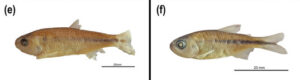
Psalidodon paiva (e) holotype, 62.0 mm SL, and (f) 34.5 mm SL. From: Rodrigues-Oliveira, I. H., P. M. de Assis, L. G. P. Pimentel, R. A. S. Soares, I. Batista da Silva, R. R. Rocha, F. B. Menegidio, R. Pasa and K. F. Kavalco. 2025. Unraveling a 150-year-old enigma: Psalidodon rivularis (Acestrorhamphidae: Acestrorhampinae), a species complex or a polymorphic species? Biology 14: 1-45.
Tomorrow, the Academy of Motion Picture Arts and Sciences will announce the nominees for the 98th Academy Awards, or Oscars. Late month, a new species of fish was named with a connection to a 2024 film that won an Oscar at the 97th Academy Awards. In fact, the film and its Oscar win are mentioned in the section explaining the fish’s name.
Psalidodon paiva is a new species of tetra (Acestrorhamphidae) closely related to the Buenos Aires Tetra P. anisitsi popular in the aquarium trade. It is one of three new species previously identified as P. rivularis but now distinguished by body shape, body measurements, chromosome counts, and DNA. It occurs in the upper and middle São Francisco River basin of Minas Gerais, Brazil.
The species is named in honor of the Paiva family, whose life was “profoundly affected by the imprisonment, disappearance, and execution of the family patriarch, Rubens Paiva, during the Brazilian military dictatorship” in 1971.
 Rubens Paiva (1929-1971) was a Brazilian civil engineer and politician who opposed Brazil’s military dictatorship in 1964. Since his activities and beliefs were deemed subversive by the dictatorial regime, he was arrested by military forces, tortured, and murdered. After Rubens’ disappearance, his wife, Eunice (1929-2018), enrolled and graduated from law school and became a prominent human rights advocate for Brazil’s indigenous peoples and the victims of political repression. Her campaign to open the military dictatorship’s closed records while caring for her five children is the subject of the 2024 film Ainda Estou Aqui (I’m Still Here).
On 23 January 2025, I’m Still Here was nominated for Best Picture, Best Actress, and Best International Feature Film (later winning that Oscar) at the 97th Academy Awards. On the same day, Rubens Paiva’s death certificate was corrected to state that he died from violent causes at the hands of the State. The previous death certificate only stated that he was missing. His body has not been recovered.
14 Jan.
Glyptothorax pulcher Zeng, Lin, Jiang & Chen 2026
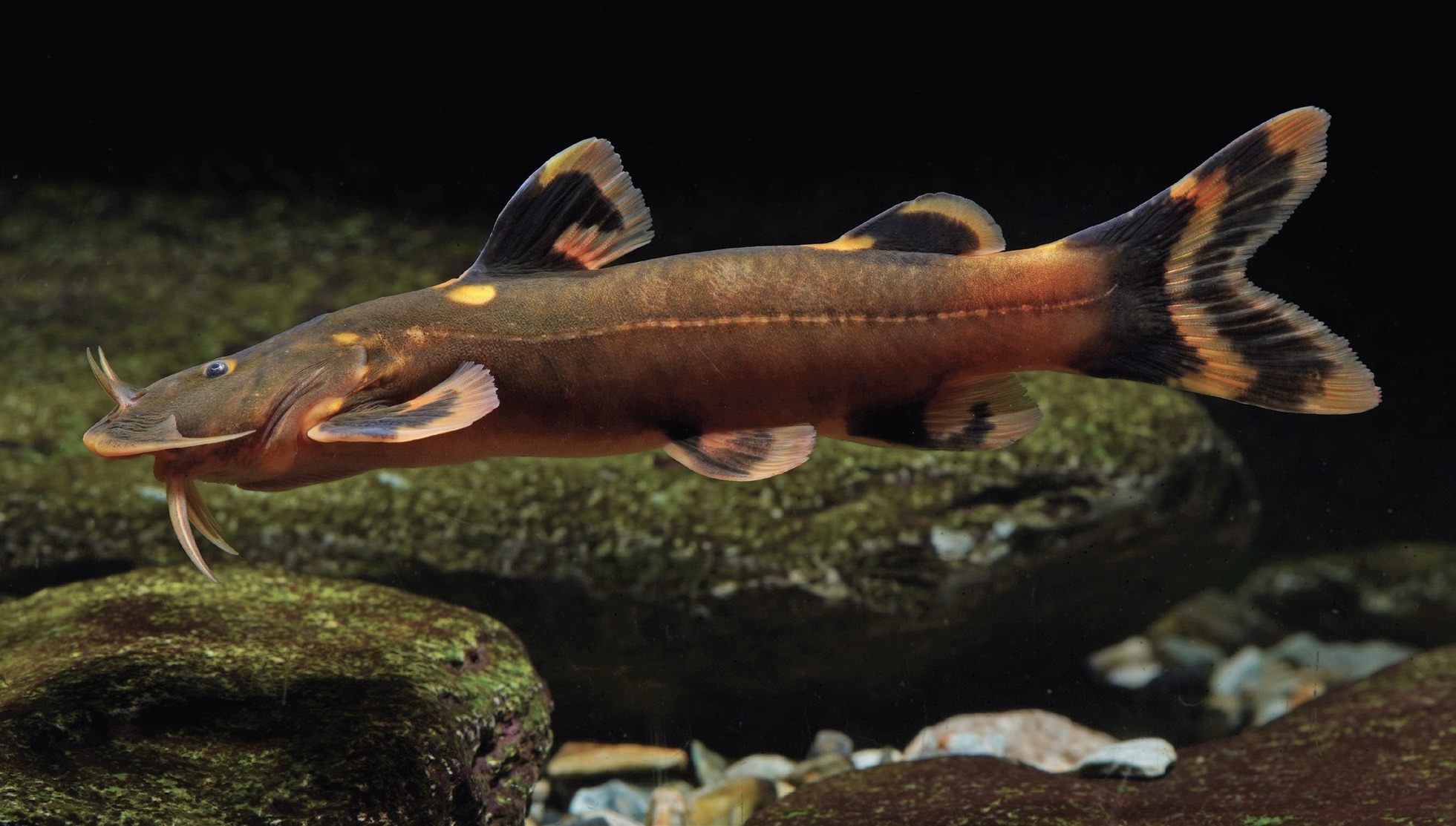
Living view of Glyptothorax pulcher, holotype, 83.5 mm SL. From: Zeng, Y.-Y., F. Lin, H.-F. Yang, X.-R. Pu, W.-S. Jiang and X.-Y. Chen. 2026. Glyptothorax pulcher (Siluriformes, Sisoridae), a new species from the upper Pearl River of Yunnan and Guangxi, southwest China. Zoosystematics and Evolution 102 (1): 17-26.
Every year we highlight the first-described new fish species of the New Year. For 2026 it is Glyptothorax pulcher.
Glyptothorax Blyth 1860 is a genus of small catfishes with a widespread distribution, ranging from the Euphrates and Tigris River Basins in Turkey in the west, to the Yangtze River in China in the east, southwards to Borneo and Java. The name is a combination of two Greek words: glyptós (γλυπτός), engraved, and thṓrax (θώραξ), breast or chest, referring to an adhesive apparatus on the thorax with grooves parallel or oblique to the longitudinal axis of the body. Glyptothorax catfishes — commonly known as hillstream catfishes — use this apparatus to attach themselves to rocks in the fast-flowing streams they inhabit.
Glyptothorax is the largest genus in the family Sisoridae, with 150 species considered valid today. The latest new species, Glyptothorax pulcher, is described from the Tuoniang River, Pearl River Basin, in south-eastern Yunnan Province and western Guangxi Zhuang Autonomous Region, China. Its specific epithet is Latin for beautiful, referring to its attractive color pattern.
By our count, 32 new genera, three new subgenera, and 380 new species of fishes, across 90 families, were described in 2025. Nearly one-third (31%) are from four freshwater families:
Nemacheilidae (Stone or Brook Loaches) … 46 new species
Cyprinidae (Carps) … 26 new species
Sisoridae (Hillstream Catfishes) … 25 new species
Trichomycteridae (Pencil and Parasitic Catfishes) … 22 new species
Note that the first new species of 2026 is from one of these families. Here we go!
7 Jan.
Photoblepharon Weber 1902
Photoblepharon palpebratum, neotype, 72.6 mm SL. Photo by Daniel Golani. From: Golani, D., R. Fricke and B. Appelbaum-Golani. 2019. Review of the genus Photoblepharon (Actinopterygii: Beryciformes: Anomalopidae). Acta Ichthyologica et Piscatoria 49 (1): 33-41.
In 1967, Israeli soldiers attacked a school of fish. I learned about this last week from Caroline Mason, an ETYFish reader from Tasmania.
Ms. Mason sent me an email pointing out an error in the ETYFish entry for Photoblepharon, a genus of flashlight fishes (Anomalopidae) so called for the patches of living luminescent bacteria underneath their eyes, which they can turn off and on, like a flashlight. They use the light to see by, to communicate, to lure prey, and to confuse predators. The entry incorrectly states that the fish’s eyes, rather than the patches below them, were bioluminescent. The entry now reads:
phōtō– (φωτω-), combining form of phṓs (φῶς), light; blépharon (βλέφαρον), eyelids; Weber was among the first scientists to understand that there is a luminescent patch under each eye and that the fish uses an elastic black skin (functioning like an eyelid) that reveals or conceals this patch, in effect blinking it on and off at will
There are only two species in the genus:
Photoblepharon palpebratum (Boddaert 1781) from the western Pacific Ocean: –atum (L.), provided with: palpebra (L.), eyelid, referring to skin folds that slide up to cover the eyes in the manner of an eyelid (blinking the luminous organs on and off, but this was unknown to Boddaert)
Photoblepharon steinitzi Abe & Haneda 1973 from the western Indian Ocean: in honor of the late Heinz Steinitz (1909–1971), marine biologist and herpetologist (Hebrew University, Jerusalem), who sent specimens to the first author and suggested he describe it
In her email, Ms. Mason included this fascinating anecdote, recalling her days as a volunteer, and later as a Master’s student, for IORL (Israel Oceanographic and Limnological Research, National Institute of Oceanography), which shared the site and facilities at the lab where Heinz Steinitz worked:
“I first came across P. steinitzi in 1980 when I was working at the Heinz Steinitz lab at Eilat. I spent a week sailing my dinghy down the Gulf of Aqaba with a couple of friends. One moonless evening I was brushing my teeth at the water’s edge and a glowing, luminescent blob, about 3m by 2m, drifted past in the water, scaring the bejasus out of me. Back at the lab I recounted the story and was told that it was a school of P. steinitzi that had come to the surface to feed.
“Apparently in the days of the ‘67 war [the Six-Day War, fought between Israel and a coalition of Arab states, including Egypt], Israeli soldiers stationed in Sinai assumed that the glowing patches were a secret Egyptian weapon, and lobbed hand grenades at them – only to find schools of odd little black fish dead on the shore the next day.”
Curious if this incident had been recorded in any journal or history book, I searched my files and found a 1977 article on flashlight fishes from Scientific American magazine written by ichthyologist John E. McCosker of the California Academy of Sciences. His account differs slightly from Ms. Mason’s reminiscence but tells essentially the same story:
“During midnight patrols along the coastline of the Sinai Peninsula after the Six-Day War, Israeli soldiers had observed a faint green glowing mass beyond the coral reef. The soldiers, naturally assuming that they had encountered a team of enemy frogmen, responded by discharging explosives in the glowing shoals. To their surprise the result was a beach littered with the bodies of small, dark fish whose heads continued to blaze with a pair of green, glowing patches.”